

Green Star – Interiors is the Green Building Council of Australia’s rating tool for sustainable fitout design and construction, used by owners, tenants and design teams across office, retail and education projects. It remains open for new registrations only until the end of September 2026, after which every new project moves to its replacement, Green Star Fitouts. If you’re scoping a certified fitout now, that deadline should shape your decision today.
TL;DR:
- Green Star – Interiors registration closes on September 30, 2026, after which projects must switch to the more demanding Green Star Fitouts system.
- The certification emphasizes measurable actions like low-VOC products, reuse targets, and modular design, with higher weights on circularity and climate positivity under the new framework.
- Evidence collection, timely engagement of accredited professionals, and detailed documentation are the main challenges that can hinder certification success.
- Achieving a Green Star rating influences tenant demand, lowers operational costs, and enhances occupant health, making certification a valuable commercial asset.
- Certification process involves strict guideline adherence, independent assessment, and comprehensive commissioning, all of which require early planning and procurement of guideline access.
Table of Contents
- What green star interiors covers and who uses it
- The transition to Green Star Fitouts: dates and what changes
- Credit categories and how points are actually earned
- How certification actually works, step by step
- What the star ratings mean and why clients pursue them
- A practical checklist for a certification-ready fitout
- How Nicheprojects turns Green Star criteria into a working fitout
- Common challenges in the certification process, and how to solve them
- Does certification actually affect property value and tenant demand?
- Where to go for the source documents
- Sources
What green star interiors covers and who uses it
Green Star – Interiors assesses the sustainable design, construction and fitout of a tenancy, rather than the base building shell. It has been used on numerous projects since 2014, with the Green Building Council of Australia reporting that office and retail fitouts make up the bulk of certifications. The tool works at almost any scale, from a single-floor tenancy refresh to a full multi-level workplace fitout, and it applies equally to education and industrial fitouts where a client wants a documented sustainability outcome.
A handful of roles typically drive a submission:
- The building owner or tenant, who sets the sustainability brief and budget.
- Architects and interior designers, translating that brief into specifications.
- Contractors and subcontractors, who deliver and document the work.
- A sustainability consultant or Green Star Accredited Professional, who manages the credit strategy and submission.
Green Star Interiors sits alongside Green Star Buildings (base building) and NABERS. The distinction matters: Green Star sets design and delivery intent, while NABERS measures how a building actually performs once it’s in use. A fitout can be Green Star certified at handover and still need NABERS data a year later to prove it performs as designed.
The transition to Green Star Fitouts: dates and what changes
The timeline is fixed and worth writing on your project calendar. Here’s how it plays out:
- Now until 30 September 2026: new projects can still register under Green Star – Interiors v1.3.
- From 1 October 2026: all new registrations move to Green Star Fitouts, and Interiors closes to new entrants.
- Existing Interiors registrations: continue to be assessed under the version they registered under, so a project registered in August 2026 finishes its journey on the old tool.
Green Star Fitouts isn’t a simple rename. It introduces stronger minimum expectations that every certified project must meet, plus an explicit Climate Positive Pathway aimed squarely at cutting Scope 3 emissions, the embodied carbon in materials and construction that fitouts generate in large volumes. Circular design and reuse carry more weight than they did under Interiors.
If your project is ready to register in the next few months, going in under Interiors is still valid and often simpler for teams already familiar with it. If you’re still at concept stage with a target completion well into 2027, plan for Fitouts from day one.
Credit categories and how points are actually earned
Green Star – Interiors groups its requirements into familiar categories: management, indoor environment quality, energy, water, transport, and materials or responsible products, with circular and climate-positive outcomes weighted more heavily under the newer framework.
Real credits come from specific, checkable decisions, not vague good intentions:
- Specifying low-VOC paints, adhesives and finishes to lift indoor air quality.
- Setting a measurable reuse target for existing joinery, ceiling tiles or furniture rather than sending it to landfill.
- Designing modular joinery that can be reconfigured or relocated at lease-end.
- Choosing electric-only services and appliances over gas.
- Maximising daylight access and controlling reverberation time in open-plan zones.
Each action contributes points toward a final score, and Green Star – Interiors’ own data shows that 56% of certified projects land at 5 Star and 37% at 6 Star, with only 7% at 4 Star. That distribution tells you something: teams that pursue certification tend to chase the higher bands, not the minimum. Fitouts adds a Responsible Products score checker that makes it faster to confirm whether a specified product actually counts toward materials credits, cutting down on guesswork at specification stage.
How certification actually works, step by step
Certification runs through the GBCA’s project portal, but the paperwork trail matters as much as the design.
- The project lead (usually the owner or head contractor) registers the project and manages the submission timeline.
- A Green Star Accredited Professional guides the credit strategy and keeps documentation aligned to the rating tool.
- An independent GBCA assessor reviews evidence against the submission guidelines, which set out exactly what each credit requires.
Access to those guidelines depends on membership. Members generally get access as part of their subscription, while non-members purchase individual licences, and GBCA product listings show non-member fees for comparable submission guideline packages running to $660.00 for a single licence, so it’s worth checking current GBCA pricing before you budget. Assessors typically want to see calculations behind claimed outcomes, proof of design intent carried through to construction, transparent material data sheets, and commissioning records confirming systems perform as specified at handover.
What the star ratings mean and why clients pursue them
A Green Star rating isn’t pass or fail. It’s a scale, and the number matters commercially as much as it matters technically.
- 4 Star signals best practice, the baseline for a credible sustainability claim.
- 5 Star represents Australian excellence, well above standard market practice.
- 6 Star is world leadership, the tier most large corporate tenants now expect from a flagship fitout.
Certified projects have used that top tier as a genuine selling point. GBCA case material cites Arup HQ and fitouts within International Towers as examples that achieved 6 Star Interiors ratings under earlier tool versions, and both are still referenced as benchmarks for what a top-tier commercial fitout looks like. Beyond the plaque on the wall, certification tends to support tenant attraction, favourable treatment in government and corporate procurement panels, lower lifecycle running costs, and measurably better occupant health outcomes tied to air quality and daylight.
A practical checklist for a certification-ready fitout
Certification succeeds or fails on sequencing. Leave the sustainability strategy until construction documentation and you’ll spend the project chasing evidence instead of designing for it.
- Appoint an Accredited Professional early, ideally before the design brief is finalised, so credit targets shape the brief rather than get bolted on afterwards.
- Buy or review the submission guidelines for whichever tool you’re registering under, and map your credit targets against them line by line.
- Set reuse and embodied carbon targets at concept stage, including a specific percentage of existing fitout elements to retain.
- Specify responsible products with verifiable transparency data, not just marketing claims from suppliers.
- Design for adaptability, using modular partitions and joinery that can be reconfigured without demolition.
- Confirm services support electrification and indoor air quality targets before services contractors lock in their scope.
- Write a waste management plan before demolition starts, with diversion targets, not just aspirations.
- Commission thoroughly and keep every test result, and hand over a documentation pack the assessor can actually use.
- Check post-occupancy performance, ideally against NABERS data, once the space has been in use for several months.
Pro Tip: Treat your submission guidelines as a live checklist from day one of design, not a document you consult after construction finishes. Teams that leave it until handover almost always find gaps in material transparency data that are far cheaper to fix in the specification stage than after fit-out.
Our own tips for a green office fit out go deeper on how specific design choices map to individual credits if you want the next level of detail.
How Nicheprojects turns Green Star criteria into a working fitout
On the floor, Green Star credits stop being abstract line items and become specification decisions. A fitout partner can build credit strategies into the brief from the first design meeting, specifying things like reclaimed timber joinery panels, modular partition systems that survive a lease renewal without demolition, and low-VOC product schedules that hold up under an assessor’s scrutiny.
The coordination work matters just as much as the specification. A few habits keep a certification submission on track:
- Align the client brief, contractor scopes and product schedules to the actual submission guidelines wording, not a generic sustainability checklist.
- Lock in commissioning documentation requirements with contractors before trades start, not after.
- Keep a running evidence file for material transparency data so nothing gets chased retroactively.
Pro Tip: Ask your fitout partner for examples of past commissioning packs before you sign a contract. A team that can produce clean, assessor-ready documentation from a previous project will save you weeks of rework on this one.
Our guide on managing your office fit out covers the coordination side of this in more detail.
Common challenges in the certification process, and how to solve them
The most common failure point is evidence, not design. Teams design a genuinely sustainable fitout, then can’t produce the paperwork an assessor needs to prove it. Material transparency data sheets go missing when a supplier substitutes a product mid-construction, and nobody updates the compliance record. The fix is procedural: build a live material register into the project program and update it the moment a substitution happens, not at the end of the job.
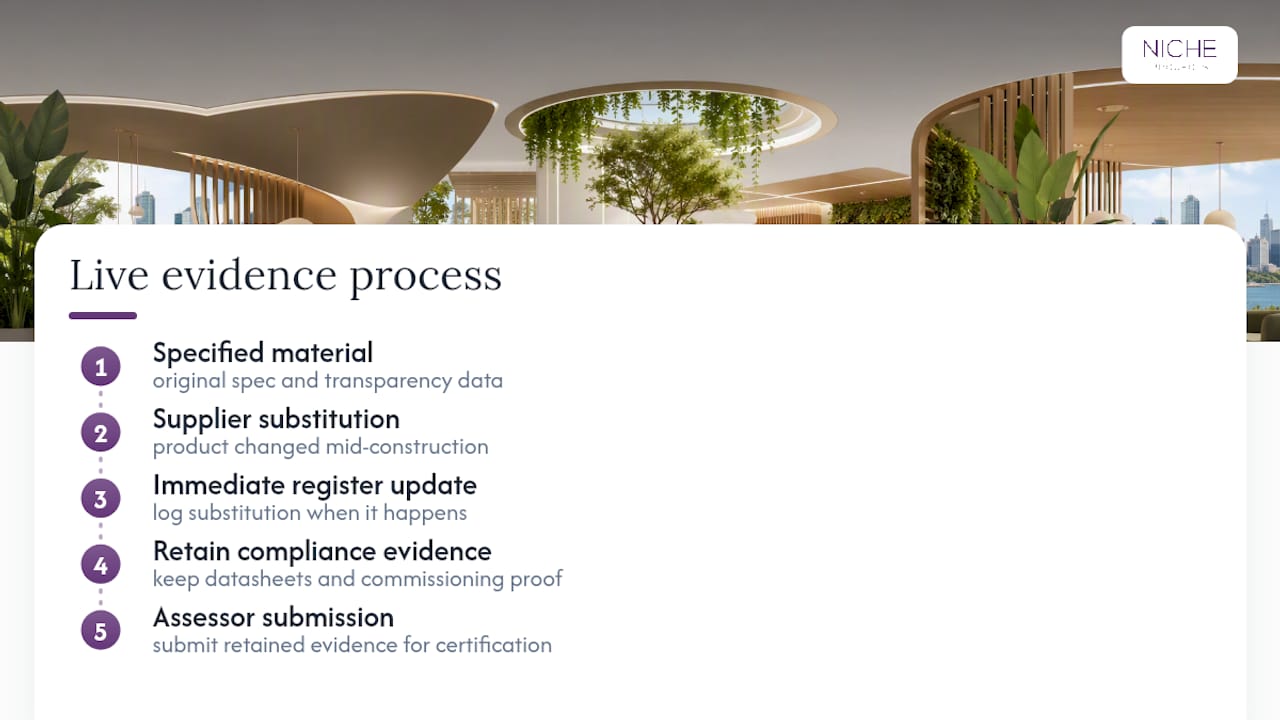
Timing is the second recurring issue. Teams that bring a sustainability consultant on board after the design is locked find themselves retrofitting credits into a scheme that wasn’t built for them, which usually means missed points on reuse and embodied carbon that would have been easy wins earlier. Engaging an Accredited Professional at brief stage, as covered above, solves most of this before it starts.
Commissioning evidence trips up more projects than people expect. Assessors want proof that mechanical, electrical and IAQ systems perform as designed, not just that they were installed as specified. Contractors used to conventional fitouts sometimes treat commissioning as a formality rather than a documentation exercise, leaving gaps that surface only when the submission goes in.
Finally, the fee and licensing structure around submission guidelines catches non-member organisations off guard. Budgeting for guideline access, and confirming whether your consultant’s GBCA membership covers your project, avoids a late surprise in the certification budget.
Does certification actually affect property value and tenant demand?
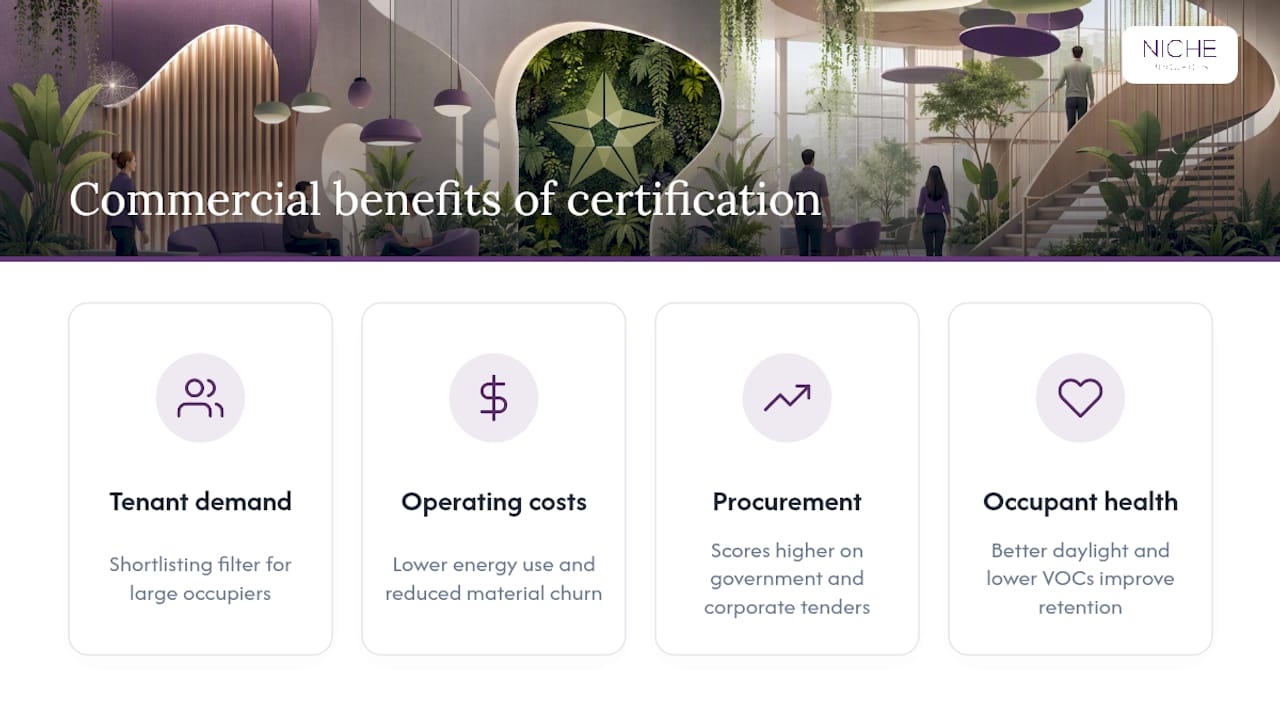
Corporate tenants increasingly treat a Green Star rating as a shortlisting filter, not a nice-to-have. Large occupiers with their own sustainability targets, particularly listed companies with Scope 3 reporting obligations, now ask for certified space by default when they’re evaluating a new lease. A fitout without any rating can find itself excluded from the conversation before pricing is even discussed.
The commercial case runs on more than reputation. Certified fitouts typically run lower operating costs over their life, largely from lower energy use and reduced churn on materials designed for reuse rather than replacement. Government and larger corporate procurement panels increasingly give scoring weight to Green Star certification, which means a rated fitout can win tenders that an unrated one can’t even enter, a point NATSPEC’s national guidance on environmental rating schemes backs up in its discussion of how these schemes connect to NCC/BCA verification methods.
Occupant health outcomes feed back into the same commercial case. Better daylight, lower VOC exposure and improved acoustics support staff wellbeing and, indirectly, retention, which matters more to most tenants than the certificate itself. If you’re weighing up whether certification is worth the extra documentation effort, our piece on office fit outs and sustainability sets out the return in more detail, and pairing a certified fitout with genuinely ergonomic office design tends to compound both the wellbeing and leasing benefits rather than treating them as separate line items.
Good indoor air quality outcomes don’t happen by accident either. Independent guidance on improving indoor air quality is a useful cross-check against the IEQ credit requirements if your team wants a second reference point beyond the GBCA’s own material.
If your project is heading toward registration before the September 2026 cut-off, or you’re planning ahead for Green Star Fitouts, consider talking to a workplace design specialist to explore a free office space plan that maps your sustainability targets against a realistic fitout budget and timeline.
Where to go for the source documents
The Green Star – Interiors overview and the Green Star Fitouts overview are the two pages to bookmark, since together they cover both the closing tool and its replacement. The actual credit criteria live in the submission guidelines, purchasable directly from the GBCA store, with licence fees varying by membership status. For a national view of how Green Star fits alongside NABERS and NCC/BCA requirements, the NATSPEC technical note on environmental rating schemes is a solid, plain-English reference.
Sources
- Green Star 13 Interiors | Green Building Council of Australia
- Green Star Fitouts overview – Green Building Council of Australia
- Environmental rating schemes for buildings (NATSPEC technical note)