
Expect roughly $800 to $3,500 per square metre for an Australian office refurbishment in 2026, with a moderate‑quality fit‑out sitting near $3,011/sqm nationally. The final number moves on four levers: which city you’re in, the spec tier you choose, how big the floor is, and the condition of the existing services. City benchmarks and a full budgeting checklist follow below.
TL;DR:
- Cost per square meter varies significantly by city, with Sydney and Melbourne being highest due to competitive labor markets and infrastructure demand.
- Labour costs in Sydney can range from $400 to $600 per sqm, with materials adding another $300 to $450 per sqm, excluding additional fees and GST.
- Price increases in 2026 are driven mainly by skilled labor shortages, volatile M&E and tech costs, energy prices, and supply chain delays.
- Smaller floors in high-cost cities face disproportionately higher per‑sqm rates due to fixed setup costs and limited scale advantages.
Table of Contents
- What does office refurbishment cost per square metre in each city?
- Where does the money actually go?
- What do you get at each specification tier?
- What’s pushing prices up in 2026?
- How do you turn a per‑sqm figure into an approved budget?
- How long does an office refurbishment take, and which procurement route suits you?
- Where can you cut cost without cutting outcomes?
- Why trust this budgeting guide?
- Do costs differ much outside the major capitals?
- How much does layout choice change your refurbishment budget?
- Is refurbishing cheaper than a full new fit-out?
- Do green building certifications add to the cost?
- How Niche Projects can help you land the right number
- Sources
What does office refurbishment cost per square metre in each city?
Sydney and Melbourne sit at the top of the national range, driven by tighter labour markets and heavier competition for trade contractors on infrastructure work. Perth and Brisbane trail slightly, though both have firmed up as resource-sector and population growth pull skilled trades away from commercial fit-out work. Canberra tends to track close to the national mid-point, helped by steadier government-linked demand rather than the boom-bust cycles that hit resource states.
Cushman & Wakefield’s 2026 fit-out cost guide uses these city-level benchmarks to triangulate national averages, and JLL’s regional guide puts the moderate-quality national figure at roughly $3,011/sqm. One catch that trips up a lot of first-time budgets: smaller floors don’t scale down proportionally. A sub‑300 sqm tenancy in Sydney can pay a noticeably higher per‑sqm rate than a 1,000 sqm floor, because fixed mobilisation and site setup costs get spread across fewer square metres.
Where does the money actually go?
A per‑sqm headline figure hides a lot. Builders’ works (partitions, flooring, ceilings, painting) usually takes the biggest single bite of a refurbishment budget, with mechanical and electrical (M&E) services close behind.
- Builders’ works: roughly 35 to 45% of construction cost
- Mechanical, electrical and hydraulic services: roughly 25 to 35%
- Joinery and fit-out carpentry: roughly 10 to 15%
- Furniture, fixtures and equipment (FF&E): roughly 10 to 20%
- Professional fees (design, quantity surveying, project management): roughly 8 to 12% of construction cost, on top of the build figure
Labour typically accounts for a substantial portion of the total renovation spend in Sydney, with materials and finishes also representing a significant part of the budget, according to local Sydney pricing data. On a $1,000/sqm project, that roughly translates to $400 to $600/sqm in labour, $300 to $450/sqm in materials, and the balance in fees and margin. Most Australian quotes exclude GST, council or development application fees, and external consultant costs, so always ask what’s carved out before comparing two quotes side by side.
What do you get at each specification tier?
- Cosmetic refresh ($800 to $1,200/sqm): new paint, carpet tiles, basic joinery touch‑ups, and minor lighting upgrades without touching services or layout.
- Mid‑range refurbishment ($1,200 to $2,200/sqm): reconfigured partitions, upgraded ceilings and lighting, new joinery, and moderate M&E works including partial HVAC upgrades.
- Premium fit‑out ($2,200 to $3,500+/sqm): custom joinery, structural alterations, high‑end M&E including full HVAC and AV integration, and bespoke finishes throughout.
Custom joinery, any structural change (removing a wall, adding a mezzanine), and premium M&E packages are what push a project from one tier into the next. And the small‑project penalty applies at every tier: a 200 sqm premium fit‑out will run a noticeably higher per‑sqm rate than an 800 sqm version of the same brief.
What’s pushing prices up in 2026?
Labour scarcity is the single biggest upward pressure on Australian fit-out costs right now. Skilled trades are stretched across commercial and infrastructure work simultaneously, and JLL’s 2026 guide names this as the dominant driver of price growth nationally.
- Skilled trade shortages, especially electricians and data cablers
- M&E and tech packages (cabling, HVAC, AV) exposed to commodity and lead‑time volatility
- Energy-related cost pressure flowing through to building services pricing
- Supply chain delays on imported fixtures and specialist finishes
Pro Tip: Locking in your procurement window and agreeing a fixed‑price scope early protects you from trade premiums that can appear mid‑project — clients who commit early to fixed scopes reduce their exposure to the labour squeeze significantly.
How do you turn a per‑sqm figure into an approved budget?
An all‑in budget needs more line items than the headline rate suggests. Miss one and your approval process starts again from scratch.
- Construction cost (builders’ works plus M&E, at your chosen tier’s per‑sqm rate)
- Joinery and FF&E allowance
- Professional fees (design, quantity surveying, project management) at 8 to 12% of construction cost
- Permits, council and DA fees where applicable
- Dilapidations allowance for base building make‑good obligations
- GST (added on top, not baked into most quoted rates)
- Contingency
Standard estimating practice backs building fees and contingency into every serious budget from the outset, not as an afterthought. Contingency should sit at 5 to 10% where conditions are known, rising to 10 to 15% on projects with structural unknowns.
How long does an office refurbishment take, and which procurement route suits you?
A cosmetic refresh typically runs 4 to 8 weeks. A mid‑range refurbishment sits at 10 to 16 weeks, and a premium fit‑out with structural work can extend to 20 to 30 weeks including design and approvals.
- Design-and-construct (single contractor) usually cuts programme length and management overhead, at some cost of design flexibility
- Traditional procurement (separate design and build contracts) gives more control but stretches timelines
- Construction management suits complex premium projects but needs a client team who can actively manage risk
- Compressed timelines that force overtime, night works, or rushed procurement typically add a real cost premium, not just risk
Our guide to managing an office fit-out walks through how these procurement routes play out in practice.
Where can you cut cost without cutting outcomes?
Value engineering isn’t about stripping quality. It’s about redirecting spend to where it actually shows up for staff.
- Standardise FF&E specifications instead of custom-sizing every workstation
- Simplify joinery detailing in low-visibility areas while keeping it premium in client-facing zones
- Phase delivery across floors or departments to spread cashflow and reduce peak-period trade rates
- Package the build under a single contractor to cut management fees and coordination overhead
- Time procurement outside peak construction demand periods where possible
Pro Tip: Sustainable choices like efficient HVAC or better glazing often raise upfront capex, but the payback usually shows up in lower energy bills within a few years, worth mapping into any funding case. Our page on office fit-outs and sustainability covers this trade‑off in more detail.
Why trust this budgeting guide?
This guide draws on the same market data used by Australian workplace strategists and quantity surveyors every day, cross-checked against city-level benchmarks rather than a single source.
- Read our case for why an office refurbishment might outperform a full relocation
- Start your project the right way with assessing your needs before an office fit out
- Adam and the Niche Projects team review budgets against real project data, not just rules of thumb, and are happy to talk through your numbers before you lock a scope
Do costs differ much outside the major capitals?
Regional and outer-metro projects run on a different cost logic than CBD refurbishments. Labour rates in regional New South Wales, regional Victoria, and regional Queensland typically sit below capital-city averages, since trade competition from major infrastructure projects is lower. That can shave a meaningful margin off the labour component of a budget.
Materials tell a more complicated story. Freight and logistics add cost the further a site sits from a capital city, and lead times stretch when specialist finishes or custom joinery need to travel from metro suppliers. A regional refurbishment might save on trade day-rates while losing some of that saving back on delivery costs and site access constraints.
Western Sydney, South West Sydney, and growth corridors around Sydney Olympic Park and Macquarie Park sit in an interesting middle ground. They’re technically outside the CBD premium, but proximity to Sydney’s trade labour pool means rates track closer to metro pricing than genuinely regional areas do. Ryde, North Ryde, and West Ryde fall into this same band, close enough to draw on the same contractor networks as the CBD, without carrying quite the same site-access and building-height complexity that pushes CBD fit-outs toward the top of the range.
The practical takeaway for a business with sites in multiple locations: don’t apply a single blended rate across your portfolio. A refurbishment in outer Western Sydney can genuinely cost less per square metre than an identical brief in North Sydney or the CBD, purely on labour and site logistics.
How much does layout choice change your refurbishment budget?
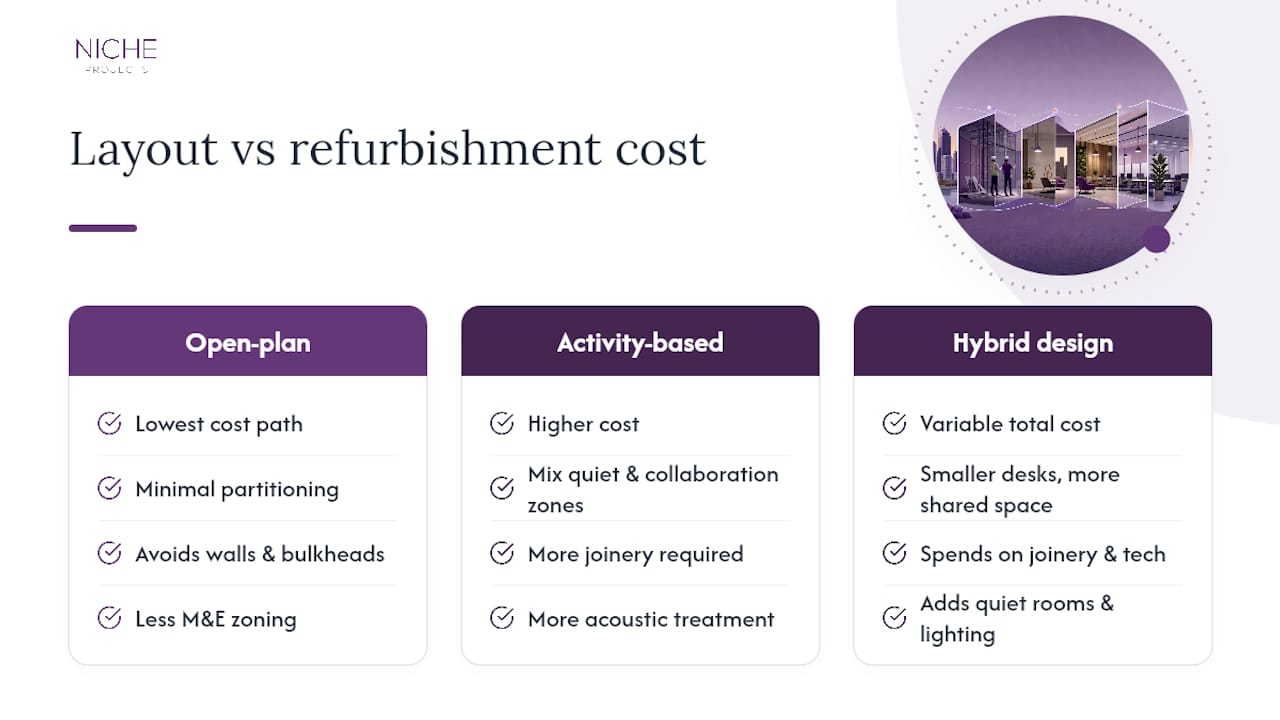
Layout drives cost more than most budget-holders expect going in. An open-plan refresh with minimal partitioning is one of the cheaper paths to a modernised office, because it avoids the biggest cost items: new walls, ceiling bulkheads, and rerouted services.
Activity-based working layouts, which mix quiet zones, collaboration spaces, and informal meeting areas, cost more than a straight open-plan refresh because they need more joinery, more acoustic treatment, and often more M&E zoning for lighting and climate control by area. The payoff shows up in staff experience rather than the invoice, which is why it’s worth weighing against your actual workplace strategy rather than budget alone. Our page on office layouts and which suits your business breaks down how different layout philosophies map to different cost profiles.
Hybrid-work-driven trends, smaller individual desk footprints, more shared collaboration space, more informal breakout areas, tend to shift budget away from raw square metreage of workstations and toward joinery, acoustics, and technology integration. A business shrinking its desk count but adding more collaborative zones might end up spending a similar total even on a smaller floor plate. Our guide to encouraging socialisation through office design covers how these layout shifts play out on the ground. Neurodiversity-informed design, quiet rooms, sensory-considered lighting, flexible zoning, also adds a line item most budgets miss on the first pass, and it’s worth pricing in from the design stage rather than retrofitting later.
Is refurbishing cheaper than a full new fit-out?
Refurbishing an existing tenancy is almost always cheaper than a full new fit-out, because you’re retaining base building services, existing partitions, and often ceiling and flooring substrates rather than stripping back to shell and core. A refurbishment at $1,200 to $2,200/sqm for a mid-range spec compares against a new fit-out that frequently starts where refurbishment tops out and climbs from there, since new fit-outs typically include full services installation, complete ceiling and floor systems, and base building compliance work that a refurbishment can often avoid.
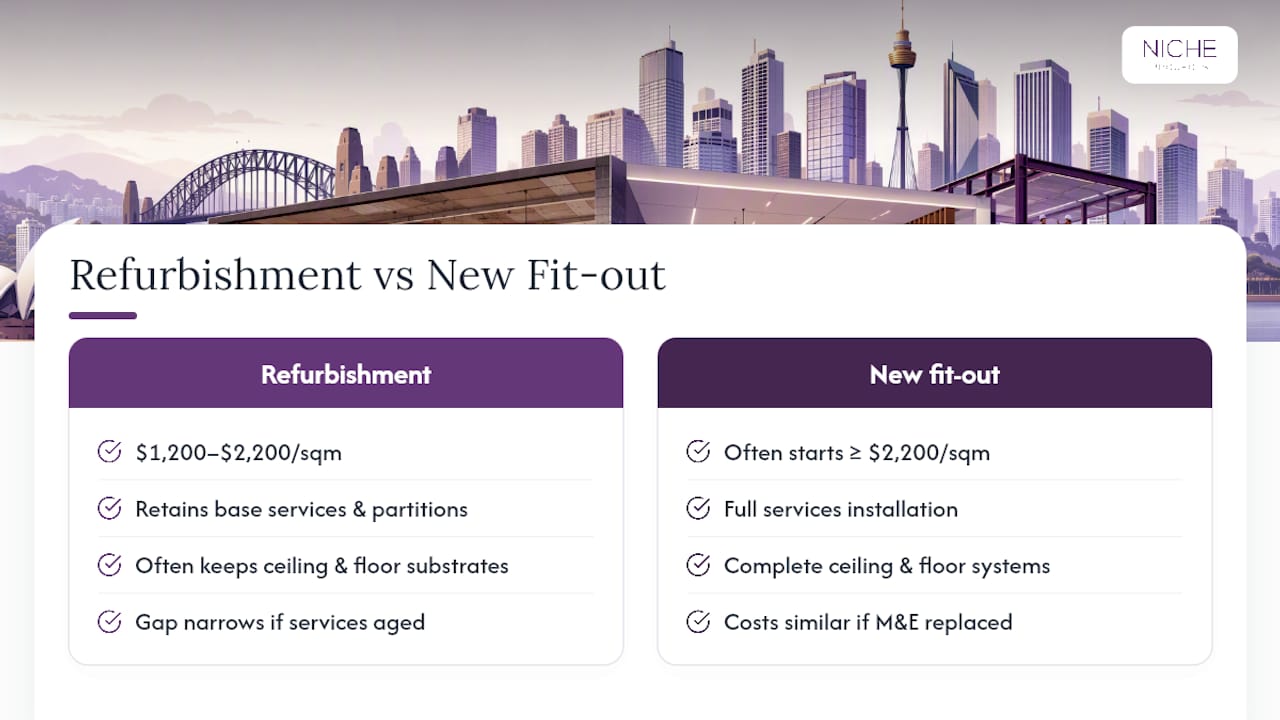
The gap narrows, sometimes disappears, when a refurbishment uncovers ageing services that need full replacement anyway. An office with 20-year-old HVAC or outdated electrical infrastructure can push a “refurbishment” budget close to new fit-out territory once M&E replacement gets factored in properly.
The decision usually comes down to lease term and building condition rather than cost alone. A business with 5 or more years left on a lease, in a building with reasonable base services, typically gets better value refurbishing. A business moving into a raw shell, or one whose current tenancy has aged past the point of cost-effective upgrade, is often better served starting fresh. Either way, get a condition assessment before committing to a budget line, guessing at the state of hidden services is how refurbishment budgets blow out mid-project.
Do green building certifications add to the cost?
Sustainability upgrades and green certification pathways (like NABERS ratings or Green Star targets) generally add to upfront capex rather than reduce it. Efficient HVAC systems, better glazing, LED lighting with smart controls, and low-VOC materials all carry a price premium over standard specification equivalents.
The size of that premium varies with ambition. A refurbishment targeting basic energy efficiency improvements might add a modest percentage to the M&E budget. Chasing a formal certification rating adds further cost, both in higher-spec materials and in the assessment, documentation, and commissioning work required to prove compliance.
Where this pays off is on the operating side, not the capital side. Efficient services reduce ongoing energy bills, and for businesses on longer leases, that payback can offset the higher upfront spend within a few years. It’s also increasingly a leasing and talent consideration: buildings with strong sustainability credentials are easier to lease and, for many businesses, easier to recruit into. Whether that trade-off makes sense for your project depends on lease length, energy costs at your site, and how much weight your organisation puts on sustainability credentials in its own reporting. Treat it as a genuine line-item decision, not an automatic inclusion.
How Niche Projects can help you land the right number
Getting from a per‑sqm benchmark to an approval‑ready figure is where most projects stumble, especially when hidden services conditions or scope creep aren’t caught early. Niche Projects works through that gap directly with clients: reviewing draft estimates, stress-testing scope against spec tier, and flagging where a design choice will quietly shift a budget line. Rather than handing you a generic quote, the team combines workplace strategy with construction delivery so the number you approve is the number you actually build to.
If you’re at the early stage of scoping a refurbishment, start with a free office space plan to get a realistic layout and initial cost indication before you commit to a full design brief.
Sources
- Australia and New Zealand fit-out cost guide 2026 — JLL
- Office fit out costs in Australia 2026 — Cushman & Wakefield
- Office renovation cost in Sydney — SydneyHomeRenovation
- Commercial office renovation cost Sydney (2026) — BuildScope Projects