

A post-occupancy evaluation is a structured assessment of how a building performs once people actually work in it, run against the goals set before it was built. It closes the gap between what the design promised and what occupants experience day to day, catching wasted energy, poor comfort and underused space before they become permanent costs. Most teams run the first check several months after handover, then follow up seasonally or annually.
TL;DR:
- A post-occupancy evaluation should be conducted at least one year after handover to capture seasonal variations in building performance.
- Combining occupant surveys with environmental monitoring and utility data provides the most accurate assessment of a building’s performance gap.
- Prioritizing low-cost methods, such as occupant feedback and utility bill analysis, can identify major issues before investing in advanced diagnostics.
- Engagement from independent evaluators and clearly defined roles improve the credibility and actionable quality of the evaluation report.
- Feeding insights into future design and operational adjustments ensures continuous improvement and prevents recurring issues.
Table of Contents
- What is post-occupancy evaluation and why does it matter?
- What methods do POE practitioners use?
- When should you run a POE, and for how long?
- Which metrics actually belong in a POE report?
- A step-by-step checklist for running a credible POE
- Who should run the evaluation, and what roles matter?
- How do you report findings and make them stick?
- Low-cost POE, common pitfalls, and how Niche Projects applies this thinking
- Sources
What is post-occupancy evaluation and why does it matter?
A post-occupancy evaluation, sometimes shortened to POE, sits inside the broader discipline of building performance evaluation. It asks a specific question: does the finished, occupied building do what it was designed to do? The University of Melbourne’s Learn Network frames this as identifying the “performance gap” between what was designed and what actually happens once people move in, covering energy, water, maintenance costs and occupant satisfaction together.
That gap costs money in ways that rarely show up until months after handover. A workplace that looks right on the drawings can still run hot, waste energy, or leave staff frustrated with noise and glare. Running a proper evaluation gives you:
- Evidence to fix problems while they’re still cheap to fix
- A defensible record for risk management and future briefs
- Data that separates real occupant complaints from anecdote
- A feedback loop that makes your next fit-out smarter than the last
Industry bodies including RIBA and BSRIA now treat this as standard practice rather than an optional extra, and that shift matters when you’re arguing for budget internally.
What methods do POE practitioners use?
POE splits cleanly into two camps, and the best evaluations use both. Architecture Australia describes qualitative approaches as occupant surveys, one-on-one interviews, focus groups and design review workshops, while quantitative approaches lean on instruments and data.
- Qualitative: structured surveys, interviews with department heads, focus groups, walkthrough workshops with staff
- Quantitative: indoor environmental quality (IEQ) monitoring, utility and meter data, space-use metrics such as desk occupancy rates, technical audits of building systems
Which combination you use depends on project size, the outcomes you set at briefing, and what budget remains after construction. A small fit-out rarely justifies a full environmental monitoring rig; a large head office usually does.
Pro Tip: Run the survey before you book any monitoring equipment. Occupant feedback often tells you exactly where to point the sensors, which saves you paying to measure rooms nobody has a problem with.
When should you run a POE, and for how long?
Most guidance points to an initial check after occupants have settled into normal routines rather than reacting to the novelty of a new space. RIBA’s guidance recommends waiting at least a year after handover before running a full in-use study, so seasonal effects on heating, cooling and daylight get captured properly.
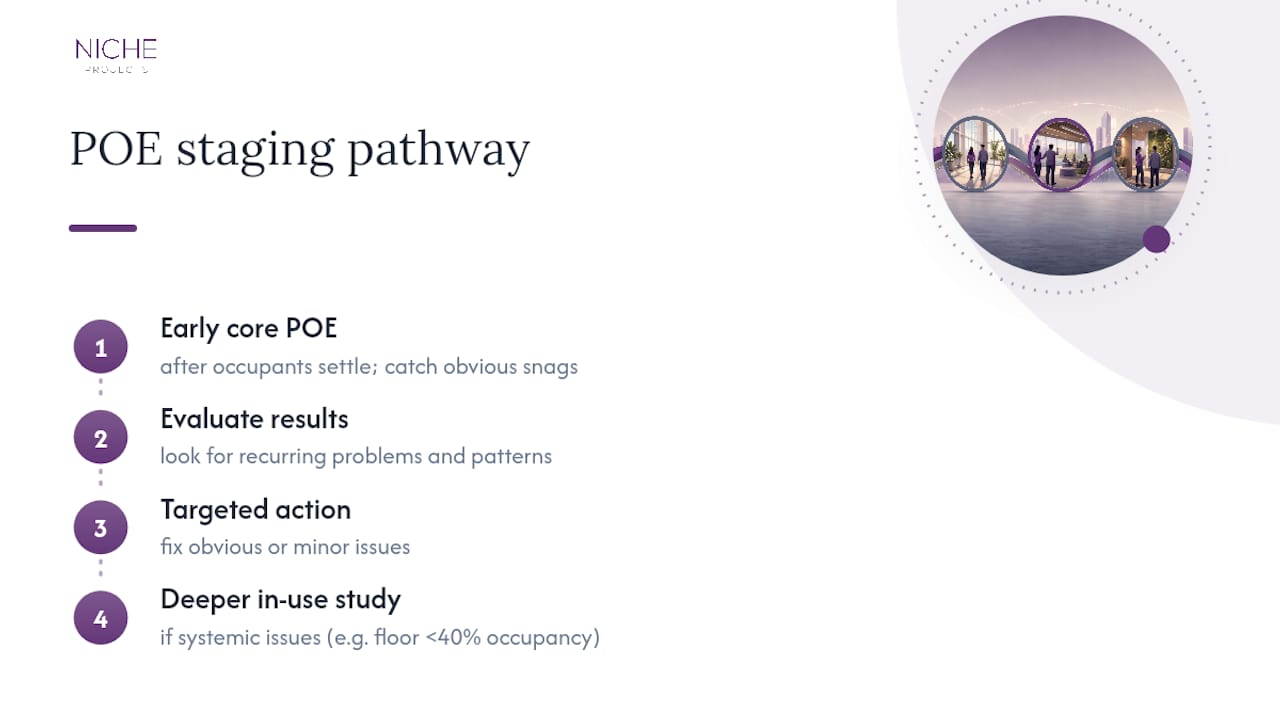
A staged approach works best in practice. Run a lighter “core” POE early to catch obvious snags, then escalate to a deeper study if the results flag something systemic, like consistent complaints about temperature or a floor that never fills past 40% occupancy.
Which metrics actually belong in a POE report?
A credible report mixes subjective experience with hard numbers, because either one alone tells only half the story. A 2023 systematic review in Building and Environment found that studies using inconsistent metrics produce results that can’t be compared project to project, which is exactly the trap a clear KPI list avoids.
- Occupant satisfaction scores, often tracked with an eNPS-style metric over time
- Indoor environmental quality: temperature, humidity, CO2 levels, lighting and acoustics
- Energy, water and waste consumption against design targets
- Space utilisation rates by desk, meeting room and collaboration zone
- Maintenance costs and fault frequency post-handover
Not every project needs all five tracked in depth. If your brief was built around collaboration and flexible working, prioritise space utilisation and satisfaction over granular acoustic data. If the client’s biggest concern was running costs, energy and maintenance figures carry the most weight in the final report.
A step-by-step checklist for running a credible POE
Skipping the planning stage is the single biggest reason POEs produce weak, unusable results. Here’s the sequence that keeps a study on track from brief to action.
- Define outcomes and success criteria up front. Tie the evaluation back to what the original brief promised, whether that’s reduced energy use, higher collaboration, or fewer complaints about noise.
- Set scope and ownership. Decide who runs the process, what methods you’ll use, and how you’ll handle consent for staff surveys and interviews.
- Collect the data. Deploy occupant surveys, schedule any environmental monitoring, and pull utility bills and occupancy sensor data covering the same period.
- Cross-reference qualitative and quantitative findings. A spike in complaints about stuffy air means something different when meter data shows the ventilation plant is running below spec versus running fine.
- Report recommendations with owners and timelines. Every finding needs a named action, a responsible person, and a low, medium or high impact tag so facilities teams can prioritise.
Pro Tip: Tag each recommendation by cost as well as impact. A finding that’s high impact and low cost, like adjusting blind schedules to cut glare complaints, should always jump the queue ahead of a high impact, high cost HVAC upgrade.
Planning the evidence you’ll need at project inception rather than retrofitting a measurement plan after the fact makes every one of these steps cheaper and more reliable.
Who should run the evaluation, and what roles matter?
Project teams can run their own POE, and often do for smaller fit-outs, but an independent evaluator brings distance that catches issues a team too close to the design might excuse. RIBA’s guidance notes that independent POE is often the more appropriate choice for larger or higher-risk projects.
- Client sponsor: owns the decision to run the study and signs off on findings
- Evaluator: designs the methodology, collects and analyses data
- Facilities manager: supplies operational data and implements accepted recommendations
- User representatives: speak for the occupant experience across departments
- Technical specialists: handle IEQ monitoring or HVAC-specific diagnostics where systems need deeper inspection
Worth a quick conversation with your professional indemnity insurer before you start, particularly on larger projects where findings could touch on design liability.
How do you report findings and make them stick?
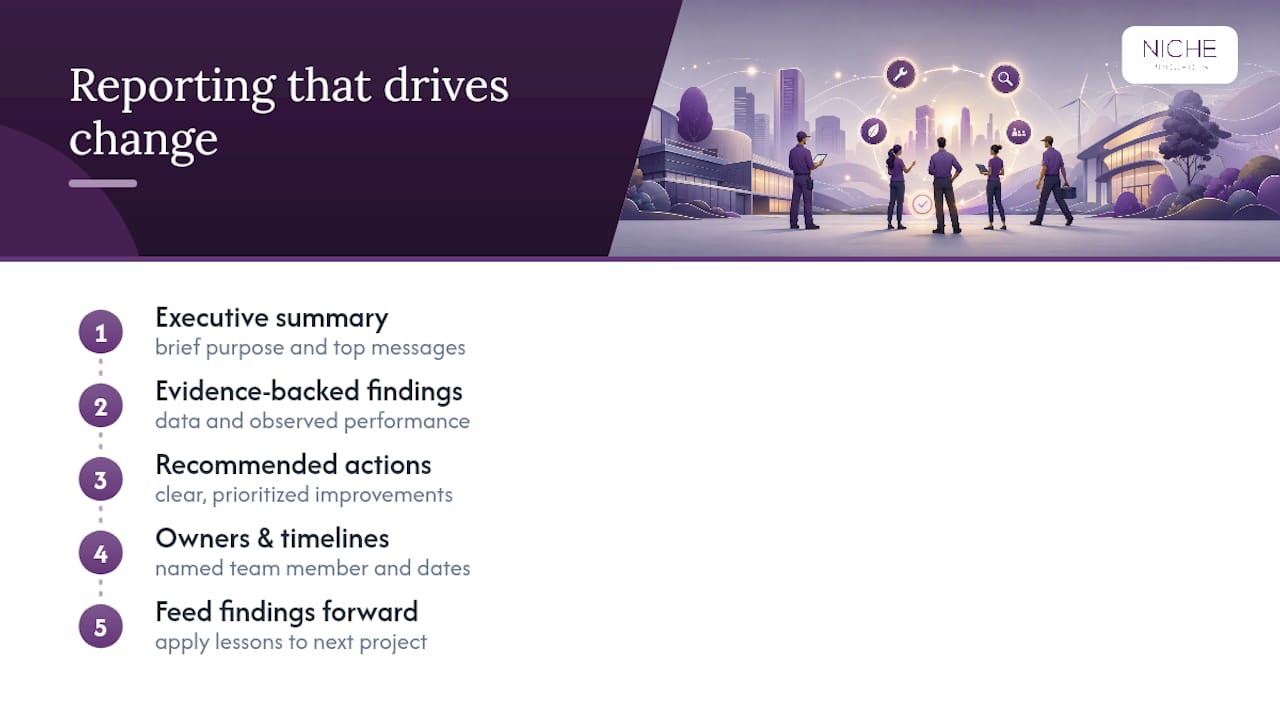
A useful report has four parts: an executive summary, evidence-backed findings, a set of recommended actions, and clear owners with timelines attached. Skip any one of those and the document turns into a filing exercise rather than a driver of change.
The real value shows up when findings feed forward, not just back. BSRIA’s guidance on building performance evaluation frames this as mapping BPE activity across the whole project lifecycle, so lessons from one fit-out shape the brief for the next. That might mean updating facilities management plans, revising maintenance schedules with input from a sustainable building maintenance approach, or feeding satisfaction data into how you manage the change process when new layouts roll out.
Decide early whether results stay client-only or get shared more broadly. Architecture Australia’s reporting on POE practice notes that evaluations tend to work best when a named team member owns them from the start and shares findings beyond just the immediate client, contributing to the sector’s collective understanding of what actually works.
Low-cost POE, common pitfalls, and how Niche Projects applies this thinking
You don’t need a lab’s worth of sensors to get a useful evaluation. A focused occupant survey paired with a basic reconciliation of utility bills against design targets often surfaces the biggest issues before you spend a dollar on specialist diagnostics. That’s the practical entry point for most commercial fit-outs.
The pitfalls tend to repeat across projects:
- Leaning too hard on instrumentation while skipping occupant interviews, missing the human context behind the numbers
- Leaving POE planning until after handover, which pushes up cost and narrows what data you can actually collect
- Treating the report as a one-off rather than feeding it into the next brief
Outcome definitions should be built into the Stage 1 conversation with every client, not as an afterthought once the fit-out is finished. That means agreeing what “success” looks like for a workspace before a single wall goes up, then treating the months after move-in as an aftercare period where small tweaks, from desk layout to lighting zones, get made based on how people actually use the space.
Pro Tip: If budget is tight, spend it on the occupant survey first. Instrumentation tells you what’s happening; people tell you why it matters.
If a POE on your current office has flagged issues around desk comfort or workstation strain, ergonomic office design is often the fastest, most cost-effective fix. Where the findings point to bigger structural gaps between how your space was designed and how your teams actually work, workplace strategy through to construction can be used to close that loop, so the next fit-out doesn’t repeat the same mistakes. Explore how a productivity-focused office design approach turns evaluation findings into a workspace that earns its keep.
Sources
- Post-occupancy evaluation — University of Melbourne (Learn Network)
- Post-occupancy evaluation: Time for some feedback? — Architecture Australia
- Post Occupancy Evaluation Guidance — RIBA
- Post-occupancy evaluation in residential buildings: A systematic literature review of current practices in the EU — Building and Environment, 2023