

The defects liability period (DLP) is the contractual window, typically starting at practical completion, during which a contractor must return and fix defects at no extra cost to the client. In Australia, 12 months is the most common industry baseline for straightforward commercial and fit-out work, though contracts can shorten or extend it. What matters most is knowing how to notify defects properly, what security protects you, and how this contractual mechanism sits alongside your statutory and legal rights.
TL;DR:
- The typical defects liability period in Australia lasts 12 months, starting from practical completion, with larger or complex projects extending beyond this timeframe.
- Proper defect notification requires clear documentation and written notices through the contract’s designated channels, with tracking of rectification and security claims.
- Security held in retention or guarantees is essential for enforcing defect rectification obligations, with releases tied to compliance and certificates of making good.
- Statutory warranty periods often exceed the DLP, allowing legal claims for latent defects to continue beyond the contractual period, sometimes for several years.
- Early, thorough inspections, staged commissioning, and detailed records during handover help prevent most disputes and reduce defect rectification headaches later.
Table of Contents
- What the defects liability period does in a contract
- How long does a defects liability period typically run?
- Patent defects versus latent defects: why the distinction matters
- How to notify defects and get them rectified during the DLP
- Retention, security, and the final certificate
- Statutory warranties and limitation periods: the DLP isn’t the finish line
- What to do when rectification isn’t happening
- A practical checklist for the DLP period
- How Nicheprojects reduces defects before handover ever happens
- Getting your fit-out right from the start
- Sources
What the defects liability period does in a contract
A DLP is a negotiated right, not a legal default. It gives the contractor first option to return and rectify anything that goes wrong after handover, rather than the client immediately hiring someone else and suing for the cost. That matters because remobilising a new trade to fix someone else’s work is expensive and slow, and it usually costs more than the original contractor coming back to fix their own mistake.
For the client, the DLP creates a defined window of accountability tied to security held under the contract. For the contractor, it draws a line: defects reported after the period closes generally fall outside this particular remedy, though other legal avenues can still apply.
The period usually starts the day the superintendent or principal’s certifier issues practical completion, the point at which the works are complete enough for the space to be used for its intended purpose, minor items aside.
- The contractor retains an express right (not just an obligation) to rectify before the client can call in someone else at the contractor’s expense. Retention or bank guarantees held under the contract typically back this obligation, giving the client leverage if the contractor stalls. The superintendent’s role continues past handover, issuing directions and certifying when the DLP has been properly discharged.
How long does a defects liability period typically run?
Most fit-out and commercial contracts in Australia sit at six or 12 months, though this varies with project complexity and negotiation. Queensland’s building regulator notes that six or 12 months are the figures most commonly written into residential and commercial building contracts.
Larger or more technically complex projects often push past 12 months, particularly where specialist plant needs a full seasonal cycle to prove itself. A chiller system installed in autumn, for example, won’t show its true performance until it’s carried a full summer load.
- Six months suits smaller, lower-risk fit-outs with limited mechanical or hydraulic scope.
- Twelve months is the standard for most commercial fit-outs and covers a full seasonal cycle for air conditioning and other building services.
- Twenty-four to 36 months appears on complex builds with specialist mechanical, electrical, or facade systems where failure modes take longer to surface.
Drafting levers change the exposure further. Sectional completion lets different trades or zones start their DLP clocks at different times. A contract might also extend the DLP for the specific item that was rectified, so a re-fixed defect gets its own fresh notice period rather than expiring alongside the rest of the works, though most contracts cap the total extension so a contractor’s exposure doesn’t run indefinitely.
Patent defects versus latent defects: why the distinction matters
A patent defect is one you can see or reasonably discover at handover: a scuffed skirting board, an uneven paint finish, a door that doesn’t close flush. A latent defect is hidden at the time of handover and only reveals itself later, often through failure: waterproofing that leaks after the first heavy storm, ductwork that was never properly sealed, structural movement that shows up as cracking months down the track.
The distinction changes everything about timing and proof. Patent defects should be caught and listed during your pre-handover inspection, because a client who signs off on practical completion without flagging an obvious fault has weaker grounds to complain later. Latent defects, by contrast, can surface after the DLP has closed, which is exactly why the DLP is not the end of your rights (more on that shortly).
Contemporaneous evidence is what wins disputes over hidden faults. Photograph everything at handover, keep commissioning reports, and log dates the moment a problem appears.

Pro Tip: Keep a dated photo log from the day you take occupancy, even of things that look fine. When a latent defect appears eight months later, that baseline record is what proves the fault wasn’t caused by how the space was used after handover.
How to notify defects and get them rectified during the DLP
Getting the notice right matters more than most owners realise. A vague email saying “the aircon isn’t working properly” gives a contractor room to argue the notice was invalid or too imprecise to act on.
- Identify and document the defect with photos, location, and a clear description of what’s wrong versus what was specified or expected.
- Issue a written notice, ideally through the superintendent or contract administrator named in the contract, specifying the defect, its location, and a reasonable timeframe for rectification.
- Allow the contractor first right of return to inspect and fix the issue, rather than engaging another trade immediately.
- Track the rectification date, because many contracts restart or extend the DLP for that specific defect once it’s been fixed.
- Escalate through security if the contractor doesn’t act within a reasonable time, claiming against retention or a bank guarantee to fund someone else to complete the work.
Practitioner experience backs this up: most disputes are avoidable when parties clearly distinguish patent and latent defects and keep contemporaneous records from day one, rather than trying to reconstruct a timeline months after the fact.
If the contractor genuinely can’t or won’t return, most contracts let the client step in: engage another party to complete the rectification and deduct the cost from retention or claim it against the security held. That’s the entire point of holding security in the first place, so you’re never stuck negotiating from a position of no leverage.
Retention, security, and the final certificate
Money is the enforcement mechanism behind the whole DLP structure. Without security held back, a contractor’s promise to return and fix defects is just goodwill.
Retention is commonly withheld as a percentage of the contract sum, or as a bank guarantee of equivalent value, and released in stages. Half is typically returned at practical completion, with the balance held until the contractor has demonstrably made good all defects.
- Practical completion release: usually half the retention amount, reflecting that the works are substantially done but not yet proven defect-free.
- Certificate of Making Good: issued by the superintendent once outstanding defects are rectified, triggering release of the remaining retention.
- Disputed certificate timing: if the superintendent won’t certify, the balance can sit unresolved for months, so contracts should specify a clear process and timeframe for certification disputes.
- Drafting tip: cap the total value of retention that can be claimed against, and specify exactly what evidence (photos, sign-off, test reports) satisfies “making good” before security is released.
Statutory warranties and limitation periods: the DLP isn’t the finish line
The DLP is a contractual mechanism. It’s not a legal cut-off, and closing the DLP doesn’t extinguish your broader rights. Legal analysis of DLP clauses is consistent on this point: the period simply defines when a specific contractual remedy applies, separate from statutory warranties and limitation law.
Statutory warranty regimes vary by state and territory and generally run independently of whatever the contract says. NSW Building Commission guidance draws a distinction between major structural defects, which attract a longer statutory window (commonly around six years from completion), and other defects, which typically carry a shorter statutory period of around two years. Exact figures and categories differ between jurisdictions, so check the rules in your own state before assuming a number applies.
- Limitation periods for a contract claim commonly run six years from breach; deeds can extend that to 12 years, which is why some construction contracts are executed as deeds specifically to widen the window.
- Claims in tort (negligence) run on a different clock, often from when the defect was discovered or reasonably discoverable, which matters enormously for latent defects that surface years later.
- A latent defect discovered after the DLP has closed may still be pursued under statutory warranty or general legal claims, so don’t assume you’re out of options once the 12 months lapse.
Given how many rides on discovery dates and evidence, engaging an expert early once a latent defect appears strengthens your position considerably, whether that ends up as a statutory complaint or a broader legal claim.
What to do when rectification isn’t happening
Escalation should follow a ladder, not jump straight to litigation. Most disputes resolve well before a courtroom becomes necessary.
- Formal contractual notice first: a clear written demand through the superintendent, referencing the specific clause and timeframe for rectification.
- Security claim: if the contractor is unresponsive, claim against retention or the bank guarantee to fund someone else to finish the job.
- Regulator complaint: bodies like the Queensland Building and Construction Commission or the NSW Building Commission can investigate, direct rectification, and in some cases issue enforceable directions against a licensed builder. You’ll need your documented evidence trail, so the photos and dated records from earlier really do earn their keep here.
- Expert determination or mediation: faster and cheaper than court, and often required as a contractual precondition before litigation can even begin.
- Urgent court relief: reserved for situations involving safety risk or ongoing damage, such as active water ingress threatening other parts of a building, where waiting for mediation isn’t realistic.
Most disputes never reach the final two steps. The ones that do usually got there because notices were vague, evidence was thin, or nobody escalated early enough to use retention as leverage while it still existed.
A practical checklist for the DLP period
- Inspect thoroughly before signing off on practical completion. A rushed walk-through misses the patent defects that are easiest to fix cheaply and fastest.
- Photograph and log everything at handover, including systems that appear to be working fine.
- Keep commissioning reports and test certificates for mechanical, electrical, and hydraulic systems on file, not just verbally confirmed.
- Issue defect notices in writing, through the proper contract channel, with location, description, and a reasonable rectification timeframe.
- Diary the DLP end date and any extended dates tied to specific rectified items, so nothing lapses unnoticed.
Pro Tip: Set a calendar reminder for 30 days before your DLP closes. That gives you time for one final walk-through and a last chance to lodge notices on anything that’s crept up, rather than discovering an issue the week the period expires.
How Nicheprojects reduces defects before handover ever happens
Prevention beats rectification. On Nicheprojects fit-outs, staged inspections and formal commissioning records at each milestone catch issues before they reach practical completion, echoing what field research on construction defects consistently finds: workmanship and early-stage quality control drive most defect outcomes.
Early client engagement during workplace strategy and design also matters. Specifications get clarified before construction starts, not argued over after handover, which is where most latent M&E disputes originate.
Getting your fit-out right from the start
A defects liability period only becomes a headache when the groundwork before handover was shaky. Clear specifications, staged commissioning, and a properly documented practical completion process prevent most disputes before they start, which is the entire premise behind ergonomic office design done properly the first time.
If you’re planning a fit-out or refurbishment and want a partner who treats commissioning and handover as seriously as the design itself, Nicheprojects manages that process end to end across Sydney, from Sydney CBD through to North Ryde and Macquarie Park. Getting the construction management right from day one is what keeps your defects list short and your retention release straightforward.
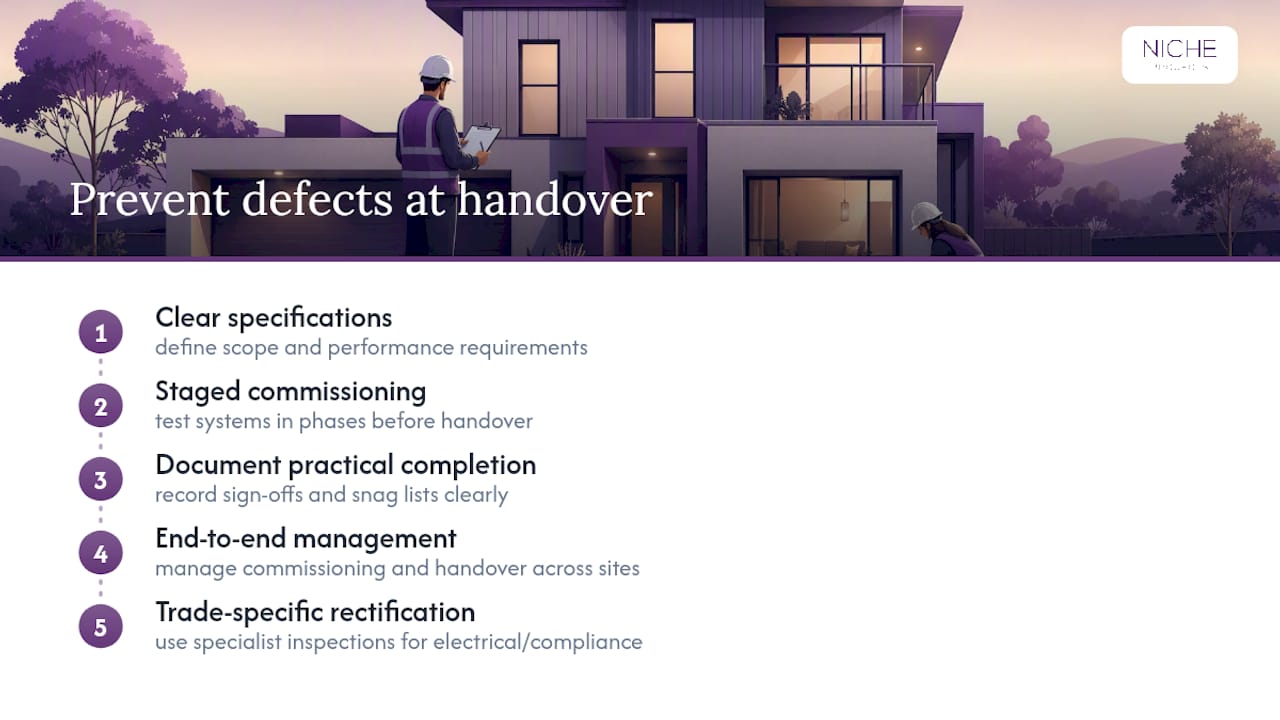
For readers dealing with trade-specific rectification, electrical defect inspection and rectification services in Sydney can help resolve specific compliance issues flagged during the DLP, and new home defects inspection guidance is a useful reference for owners building their own snagging checklist ahead of practical completion.
Sources
- Procore — defect liability period
- Help with defective work | Queensland Building and Construction Commission (QBCC)
- How Building Commission NSW deals with building defect complaints
- PwC — defects liability period (practical guidance and drafting considerations)