
Pick design and construct when speed and single-point accountability matter more than granular design control. Pick traditional procurement (design–bid–build) when you need maximum design oversight or public procurement rules force lowest-price tender selection. That’s the whole decision in one line, but the trade-offs behind it decide whether you’ll be happy with the outcome eighteen months from now.
- Schedule and cost certainty run in favour of design and construct, because construction expertise enters the process during design rather than after it.
- Design control and competitive tendering run in favour of traditional procurement, which is why NSW government guidance still lists it alongside D&C variants for public works.
Infrastructure Australia frames this as a fit-for-purpose decision rather than a universal winner, and that framing holds up whether you’re delivering a 40-storey tower or a 400 square metre office fit-out.
Key Takeaways
Design and construct wins on speed and single-point accountability, while traditional procurement wins on design control and open competitive pricing.
| Point | Details |
|---|---|
| Match route to priority | Choose D&C for schedule and accountability; choose traditional for design control or mandated tender rules. |
| Cost certainty timing differs | D&C firms pricing earlier through GMP or lump sum; traditional risks escalation from post-tender variations. |
| Brief quality decides outcomes | Vague employer’s requirements are the leading cause of D&C disputes and scope creep. |
| Client capability matters | Traditional procurement demands in-house coordination between architect and builder that D&C removes. |
| Nicheprojects delivers integrated D&C | Nicheprojects combines workplace strategy, design, and construction management under one contract for occupied-building fit-outs. |
Table of Contents
- Design and construct vs traditional: the core definitions
- How do design and construct and traditional procurement compare?
- What are the real advantages and disadvantages of each?
- What are the procurement steps and where does cost certainty sit?
- How do you choose between design and construct and traditional?
- What does this look like on a real workplace fit-out?
- Nicheprojects gives you one team for design and construction
- Frequently asked questions
- Sources
Design and construct vs traditional: the core definitions
Design and construct (D&C) puts design and construction under one contract with one contractor carrying responsibility for both. Phases overlap, so building can start before every drawing is finalised, and there is a single point of accountability if something goes wrong.
Traditional procurement (design–bid–build) separates the two. An architect or consultant designs the project fully, it goes to competitive tender, then a builder is engaged to construct it. The phases run sequentially, and the client manages the architect and the builder as separate relationships.
You’ll see the same concepts under different labels:
- Design and build = design and construct = D&C
- Design–bid–build = DBB = traditional procurement
- NSW government guidance also lists variants such as documented design, design development and construct, and novate models, all sitting within the D&C family.
How do design and construct and traditional procurement compare?
| Dimension | Design & Construct | Traditional (Design–Bid–Build) |
|---|---|---|
| Contract structure | One contract, one contractor for design and build | Separate contracts for designer and builder |
| Single point of accountability | Yes, the contractor carries both risks | No, client coordinates two parties |
| Design control & client input | Lower once briefed; changes cost more | High, full control before tender |
| Cost certainty | Earlier certainty via GMP or lump sum | Competitive at tender, riskier post-award |
| Tendering / competitive pricing | Fewer bidders, negotiated or design-competition | Open, price-competitive tender |
| Programme speed | Faster, overlapping phases | Slower, sequential phases |
| Suitability | Fit-outs, refurbishments, occupied buildings | Complex design, heritage, mandated lowest-bid |
The dimension that usually decides it is schedule versus control. If your building is occupied and every week of construction disrupts staff, D&C’s overlapping phases save real time. If the design has to survive committee sign-off or public tender rules, traditional procurement’s sequential structure protects that process even though it’s slower.
What are the real advantages and disadvantages of each?
Design and construct advantages: fewer variations because the builder helped shape the design, faster handover through overlapping phases, and one contractor to chase if something fails. Disadvantages: less designer independence, and pricing that firms up later than an open tender would.
Traditional procurement advantages: fully competitive pricing at tender, complete design control before a builder is locked in, and clear separation of design and construction liability. Disadvantages: change orders and design errors surface during construction, and the client absorbs coordination duties between architect and builder unless the contract explicitly assigns them.
Dispute likelihood tends to rise in traditional procurement when the design has gaps at tender stage, because contractors price what’s drawn, not what’s implied. In D&C, disputes more often trace back to a weak brief rather than a mid-construction discovery. Clients with strong in-house project management capability can run traditional procurement well; those without it often find D&C’s single-contract structure a better fit for their team’s capacity.
What are the procurement steps and where does cost certainty sit?
Traditional procurement runs in three broad phases:
- Design — architect or consultant develops drawings and specifications to completion.
- Tender — the completed design goes to competitive bid, giving the client comparable prices.
- Construction — the winning contractor builds, with variations and errors typically surfacing here.
D&C compresses this into overlapping stages:
- Brief and concept — client issues a project brief and performance requirements.
- Design development with contractor input — pricing firms up progressively toward a guaranteed maximum price (GMP) or lump sum.
- Construction begins on early-released packages while later design details are finalised.
Cost escalation in traditional procurement usually comes from variation orders triggered by design errors discovered on site. In D&C, most of that risk transfers earlier: a common misconception is that D&C always costs more upfront, when in practice early contractor input often prevents the costly variations that inflate traditional project budgets. Whichever route you choose, confirm contractor licensing and any specialist permits (demolition, WHS registrations) early. These checks affect programme regardless of delivery model.
How do you choose between design and construct and traditional?
Run through this checklist before committing to a route:
- Is the completion date fixed by a lease expiry, funding deadline, or business event?
- Do you need full design control, or is a well-written performance brief good enough?
- Are you bound by public procurement rules requiring open, lowest-price tender?
- Does your team have the in-house capacity to coordinate an architect and a builder separately?
- Is the building occupied, meaning disruption itself has a cost?
Red flags that signal a mismatched choice: selecting D&C but then insisting on daily design sign-offs, which erases the schedule advantage you paid for. Or choosing traditional procurement with an incomplete design and thin contingency allowances, which all but guarantees variation claims later.
Pro Tip: Whichever route you pick, write the employer’s requirements or design brief with the same precision you’d want in the finished building. Legal commentary on D&C contracts consistently flags vague briefs as the leading cause of scope creep and disputes once liability has shifted to the contractor.
What does this look like on a real workplace fit-out?
A mid-sized professional services firm needed to relocate into a partially occupied floor without shutting down operations for more than a weekend. The team chose D&C specifically for the overlapping design and construction phases.
The disruption saving was the deciding factor, not the price. Sequential design-then-build would have added weeks the business couldn’t absorb.
Two lessons carried forward from that project:
- Lock the brief before appointing the design-and-build team; changes mid-contract can cost more than in a traditional model.
- Budget contingency for the handover period regardless of route. Post-construction cleaning and readiness checks still need scheduling, and resources like post-construction cleaning guidance help plan that final stage properly.
Nicheprojects gives you one team for design and construction
If the checklist above points you toward design and construct, the next decision is who runs it. Nicheprojects combines workplace strategy, space planning, and construction management under one roof, so the disconnect that plagues traditional procurement, where an architect’s intent gets lost in translation to the builder, never happens in the first place. You brief once, and the same team that designed your space is accountable for building it.
This suits corporate offices, creative agencies, and any organisation planning a fit-out or refurbishment where operational disruption has a real cost. Nicheprojects’ approach draws on current workplace design trends while keeping construction risk with one accountable party rather than split across separate contracts.
If you’re weighing up procurement routes for an upcoming project, start with a free office space plan from Nicheprojects to see how a single-contract approach would actually run for your building and timeline.
Frequently asked questions
Is design and construct always cheaper than traditional procurement?
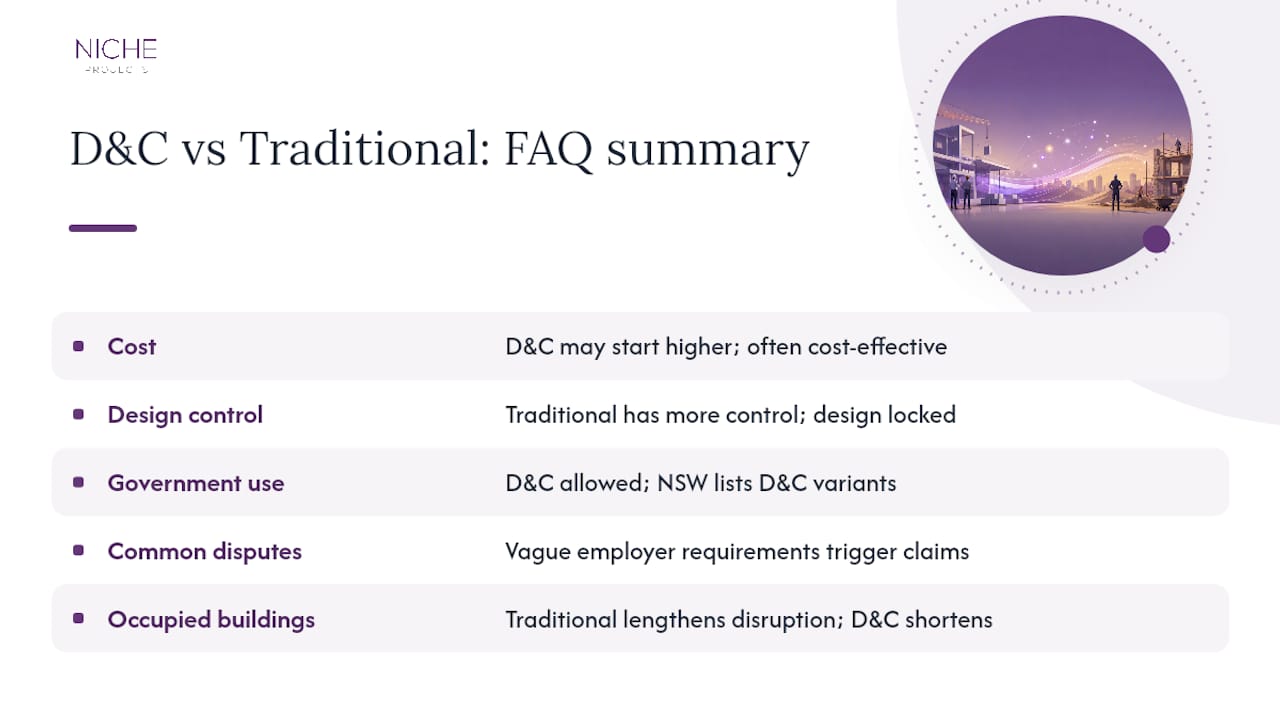
Not necessarily upfront. D&C pricing can start higher because the contractor prices design risk into the contract early, but it often works out more cost-effective overall since early contractor input prevents the variation claims that inflate traditional project budgets.
Which method gives the client more design control?
Traditional procurement, because the design is fully completed and locked before a builder is even selected. D&C still allows client input through the brief and performance requirements, but changes after contract signing cost more and take longer.
Can government agencies use design and construct?
Yes. NSW procurement guidance lists several D&C variants, including documented design and novate models, specifically for agencies that want speed without losing scope control.
What causes most D&C disputes?
Weak or vague employer’s requirements. Once the contract is signed, design liability typically shifts to the contractor, and unclear briefs are the most common trigger for scope creep and claims.
Does traditional procurement suit occupied buildings better?
Usually not. Its sequential phases extend the construction period, which increases disruption for occupied workplaces. D&C’s overlapping phases tend to shorten that disruption window considerably.
Sources
- Design and Construct (Acumen)
- Design‑construct procurement (ARBV deep dive)
- Construction procurement guide: contract systems (Buy.NSW)
- Design and construct contract (Brunet Law)
These sources underpin every checklist item and comparison in this guide.