
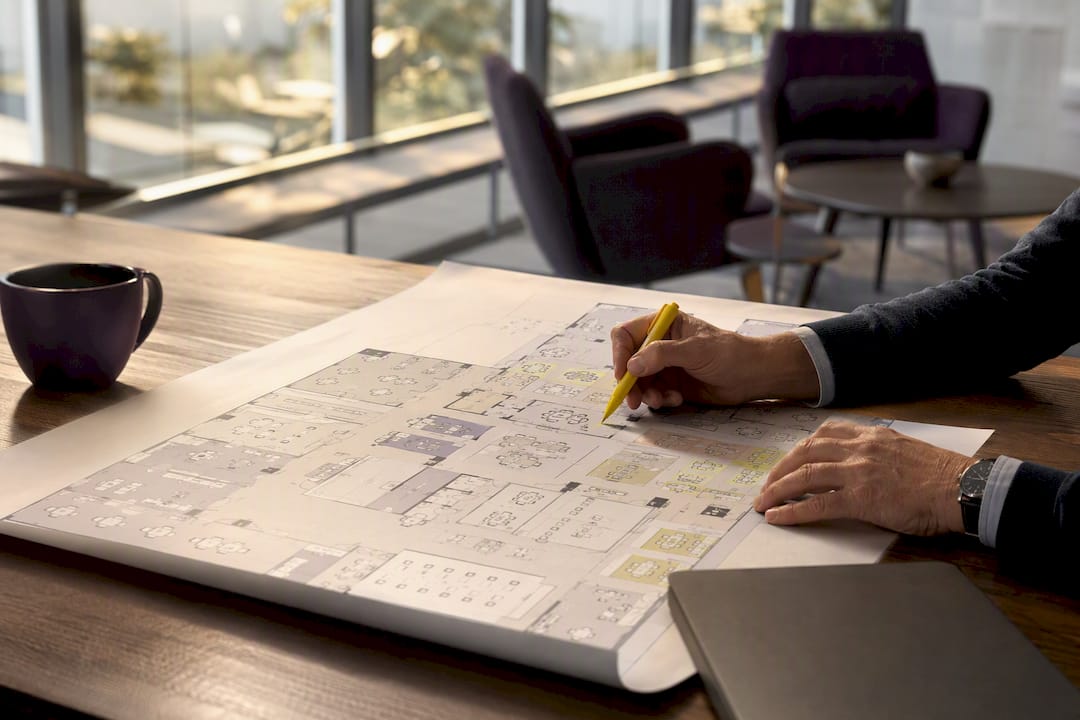
A hybrid workplace strategy is the plan that ties together where people work, how the office is designed, and which technology holds it all together, aimed at specific business outcomes rather than a headcount on a badge reader. The one thing that separates the strategies that work from the ones that quietly fail is this: the goal comes first, then the policy, then the space, then the tech. Get that order backwards and you end up with an office nobody wants to use and a policy nobody follows.
If you’re starting from scratch, don’t write a policy yet. Run a two-week diagnostic first.
- Survey current attendance patterns against booking or badge data, not guesses.
- Ask managers which tasks genuinely need in-person time versus habit.
- Check your lease end date and headcount forecast against your floor plan.
- Pick one measurable pilot goal (e.g. lift Tuesday to Thursday collaboration density by 20%) before touching the design brief.
That diagnostic tells you more in ten working days than a six-month committee debate ever will.
Key Takeaways
A successful hybrid workplace strategy requires goals-led design across policy, space and technology, validated through pilots and utilisation data before scaling company-wide.
| Point | Details |
|---|---|
| Goals before schedule | Pick three to five measurable KPIs across commercial, people and cultural goals before setting any attendance rule. |
| Match model to role | Choose schedule-based, anchor days, minimum days, fully flexible or activity-based models based on customer contact and collaboration needs. |
| Design for real attendance | Zone space by activity, not fixed desk ratios, since hybrid employees average around 2.3 days in the office weekly. |
| Consult before mandating | Team-led scheduling within a clear framework improves perceived fairness and reduces psychosocial risk. |
| Pilot, measure, iterate | Triangulate booking, sensor and survey data, and set scaling or consolidation triggers before the pilot starts. |
| Partner with specialists | Nicheprojects combines workplace strategy consulting with direct fit-out delivery, closing the gap between design intent and the finished space. |
Table of Contents
- Setting strategic goals and success metrics for your hybrid workplace strategy
- Which hybrid model actually fits your organisation?
- Designing office space and operations for hybrid attendance
- What tech stack actually makes hybrid reliable?
- Who decides the roster? Building policy and governance that holds up
- How do you roll out a hybrid workplace strategy without a backlash?
- Measuring what matters and improving on the fly
- Niche Projects evidence and practical examples
- Why employee engagement and inclusion make or break the plan
- Training managers to lead a hybrid team, not just a hybrid roster
- Health and safety considerations you can’t skip in a hybrid model
- Legal and compliance issues to get right early
- Supporting wellbeing and mental health in a hybrid setting
- Technology security and access control across two environments
- Get a hybrid workplace strategy built by people who deliver the fit-out too
- Frequently asked questions
- Sources
Setting strategic goals and success metrics for your hybrid workplace strategy
Most hybrid failures trace back to a single mistake: leadership picked a schedule before picking a goal. Three days in the office sounds decisive, but three days in the office for what purpose is the question that actually matters. A hybrid workplace strategy without a defined outcome is just a roster.
Start by sorting your goals into three buckets, because a strategy chasing all of them equally will satisfy none of them well.
- Commercial goals — reduce real estate cost per head, consolidate two floors into one, or extend runway on an existing lease before renegotiating.
- People goals — lift retention among remote-capable staff, widen the talent pool beyond commuting distance, or cut recruitment cost by relaxing location requirements.
- Cultural goals — rebuild cross-team collaboration that eroded during fully remote years, or protect onboarding quality for staff who’ve never worked alongside a mentor in person.
Once you know which bucket matters most this year, narrow to three to five measurable outcomes with a KPI attached to each. “Improve collaboration” is not measurable. Good candidate metrics include space utilisation rate against booked capacity, employee engagement scores split by attendance pattern, unplanned attrition among remote-capable staff, and average commute-adjusted satisfaction. Gallup’s tracking shows roughly six in ten remote-capable employees prefer a hybrid arrangement over full remote or full on-site, and fewer than one in ten want to be in the office five days a week, so any KPI set that assumes people want to return full-time is starting from a false premise.
Timing matters more than most leaders account for. A hybrid workplace strategy designed in isolation from your lease cycle, recruitment plans and any planned restructure will need rework within twelve months. If your lease renews in eighteen months, that’s your natural checkpoint for locking in floor size. If you’re scaling headcount by 30% next year, your space plan needs headroom baked in now, not a retrofit later.
Pro Tip: Write your KPIs down before you brief a designer or sign a fit-out contract. A goals document written after the space is built is a rationalisation, not a strategy.
Which hybrid model actually fits your organisation?
There’s no single right answer here, and the model that works for a 40-person creative agency will strangle a 400-person insurer with strict compliance obligations. Five broad models cover almost every organisation you’ll encounter.
- Schedule-based: leadership sets fixed days (e.g. Tuesday, Wednesday, Thursday) for everyone, which is simplest to plan around but the least popular with staff seeking autonomy.
- Anchor days: each team picks its own core in-office days, which preserves team cohesion while still respecting different functions’ needs.
- Minimum days: a floor requirement (e.g. two days minimum) with discretion above that, which gives individuals more control but makes space planning harder.
- Fully flexible: no mandated days at all, attendance driven entirely by task and preference, best suited to knowledge work with little client-facing need.
- Activity-based: attendance tied to what you’re doing that day (deep work at home, workshops and reviews in the office) rather than a fixed calendar rule.
Pick based on role type and customer contact, not on what a competitor announced in a press release. Customer-facing and reception-dependent roles often need fixed presence regardless of what the rest of the business does. Engineering and analysis roles with little cross-functional dependency can usually run fully flexible without any drop in output.
Run these four questions with your leadership team before locking in a model:
- Does this role require physical presence for legal, safety or customer-service reasons?
- How much of this team’s value comes from spontaneous collaboration versus solo focus time?
- Do we have enough desk and meeting capacity if 60% of the workforce shows up on the same peak day?
- Will this model still make sense if we grow 20% next year?
Stanford’s research on hybrid work frames well-designed hybrid arrangements as a genuine three-way win for company, worker and even city infrastructure, but that framing only holds when the model matches the actual work being done. A schedule-based model bolted onto a genuinely flexible workforce will just generate quiet resentment and empty desks on the mandated days.
Designing office space and operations for hybrid attendance
An office designed for five days a week of full occupancy is the wrong office for a hybrid workforce, full stop. Gallup’s 2025 tracking puts average in-office attendance at around 2.3 days per week among hybrid employees, which means a floor plan built for 100% occupancy is carrying dead weight most days and getting crushed on peak days like Tuesday and Wednesday.
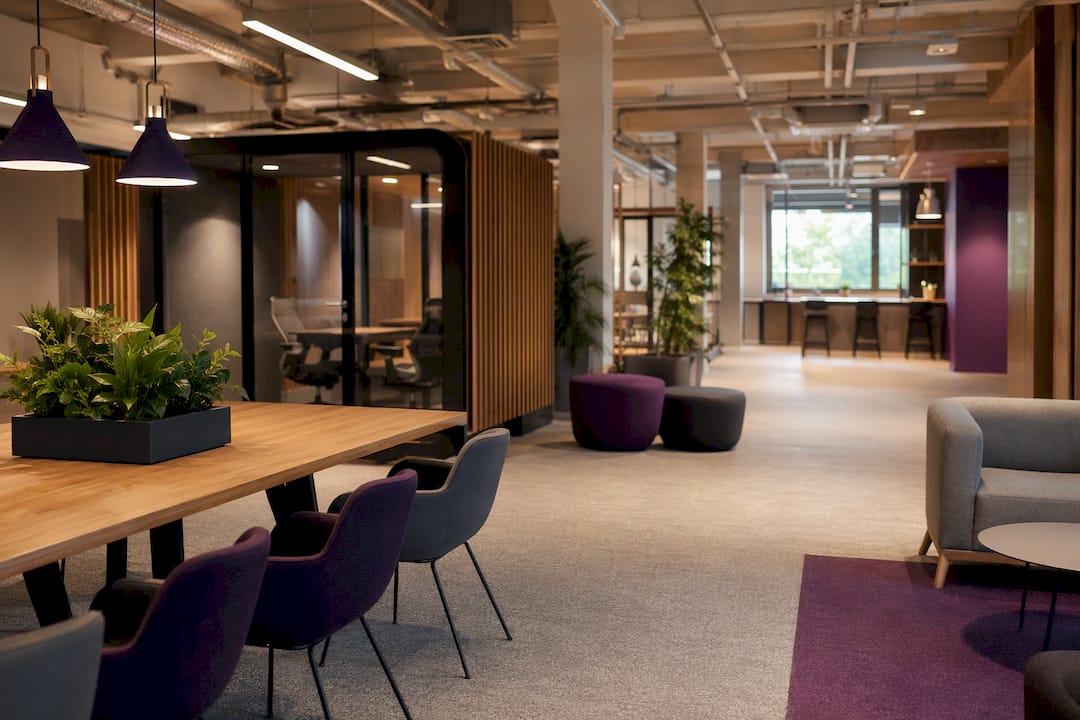
Activity-based zoning solves this better than fixed desk ratios ever will. Instead of assigning every employee a desk, you design zones for what people are actually doing: focus pods for solo work, acoustically separated huddle rooms for calls, open collaboration tables for workshops, and a social zone that doesn’t double as a thoroughfare. Practitioner guidance on hybrid office design consistently finds that pairing activity zones with clear wayfinding and a booking system beats fixed desk allocation for day-to-day employee experience, largely because it matches the space to the task rather than forcing the task to fit whatever desk someone happened to grab.
Before you commit to a layout, pilot it. Run four to eight weeks of utilisation data on your current space, then test proposed changes in a smaller zone before rolling out floor-wide. This single step prevents the most expensive mistake in hybrid design: overbuilding for a peak day that only happens twice a week, or underbuilding collaboration space because nobody measured how often teams actually huddle.
| Attendance pattern | Design implication |
|---|---|
| Peak days (Tue to Thu) | Size collaboration and meeting zones for near-full capacity |
| Low days (Mon, Fri) | Reduce fixed desk count, expand quiet/focus zones |
| Cross-team workshops | Reservable, reconfigurable spaces with moveable furniture |
| Solo deep work | Acoustic booths or quiet zones, not open-plan overflow |
Storage is the operational fix everyone forgets, and it’s usually the reason a redesigned office feels worse than the one it replaced. When desks aren’t assigned, staff still need somewhere secure to keep a laptop bag, documents or personal items between visits. A shared, bookable smart locker system solves this without reverting to fixed desks, and retrofitting existing cabinets with Bluetooth smart locks is often cheaper and faster than buying new furniture. Pair that with an integrated booking system for desks and rooms, and clear physical wayfinding so staff aren’t wandering the floor on their first visit back.

Pro Tip: Before you approve a new floor plan, walk it as if you’re a staff member visiting for the first time in three months. If you can’t find a locker, a bookable desk or the toilets without asking someone, neither can they.
For teams building this out, activity-based working principles and practical collaborative space design approaches both give a starting framework for matching zones to actual work patterns rather than guesswork.
What tech stack actually makes hybrid reliable?
Space planning and policy mean nothing if staff can’t find a desk, book a room or see who else is in that day. The technology layer is what turns a hybrid policy from an intention into something that functions daily.
At minimum, you need four systems working together, not four separate logins staff have to check.
- Desk and room booking, integrated with calendars so people can see availability without opening a second app.
- Visitor management, particularly if client-facing teams work hybrid and need to coordinate meeting attendance in advance.
- Occupancy sensors, to validate booking data against actual usage rather than relying on booking logs alone.
- Calendar visibility across teams, so managers and colleagues can see attendance patterns without a separate spreadsheet.
Workplace technology guidance from Eptura treats integrated booking and analytics as the backbone of hybrid operations, and that’s a fair description: without real-time visibility into who’s where, every other decision in this article is a guess dressed up as a plan.
Meeting equity deserves its own standard, not an afterthought. If half your team is remote on any given call, the default should be camera-on for everyone including in-room participants, one screen per remote attendee rather than a single shared laptop camera, and a facilitator who actively checks in with remote voices rather than letting the loudest person in the room dominate. Stanford’s research on hybrid arrangements points to deliberate meeting norms as one of the clearest levers for preserving collaboration quality once a workforce splits across locations.
On the data side, combine booking logs with occupancy sensor data and periodic headcount checks. Booking logs alone overstate attendance because people book and don’t show up, a pattern known as ghost booking, and sensor data alone misses context like which meetings were actually productive. Keep the privacy bar sensible: track aggregate zone usage, not individual movement, and be explicit with staff about what’s measured and why.
Who decides the roster? Building policy and governance that holds up
A hybrid workplace strategy needs a governance layer or it collapses into whichever manager shouts loudest about their team’s preferences. Get the policy skeleton right and the rest becomes much easier to enforce fairly.
- Define scope — which roles are covered, which are exempt (client-facing, safety-critical, contractual), and why.
- Set office expectations — minimum days or anchor days, and whether that’s organisation-wide or team-negotiated.
- Assign scheduling authority — does the team vote, does the manager decide, or is it dictated top-down? Say so explicitly.
- Cover equipment and expenses — who owns the home office setup, what the business supplies, and what’s the employee’s responsibility.
- Set communication norms — response time expectations, which channels for what, and core collaboration hours across time zones if relevant.
The policy document is only step one. Managers are the ones who translate a company-wide policy into workable team rules, and most of them have never been trained to do it. Give managers a short playbook: how to run a fair rostering conversation, how to handle a request that breaks the team’s usual pattern, and how to spot early signs that someone’s struggling with isolation or overload on remote days. Untrained managers default to either rigid enforcement or total permissiveness, and both create resentment over time.
Consultation isn’t a nice-to-have here, it’s risk management. Guidance from Australia’s mentally healthy workplaces framework is direct on this point: clear parameters combined with genuine worker consultation reduce psychosocial risk and improve how fair the arrangement feels, compared with a policy dropped on staff with no input. Separate practitioner research backs this up, finding that teams who set their own schedules within a broader framework report significantly higher perceived fairness than teams working under a schedule imposed purely from above.
Pro Tip: Run a 15-minute consultation session with each team before finalising their anchor days. It costs almost nothing and it’s the single cheapest way to buy goodwill for a policy people will otherwise feel was done to them.
How do you roll out a hybrid workplace strategy without a backlash?
Announcing a fully formed policy on a Monday and expecting compliance by Friday is how you generate a resignation wave. A staged rollout with a genuine pilot phase gives you room to fix problems before they become entrenched habits.
- Design the pilot. Pick one or two representative teams or floors, run it for six to eight weeks, and set the success criteria before you start, not after you see the results.
- Form a governance forum. Include HR, a facilities or workplace lead, one or two frontline managers and at least one non-management employee representative. This group owns decisions during the pilot and reviews the data at the end.
- Map your stakeholders early. Identify who’s affected (all staff), who’s impacted operationally (facilities, IT, security) and who needs to sign off (finance, executive sponsor) before you communicate anything publicly.
- Build a communication plan with feedback loops built in, not just a one-way announcement. Short pulse surveys at two weeks and six weeks tell you far more than an all-hands Q&A session.
- Set iteration triggers in advance. Decide now what result would mean you tweak the model, what result would mean you scale it, and what result would mean you scrap it and try something else.
The teams that get this right treat the pilot as genuinely provisional, not as a formality on the way to a decision leadership already made. If the data says the pilot isn’t working, change it before rolling out company-wide, not after.
Measuring what matters and improving on the fly
A hybrid workplace strategy isn’t a one-off project, it’s a system you tune continuously against real data. Four metrics matter more than the rest: space utilisation against booked capacity, employee engagement scores segmented by attendance pattern, meeting effectiveness (did remote attendees participate, not just attend), and retention among remote-capable staff specifically.
None of these metrics tell the full story alone. Detailed guidance on hybrid measurement recommends triangulating booking logs, sensor data and periodic survey input together, because booking logs overstate real attendance through ghost bookings, sensors miss the why behind the numbers, and surveys alone miss the behavioural gap between what people say and what they do.
Set decision rules before the data arrives, not after. If meeting-effectiveness scores from remote participants sit well below in-room scores for two review cycles running, that’s your trigger to retrain facilitators or overhaul your meeting-room tech, not to quietly ignore the gap.
Niche Projects evidence and practical examples
Nicheprojects builds hybrid workplace strategies the way this article describes: goals first, then a floor plan and delivery program that matches those goals, not the other way around. Our approach combines workplace strategy consulting with direct construction management, so the design intent survives the build rather than getting diluted somewhere between the concept deck and the tender process.
- Space planning grounded in actual utilisation patterns, not assumed occupancy.
- Fit-out and construction delivered by the same team that designed the strategy, closing the usual gap between architect and builder.
- Practical operational fixes, including retrofitted shared storage solutions, worked into the design brief from day one rather than bolted on after complaints start.
A hybrid office redesign that ignores shared storage almost always underperforms on day-to-day experience, even when the desks and meeting rooms are exactly right. It’s the detail that gets missed most often, and it’s cheap to fix if you plan for it early.
Why employee engagement and inclusion make or break the plan
A hybrid workplace strategy can hit every utilisation target on the spreadsheet and still fail if staff feel disconnected from the culture. Engagement in a hybrid setting isn’t the same problem as engagement in a fully co-located office, and treating it the same way is a common and costly mistake.
The core risk is a two-tier culture, where staff who show up more often get more visibility, more informal mentoring and, eventually, more promotions, while equally capable remote-leaning staff quietly fall behind. Left unmanaged, this erodes trust fast and shows up in exit interviews long before it shows up in a survey score.
Build inclusion into the operating rhythm rather than treating it as a one-off wellbeing initiative. That means rotating who chairs meetings so remote voices get airtime, making sure promotion criteria explicitly exclude “face time” as a factor, and giving new starters a structured in-person onboarding period regardless of their eventual attendance pattern. Social connection matters too, and it needs to be designed rather than left to chance, because spontaneous hallway bonding doesn’t happen when half the team is only in twice a week.
Design choices reinforce or undermine this. A well-zoned social space that invites people to linger does more for culture than a mandated in-office day ever will. Consider how office design can support socialisation directly, rather than assuming attendance alone will rebuild the connections that eroded during remote years.
Training managers to lead a hybrid team, not just a hybrid roster
Most manager training was built for a workforce that showed up in the same room every day. That training doesn’t transfer cleanly to a hybrid team, and promoting good in-person managers into hybrid leadership without new skills is a common source of friction.
Hybrid management requires a different set of habits. Managers need to run meetings that work equally well for the person in the room and the person on the screen, set clear expectations for response times and availability rather than assuming everyone’s watching the same Slack channel, and learn to judge output rather than presence, because “I saw them working” stops being a viable performance signal once half the week is remote.
Training should cover practical scenarios, not abstract principles: how to handle a team member who never comes in on the agreed anchor day, how to spot disengagement in someone you rarely see face to face, and how to run a fair one-on-one when you can’t read body language through a laptop camera. Most organisations skip this training entirely and hope managers figure it out, which is roughly how you end up with inconsistent, informal rules that vary team to team and erode trust in the policy overall.
Give managers a short reference playbook alongside any formal training session, something they can pull up mid-conversation rather than trying to recall from a workshop six months ago. That single resource does more for consistency than another all-day training day most managers will forget by Friday.
Health and safety considerations you can’t skip in a hybrid model
Workplace health and safety obligations don’t pause when someone works from home two days a week. Employers generally retain a duty of care for the physical setup and safety of a remote workspace, which means a hybrid workplace strategy needs a home-office safety component, not just an office design brief.
At minimum, provide staff with a basic home workstation self-assessment checklist covering chair support, monitor height, lighting and trip hazards. Some organisations extend this further, offering a stipend for ergonomic equipment or requiring a photo-based desk check before approving remote days for new starters. Whatever the standard, write it down and apply it consistently rather than leaving it to informal manager discretion.
Psychosocial risk deserves equal weight alongside physical safety, and it’s the one leaders most often overlook. Isolation, blurred work hours and ambiguity about expectations all sit squarely inside work health and safety obligations in most jurisdictions, not just “nice to have” wellbeing extras. Clear rostering, defined communication norms and manager training (covered earlier) are direct mitigations here, not separate initiatives.
On the office side, hybrid attendance patterns change the calculus for things like fire wardens, first aid officers and emergency evacuation coverage, since headcount on any given day now varies significantly. Build a roster-aware safety plan rather than assuming the same coverage that worked for full-time attendance still applies.
Legal and compliance issues to get right early
Hybrid work touches several compliance areas at once, and the biggest legal risk isn’t any single rule, it’s inconsistency across teams that makes the same policy mean different things depending on who manages you.
Labour law obligations, including working hours, overtime and workers’ compensation coverage, typically extend to time worked from home just as they do in the office. Data privacy is the area most commonly under managed: if staff access company systems from home networks and personal devices, your policy needs explicit rules on what device standards apply, what data can be stored locally, and how access is revoked when someone leaves. Weak device policy here is one of the most common gaps auditors flag.
Award and contract terms matter too. Some employment agreements specify a place of work, and hybrid arrangements may require a formal variation or an updated remote work policy referenced in the contract itself, rather than an informal team-level agreement that has no legal standing if a dispute arises later. Get this reviewed by whoever handles your employment law obligations before rolling out a company-wide policy, not after a dispute forces the question.
Consistency is the practical fix for most of this. A written policy applied the same way across every team, with documented consultation and a clear appeals process for exceptions, is far easier to defend than an informal patchwork of manager-by-manager arrangements that nobody wrote down.
Supporting wellbeing and mental health in a hybrid setting
Isolation is the wellbeing risk that hybrid work introduces most consistently, even among staff who report loving the flexibility. Fewer casual conversations, less visible support from colleagues, and a harder line between “at work” and “at home” all combine to make burnout easier to miss until it’s already serious.
Build check-ins into the operating rhythm rather than relying on staff to self-report when they’re struggling, because most won’t until it’s already a problem. Regular one-on-ones that ask about workload and connection, not just deliverables, catch issues earlier than an annual engagement survey ever will. Make mental health resources genuinely visible and easy to access from home, not just posted on an office noticeboard nobody working remotely that week will ever see.
Design has a role here too. A mental-health-conscious office layout that gives people quiet, low-stimulation spaces alongside collaboration zones supports the days people are in, while clear home-day boundaries (defined hours, no expectation of after-hours response) protect the days they’re not. For a deeper resource on this specific challenge, wellbeing guidance for hybrid teams covers practical approaches worth folding into your manager training.
Neurodivergent staff often benefit disproportionately from hybrid flexibility, since it lets them choose the environment that suits their sensory and focus needs on a given day. Building neuro inclusive design principles into your office, rather than treating flexibility as the only accommodation, gives those staff a genuine choice rather than a binary between an unsuitable office and permanent isolation at home.
Technology security and access control across two environments
Every hybrid workplace strategy expands your attack surface the moment staff start working from home networks and personal devices. Two locations, two sets of security assumptions, and a policy gap between them is exactly where breaches happen.
Device standards need to be explicit and enforced, not aspirational. Decide whether staff use company-issued devices only, or whether personal devices are permitted under a bring-your-own-device policy with mandatory security software, and apply that rule consistently rather than letting exceptions accumulate informally. Multi-factor authentication should be non-negotiable for any remote access to company systems, given how much more exposed a home network typically is compared with a managed office network.
Physical access control matters just as much in a hybrid office as digital access control does remotely. With attendance patterns varying day to day, badge and visitor systems need to reflect who’s actually expected in the building on a given day, not a static list that never gets updated. A booking system that ties into access control, so only people who’ve booked a desk that day can badge in, closes a gap that a lot of hybrid offices leave wide open.
Data handling policy should specify what can be accessed, stored or printed outside the office, particularly for client-sensitive or regulated information. Coordinate this closely with whoever owns your compliance obligations covered earlier. HR platforms with built in compliance workflows, like tools designed for HR teams, can help keep device and access records current as staff move between roles, locations and attendance patterns.
Get a hybrid workplace strategy built by people who deliver the fit-out too
Most workplace strategy advice stops at the recommendations deck, leaving you to find an architect, then a separate builder, then a project manager to keep them talking to each other. Nicheprojects runs strategy, design and construction management under one roof, so the goals-led plan this article describes doesn’t get diluted somewhere between the consultant’s report and the tradesperson on site. That matters most in the details this article covers repeatedly: activity-based zoning that actually gets built as specified, storage solutions that get installed rather than deferred, and a space that matches the utilisation data instead of a generic template.
If you’re commissioning a hybrid workplace redesign, corporate office or creative agency fit-out, explore how office design can lift productivity in practice, or start with a free office space plan to see how your current floor plate measures up against your hybrid attendance patterns before committing to a full redesign.
Frequently asked questions
What is a hybrid workplace strategy, in one sentence?
It’s a goals-led plan combining policy, office design and technology that lets staff split time between remote and in-office work while hitting defined business and people outcomes.
How many days should hybrid employees be in the office?
There’s no universal number, but Gallup’s 2025 data puts the average hybrid attendance at around 2.3 days per week, and your ideal number should follow role type and collaboration needs, not a copied competitor policy.
Who should decide hybrid schedules, managers or leadership?
A framework set by leadership with schedule details negotiated at the team level tends to produce the fairest outcomes, since team-led scheduling improves perceived fairness compared with a schedule imposed top-down with no consultation.
How do we measure whether our hybrid strategy is working?
Track space utilisation against booked capacity, engagement scores segmented by attendance pattern, meeting effectiveness for remote participants and retention among remote-capable staff, and combine booking, sensor and survey data rather than relying on any single source.
Do we need to redesign our office for hybrid work?
Usually yes, at least partially. An office built for full daily occupancy wastes space most days and gets overwhelmed on peak days, so activity-based zoning tested through a short utilisation pilot almost always outperforms a fixed-desk layout carried over from pre-hybrid days.
Sources
- Indicator: hybrid work — Gallup
- Principle 1: Establish clear parameters for hybrid work — Mentally Healthy Workplaces