

A NABERS Indoor Environment rating is an independent, government-backed assessment of air quality, lighting, thermal comfort and acoustics inside an office building, scored 1 to 6 stars from 12 months of real operational data. For Australian facility and building managers, it’s the clearest way to prove your building performs, not just looks good on paper. A strong rating helps attract tenants, supports staff wellbeing, and feeds directly into WELL certification.
TL;DR:
- Buildings with high NABERS Indoor Environment ratings typically maintain coordinated HVAC, lighting, and acoustic measures, supported by ongoing management and regular assessor relationships.
- Tenants and owners increasingly demand current ratings during leasing and sale processes, making timely reassessments essential for market competitiveness.
- Proper preparation involves proactive HVAC maintenance, early installation of monitoring tools, and documentation of operational and maintenance practices starting six months before assessment.
- NABERS IE measures four core areas—air quality, lighting, thermal comfort, and acoustics—using instrumented data collected continuously over 12 months to ensure accurate scoring.
Table of Contents
- What does NABERS Indoor Environment actually measure?
- Which NABERS IE rating type applies to your building?
- How does the NABERS IE assessment process work?
- What changed in NABERS IE Rules V3.0?
- How do you prepare a building for NABERS IE assessment?
- Does a higher NABERS IE rating actually pay off?
- What mistakes undermine a NABERS IE rating over time?
- How should you communicate your rating to tenants and stakeholders?
- How does NABERS IE compare with WELL and Fitwel?
- Which buildings have achieved strong NABERS IE ratings?
- Does a NABERS IE rating affect market value and lease rates?
- What technology is used to gather NABERS IE data?
- Useful NABERS resources
- Sources
- FAQ
What does NABERS Indoor Environment actually measure?
A NABERS Indoor Environment rating covers four performance areas, each with its own testing regime and pass thresholds:
- Air quality: assessors sample CO2 and PM10 over defined windows, checking ventilation rates and pollutant control against ongoing filtration and outdoor air intake.
- Lighting: illuminance readings at desk height, daylighting contribution and glare are all checked against occupant comfort benchmarks.
- Thermal comfort: temperature, relative humidity and air movement get logged, alongside how consistently your building management system holds its setpoints.
- Acoustics: background noise levels and speech privacy are tested using standard procedures, often at multiple points across a floor.
Each area contributes to the final star rating, so a building can’t coast on good lighting while its air handling underperforms. Weak ventilation control, for instance, drags the score down even if every other category is excellent. If your HVAC and lighting systems were designed together, understanding how office design and air-conditioning interact makes these four categories far less abstract.
Which NABERS IE rating type applies to your building?
Three rating types exist, and picking the wrong one wastes time and money on the wrong evidence.
- Base building: covers common areas and central plant. Building owners typically lead this, since it reflects systems they control.
- Tenancy: covers a specific tenant’s floor or suite, including fit-out elements like partitions and localised lighting. Tenants usually commission this one, often during or after a fit-out.
- Whole building: combines base building and tenancy scope, suited to owner-occupiers or buildings with a single tenant controlling everything from plant to furniture.
In multi-tenant towers where control is split between landlord and occupier, base building and tenancy assessments often run side by side, with the NABERS Accredited Assessor coordinating evidence collection across both scopes so nothing gets double counted or missed.
How does the NABERS IE assessment process work?
Every rating must be carried out by a NABERS Accredited Assessor, and the process follows a fairly predictable sequence.
- Appoint your assessor and agree scope. Confirm whether you need base building, tenancy or whole building coverage before any data collection starts.
- Collect 12 months of operational data. This includes ongoing readings plus short-term sampling for CO2, PM10 and acoustics at specific intervals.
- Site inspection and evidence submission. The assessor takes instrumented readings on site and compiles evidence against the current NABERS rules.
- Analysis and rating issuance. The assessor calculates your star rating, which stays valid for 12 months before you need to reassess.
Scheduling matters more than most managers expect. Sampling windows for acoustics and air quality often need specific occupancy conditions, so booking your assessor around a quiet holiday period can throw off results. Cost is driven mainly by building size, number of tenancies, and how much historical data you already have on hand. Buildings with poor maintenance records tend to face longer lead times, simply because assessors need more site visits to fill evidence gaps.
What changed in NABERS IE Rules V3.0?
The NABERS Indoor Environment for Offices Rules V3.0, published in September 2025, tightened several things that catch out buildings still working from older templates.
- Clarified Level 2 evidence requirements, meaning assessors need more detailed documentation to support higher-tier claims.
- Revised sampling windows for CO2, PM10 and acoustics, which change how long and when data needs collecting.
- Assessors must work to the current rules, so confirm your assessor is up to date with V3.0 before signing off on scope.
A building that scheduled acoustic testing under the old windows might now need an extra sampling round to meet the revised evidence standard, which can add weeks to a project timeline if nobody checks the rules first.
How do you prepare a building for NABERS IE assessment?
Preparation works best as a staged process, starting well before your assessor walks in the door.
- Three to twelve months out: get HVAC in order. Filter changes, commissioning checks and airflow balancing fix the most common causes of a weak air quality score.
- Set up monitoring early. Install CO2 loggers, plan your PM10 sampling points and run illuminance checks across representative desks, not just the boardroom.
- Review tenancy fit-out plans. Material selections, acoustic treatments and lighting commissioning should align with NABERS expectations before construction, not after. Sustainable material choices covered in guidance on green office fit-outs often double up as IE-friendly decisions.
- Gather your paper trail. Occupancy logs, maintenance and cleaning schedules, and control setpoint histories all count as evidence.
- Sort quick wins from capital projects. Filter changes and setpoint tuning cost little and pay off fast; full HVAC replacement is a longer capital conversation.
Pro Tip: Start your CO2 and PM10 logging at least six months before your assessment date. Assessors can only use data collected under compliant conditions, and retrofitting a monitoring gap after the fact is far more expensive than running it from day one.
Does a higher NABERS IE rating actually pay off?
Better indoor environmental quality is consistently linked to occupant performance, and a standardised NABERS IE measure gives building owners a way to prove that link rather than assert it.
- Leasing appeal: tenants increasingly ask for IE ratings during due diligence, particularly larger corporate tenants with their own ESG targets.
- Staff wellbeing and retention: air quality and thermal comfort are the two factors occupants notice fastest when something’s wrong.
- WELL certification input: NABERS IE ratings can feed directly into WELL certification, recertification and annual monitoring, saving duplicated assessment work.
A NABERS IE rating gives landlords and tenants a shared language for indoor environment quality, turning a subjective complaint (“it’s stuffy in here”) into a measurable, comparable figure both parties can act on.
When pitching capex for HVAC upgrades or acoustic treatment, framing the spend against leasing risk and staff retention tends to land better with finance teams than framing it purely as compliance cost.
What mistakes undermine a NABERS IE rating over time?
The single biggest mistake is treating the rating as a one-off certificate rather than an annual cycle. Ratings expire after 12 months, and buildings that don’t reassess lose the ability to demonstrate current performance to prospective tenants.
- Tenant fit-outs that fight the base building. A tenant installing extra partitions or sealed offices can wreck airflow patterns the base building was tuned for.
- No contract clauses protecting base performance. Lease agreements should specify that tenant works can’t degrade ventilation, lighting or acoustic outcomes without landlord sign-off.
- Maintenance drift. Cleaning standards and filter schedules slip once the certificate is on the wall, and performance quietly declines.
Pro Tip: Feed your NABERS IE results into your asset management plan, not just your marketing folder. Treat every future fit-out brief as an opportunity to protect or improve the score, rather than something to negotiate around it.
How should you communicate your rating to tenants and stakeholders?
A rating only creates value if people know about it and understand what it obliges them to maintain.
- Include the rating in leasing packs and ESG disclosures, with a plain-language note on what each star band means for occupant comfort.
- Use rating conditions to set tenant maintenance obligations, especially around HVAC access, cleaning standards and acoustic treatments in fit-out guides.
- Schedule re-tests after major changes. Post-fit-out works, plant replacement or a significant occupancy shift are all triggers for reassessment, on top of the standard annual cycle.
Building owners who skip this step often find their rating gathering dust in a compliance file rather than doing any work in lease negotiations.
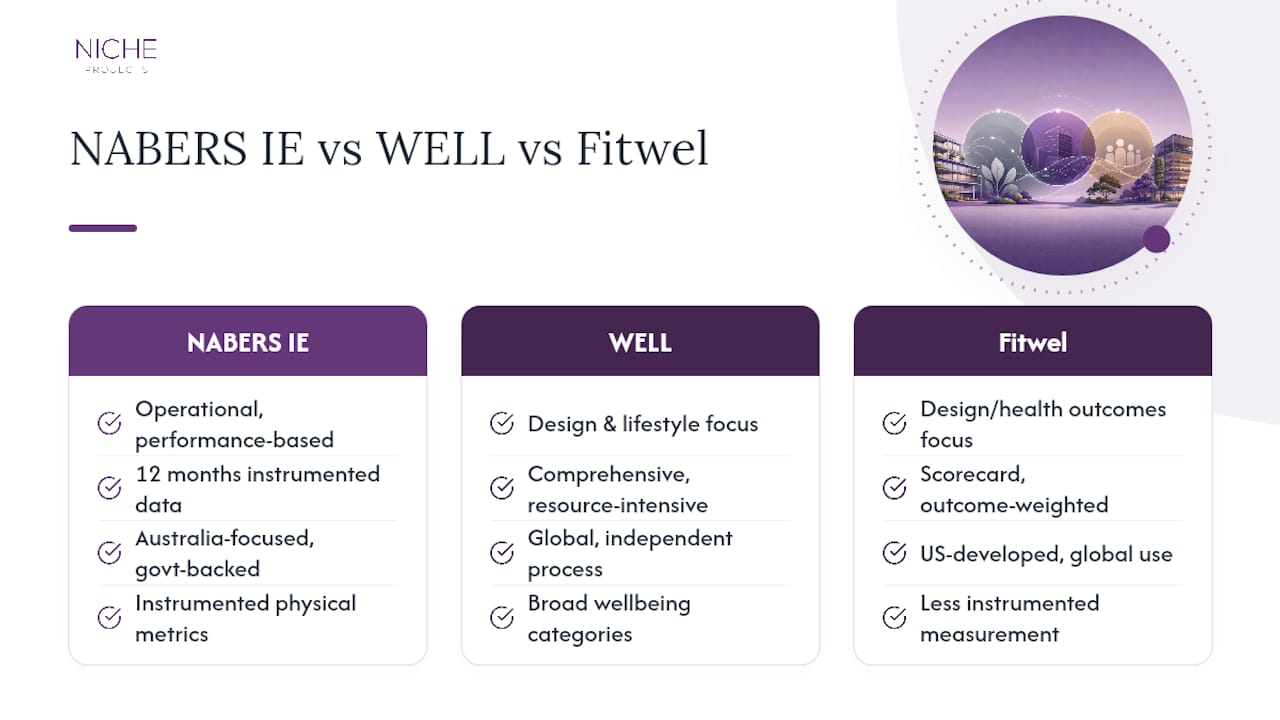
How does NABERS IE compare with WELL and Fitwel?
NABERS IE, the WELL Building Standard from the International WELL Building Institute, and Fitwel all assess indoor environment quality, but they sit at different points in a building’s lifecycle and answer slightly different questions.
NABERS IE is an operational, performance-based rating. It measures what’s actually happening in your building over 12 months of real occupancy, using instrumented data rather than design intent. That makes it Australia’s most directly comparable, government-backed benchmark for existing office buildings.
WELL takes a broader lifestyle and design view, covering categories well beyond the four NABERS IE measures, including nutrition, mental health programs and community. It’s more comprehensive but also more resource-intensive to pursue, and its certification process runs independently of Australian government oversight. As noted earlier, NABERS IE data can be used as an input into WELL certification, which is where the two systems intersect most usefully for Australian buildings chasing both credentials.
Fitwel, developed in the United States, uses a scorecard approach weighted toward health outcomes and community impact, with less emphasis on the instrumented physical measurements NABERS IE requires.
For an Australian office building, NABERS IE remains the most locally relevant starting point precisely because it’s built around Australian conditions, an Australian assessor network, and evidence standards set by the Property Council of Australia’s own market. Buildings chasing broader wellbeing credentials tend to layer WELL or Fitwel on top of a NABERS IE baseline, rather than choosing one over the other.
Which buildings have achieved strong NABERS IE ratings?
Buildings that consistently score toward the top of the 1 to 6 star scale share a few common traits, according to the patterns NABERS itself highlights across the office sector: coordinated HVAC commissioning, documented cleaning regimes, and lease clauses that protect base building performance during tenant fit-outs.
Premium-grade CBD towers with centrally managed plant and long-term facility management contracts tend to outperform buildings where mechanical services and cleaning are handled by disconnected suppliers with no shared reporting line. The difference usually isn’t the quality of the original building design. It’s whether someone is actively managing setpoints, filter changes and occupant feedback week to week, rather than only checking in when the rating is due for renewal.
Buildings that treat their NABERS IE Accredited Assessor relationship as ongoing, rather than a once-every-few-years transaction, also tend to catch small performance slips before they show up in a lower star band. That’s a management practice any building can adopt, regardless of age or original design specification.
Does a NABERS IE rating affect market value and lease rates?
A NABERS IE rating doesn’t set a lease rate on its own, but it increasingly influences what corporate tenants are willing to pay and how quickly space leases up. Larger tenants with internal ESG commitments now routinely ask for indoor environment performance data during due diligence, alongside energy ratings.
Buildings unable to produce that evidence risk being passed over for competitors that can, particularly in markets like Sydney CBD where tenant choice is high and sustainability credentials feature heavily in tender requirements. A documented, current rating also signals to prospective buyers that a building has been actively managed rather than left to depreciate quietly, which matters at sale time even though NABERS IE itself isn’t a valuation metric.
The Property Council of Australia has flagged environmental performance credentials as an increasingly standard part of institutional-grade lease negotiations, meaning buildings without a current rating start those conversations from a weaker position. For owners weighing whether to fund IE improvements, the more useful question usually isn’t “what’s the return on this specific upgrade” but “what’s the cost of being excluded from tenant shortlists that require this evidence.”
What technology is used to gather NABERS IE data?
Modern IE assessments lean on a mix of continuous monitoring and short-term instrumented sampling, and the technology choices matter for both accuracy and cost.
CO2 and PM10 data typically comes from networked sensors placed at representative points across a floor, logging continuously rather than relying on spot checks. Illuminance and glare readings use calibrated light meters taken at desk height under varied daylight conditions, since a single midday reading won’t capture how a space performs at 8am or on an overcast day. Thermal comfort monitoring tracks temperature, humidity and air movement against building management system setpoint logs, which is why a poorly commissioned BMS can undermine an otherwise decent physical fit-out.
Acoustic testing uses calibrated sound level meters following standard test procedures for background noise and speech privacy, often across multiple points on the same floor to catch inconsistency between open-plan zones and enclosed offices. Buildings investing in acoustic treatment as part of a fit-out should coordinate that work with acoustic design principles early, since retrofitting sound treatment after a rating has already flagged a problem costs considerably more than designing it in from the start.
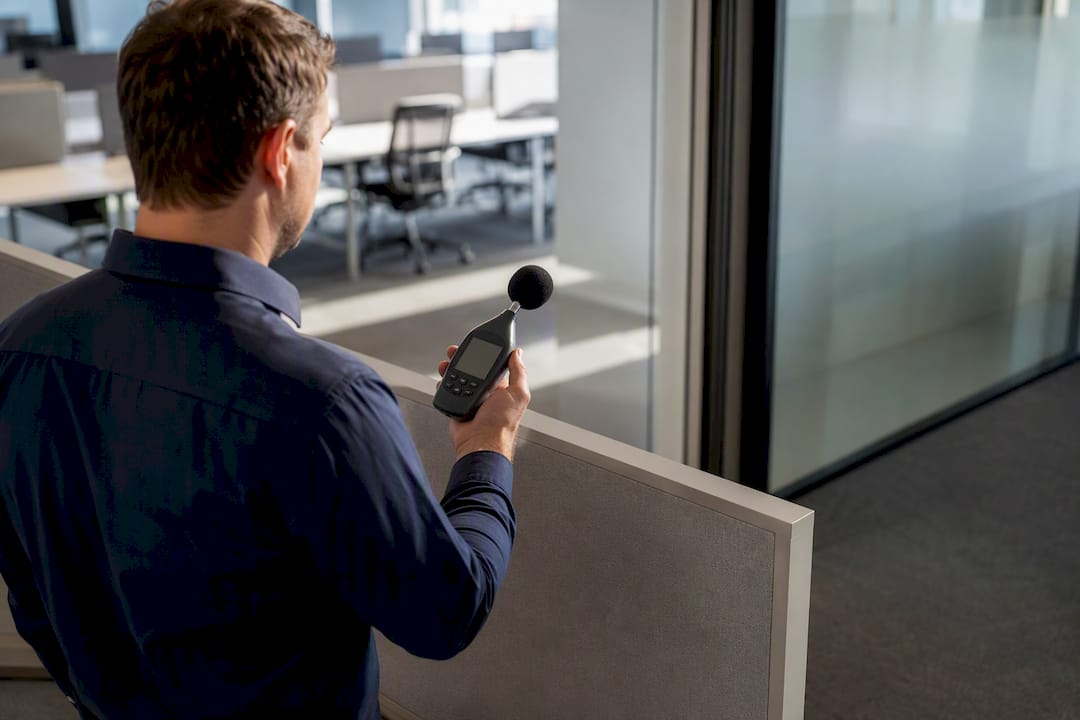
The common thread across all four categories is that data quality depends on consistent, well-placed instrumentation over the full 12-month window, not a single flying visit from an assessor with a clipboard.
Getting a building ready for any of this, from HVAC commissioning through to fit-out material choices, is work that some workplace strategy and office fit-out providers handle for Sydney office owners. If you’re planning a refurbishment or fit-out with a NABERS IE target in mind, Nicheprojects’ workplace strategy team can help align design decisions with assessment requirements before construction starts, when changes are cheapest to make. For projects already underway, the Sydney office fit-out and refurbishment service covers the construction management side, while ongoing facility maintenance support helps protect a rating once it’s achieved.
Useful NABERS resources
Start with the NABERS Indoor Environment overview and the Offices Rules V3.0 document, plus office buildings guidance and fact sheets for practical templates.
FAQ
Is NABERS mandatory in Australia?
NABERS Indoor Environment ratings aren’t legally mandatory for most office buildings, but many corporate tenants and government leases now require or strongly prefer them during due diligence.
What is the National Australian Built Environment Rating System (NABERS)?
NABERS is Australia’s government-backed system for rating the environmental performance of buildings, covering energy, water, waste and, through the Indoor Environment rating, air quality, lighting, thermal comfort and acoustics.
What does a 6-star NABERS rating signify?
A top-tier NABERS Indoor Environment rating represents market-leading operational performance across air quality, lighting, thermal comfort and acoustics, based on a full 12 months of measured data.
What is a NABERS assessment?
A NABERS assessment is the process a NABERS Accredited Assessor follows to collect 12 months of operational data, conduct site inspections and instrumented sampling, then issue a 1 to 6 star rating valid for the following 12 months.