

For most Australian office fit outs you need contract works (builders’ risk) cover plus public liability, and designers on the project often need professional indemnity as well. Who actually buys each policy depends on the construction contract, the landlord’s requirements and any lender conditions, and state statutory schemes rarely apply to commercial work at all.
TL;DR:
- Contract works insurance covers physical damage to the construction site until practical completion, with limits that depend on the full project value.
- Public liability covers third-party injuries and property damage caused by the works, often required of all contractors and subcontractors.
- Professional indemnity protects designers and consultants against claims from errors in drawings or advice, not physical damage, and is typically arranged separately.
- Insurance responsibilities vary depending on the contract, landlord requirements, lender conditions, and project structure, with no single law mandating coverage for all fit outs.
- Proper coordination of policies during handover is essential to avoid gaps, requiring clear communication of the end of contract works cover and the start of existing property insurance.
Table of Contents
- What contract works, public liability and professional indemnity actually cover
- Who has to arrange cover, and is it compulsory?
- Policy features to check and exclusions that catch people out
- Handover risk: where contract works meets your existing property cover
- A checklist for briefing a broker or insurer
- What insurers expect when something goes wrong
- A practical coordination checklist for fit out projects
- How Niche Projects helps you coordinate insurance through a fit out
- Sources
- FAQ
What contract works, public liability and professional indemnity actually cover
Each policy answers a different question, and mixing them up is where most fit out disputes start.
Contract works insurance, sometimes called builders’ risk, covers physical damage to the works themselves while construction is under way: a fire that destroys partly finished partitions, a storm that floods a half built kitchen, theft of fittings from site overnight. Sample policy wordings such as those published by VMIA define Contract Works, Plant and Equipment and Existing Property separately, and indemnity only applies up to the Limits of Liability and conditions set out in the Schedule.
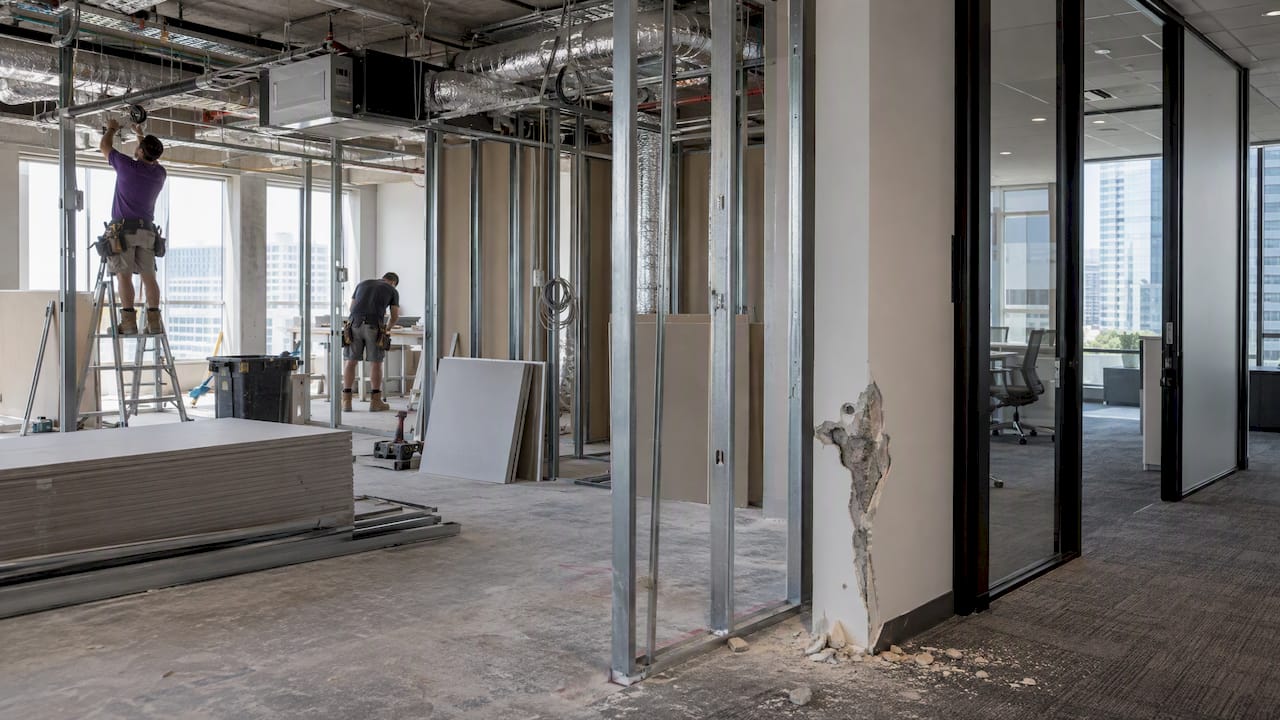
Public liability sits alongside it and covers third party injury or property damage caused by the works, such as a visitor tripping on exposed cabling or a contractor’s ladder damaging a neighbouring tenancy.
Professional indemnity is different again: it protects designers, architects and specifiers against claims arising from errors in drawings, specifications or advice, not physical damage.
Business interruption and contents cover usually sit with the building owner or occupying business rather than the fit out contractor.
- Contract works: typically arranged by the builder or head contractor for the construction period.
- Public liability: usually required of every contractor and subcontractor on site.
- Professional indemnity: carried by designers, architects and consultants, not by the builder.
- Business interruption: arranged by the tenant or landlord, separate from the construction contract.
Who has to arrange cover, and is it compulsory?
There’s no blanket Australian law forcing every commercial fit out to carry contract works insurance. Responsibility is allocated contractually, and the party expected to arrange it varies from job to job.
- The construction contract usually names who must hold contract works cover, often the head contractor, sometimes the principal.
- Landlords frequently impose their own insurance conditions in the lease before allowing any fit out works to begin.
- Lenders financing a project can require evidence of specific covers and limits before releasing funds.
- Check the contract first: as Webber Insurance notes, whether contract works cover is required depends on the construction contract, the principal or developer, lender conditions and the project structure, not a single national rule.
It’s also worth separating statutory schemes from commercial insurance entirely. The Home Building Compensation Fund exists as a residential last resort scheme, and the Insurance Council of Australia has specifically warned against confusing it with commercial contract works or professional liability cover. An office fit out, even a small one, sits outside that scheme altogether.
Policy features to check and exclusions that catch people out
A policy schedule is where the real cover sits, and the headline product name tells you almost nothing. Check the sum insured against the full contract value, not just the fit out budget, and look closely at sub-limits for categories like plant, temporary works and professional fees, since these are often capped well below the main limit. Excesses and the basis of settlement (reinstatement versus indemnity value) change what you actually recover after a loss.
Exclusions are where most arguments happen. Faulty workmanship, latent defects and pre-existing damage are commonly excluded or heavily restricted, and performance testing or commissioning periods often carry separate treatment. Sample annual wordings from VMIA set out a defined Performance Testing Period, and loss during that window can be excluded unless it’s expressly brought back into cover.
- Natural perils: flood and earthquake sometimes need separate confirmation rather than assumption.
- Temporary works: scaffolding, hoarding and site sheds should be named in the schedule, not assumed included.
- Occupied buildings: working around staff or tenants usually needs a specific endorsement.
Insurers routinely limit cover using operational definitions rather than plain English. Sample policy wordings show how terms like Contract Works and Plant and Equipment are defined precisely, and a mismatch between that wording and your actual contract scope is a common source of unpaid claims.
Handover risk: where contract works meets your existing property cover
The construction period and the defects liability period are not the same thing, and mixing them up is one of the most common causes of a coverage gap. Contract works cover generally runs through to practical completion, while the defects liability period that follows is about rectifying defects under the contract, not insuring against new damage.
This is exactly where fit outs involving an existing, occupied building need care. Coordination between the project’s contract works policy and the building owner’s existing commercial property insurance matters most at the point of handover, and industry guidance points to this transition as a frequent gap.
- Confirm in writing when contract works cover ends and when property insurance picks up.
- Add the landlord or tenant as a named or interested party where the contract requires it.
- Get written insurer agreement before any work proceeds in an occupied space.
Pro Tip: Ask your broker to put the handover date, not just the completion date, in writing across both policies before works start.
A checklist for briefing a broker or insurer
Getting a quick, accurate quote comes down to giving the insurer the same information they’d ask for on day one.
- Project scope and location, including whether the building is occupied during works.
- Total contract value and the maximum value of any single subcontract.
- Subcontractor list with trades and expected site dates.
- Permit and development approval status, since some insurers won’t bind cover until approvals are confirmed.
- Estimated annual turnover, needed for annual or master contract works policies rather than single project ones.
- Required endorsements, such as occupied building or testing and commissioning extensions.
- Policy period and excess tolerance matched to the construction programme.
An annual master policy suits businesses running several fit outs a year, while a standalone project policy fits a single, defined job. Under-declaring turnover or contract value on an annual policy can mean pro rata reductions at claim time, so accuracy matters more than speed. For help pulling this scope together before you brief a broker, see guidance on assessing your needs before an office fit out.
What insurers expect when something goes wrong
Notify the insurer as soon as damage happens, before anyone starts repairs. Acting too early can void cover if the insurer later argues the repair wasn’t authorised.
- Keep a scope of works, dated progress photos and supplier invoices from day one.
- Collect subcontractor details, licences and any relevant permits or approvals.
- Avoid unauthorised repairs, since recent submissions on the General Insurance Code of Practice highlight ongoing concerns about repairers completing legally compliant work and insurers’ own claims obligations.
- Check the loss date falls inside the policy period, not after practical completion.
A practical coordination checklist for fit out projects
Confirm development approvals before any trade starts on site, and collect certificates of currency from every contractor, including specialist electrical fitouts, before they begin work, not after. See Commercial Electrician Sydney | High Demand Electrical for expertise on electrical fit‑out work and compliance.
- Add the landlord, financier or tenant as a nominated or additional insured where the contract or lease requires it.
- Align policy start and end dates to staged handovers rather than one blanket completion date.
- Keep photographic progress logs, commissioning reports and supplier warranties together as the job proceeds.
- Make supplying these records a condition of each subcontract, not an afterthought at claim time.
Pro Tip: Build insurance evidence collection into your project schedule the same way you’d schedule a trade, as a task with a deadline, not a box to tick at the end.
How Niche Projects helps you coordinate insurance through a fit out
Coordinating contract works, public liability and professional indemnity across a live project takes the same discipline as managing trades and approvals. Niche Projects handles contract administration, approvals management and handover documentation as part of delivering a Sydney office fitout, so the paperwork insurers ask for is already in hand.
- Approvals and permit status tracked from day one, which insurers often ask for before binding cover.
- Supplier warranties and commissioning records kept together for claims or handover.
- Staged handover dates aligned with contract milestones to avoid coverage gaps.
Get in touch to talk through insurance coordination for an upcoming fit out, alongside the design and construction work itself.
This article is general information, not a substitute for advice from a qualified financial advisor. Consult a qualified financial professional about your own circumstances before acting on anything here.
Sources
- Is Contract Works Insurance a legal requirement?
- ICA submission — Home Building Compensation Fund review
- VMIA Construction Risks – Material Damage and Liability annual policy wording (Nov 2024 – Oct 2025)
FAQ
What is the cheapest professional indemnity insurance in Australia?
There’s no single published figure for the cheapest professional indemnity policy, since premiums depend on the designer’s or consultant’s claims history, turnover and scope of work. A broker comparing several insurers against your specific project is the most reliable way to find a competitive price.
What are the Big 4 insurers in Australia?
This isn’t a defined category in Australian insurance regulation, and commercial construction cover is written by a range of specialist and general insurers rather than a fixed group of four. Your broker can advise which insurers actively write contract works and liability cover for office fit outs.
What insurance do you need to hire out machinery?
Hired plant and equipment used on a fit out generally needs cover under the contract works policy or a separate plant and equipment extension, alongside public liability for injury or damage the machinery causes. Sample policy wordings from VMIA define Plant and Equipment separately from Contract Works, so check which category your hired items fall under.
Is there insurance for faulty workmanship?
Standard contract works policies commonly exclude or restrict faulty workmanship and latent defects rather than cover them outright. Rectification of poor workmanship is usually a contractual matter handled through the defects liability period, not a straightforward insurance claim.