
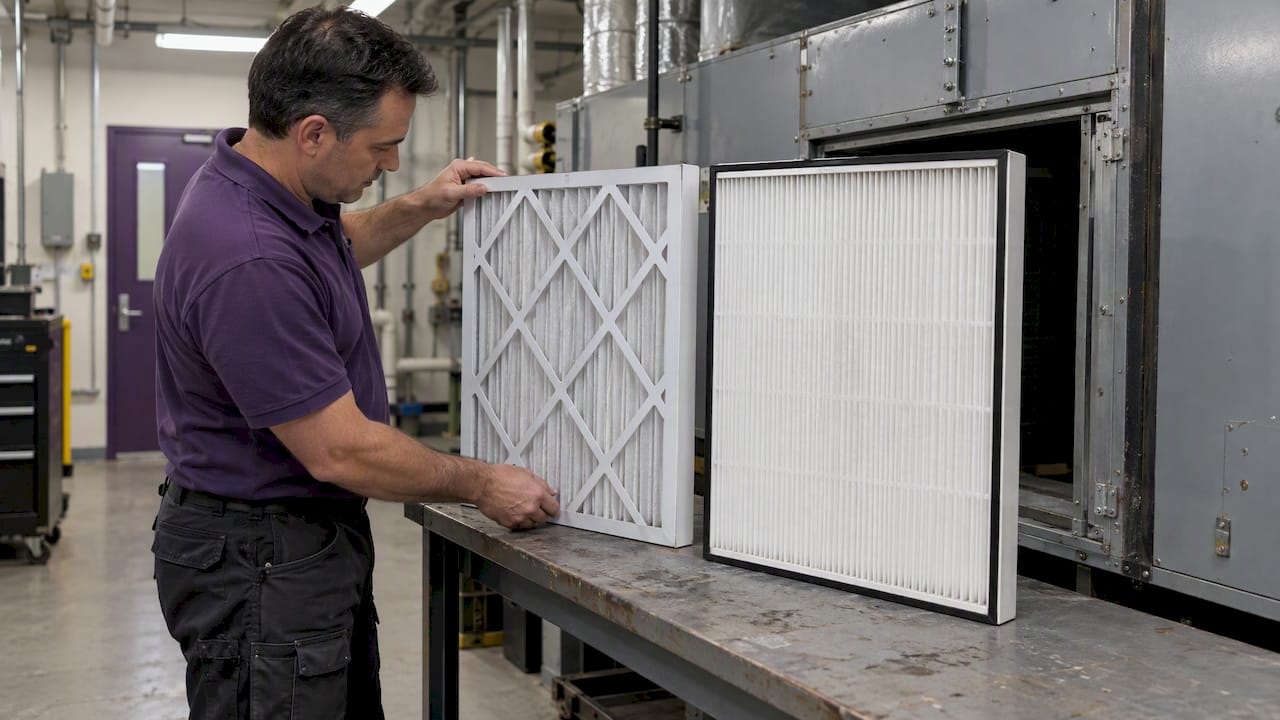
For most Australian offices, MERV 13 is the right filter for the central air-conditioning system, and HEPA belongs in stand-alone portable units placed where people gather. HEPA captures more, but it pushes back harder on the air. A building’s fans are designed for a certain resistance, and a filter that exceeds it can leave you with less ventilation, more noise and a higher power bill.
This guide explains what the two ratings measure, how they compare on the numbers that matter, and how to decide for your floor. It is written for office managers, business owners and HR leads who have to sign off on an air-quality decision, often in the middle of a refurbishment or fit-out.
TL;DR
- MERV 13 captures at least 85% of particles in the 1 to 3 µm range. HEPA, by definition, captures 99.97% of particles at 0.3 µm.
- HEPA filters create far more resistance than MERV 13, so fitting one to an ordinary office air handler can cut airflow or force fan and duct upgrades.
- MERV 13 is the usual benchmark for commercial HVAC. Portable HEPA units are the practical choice for meeting rooms, reception areas or high-density hot spots.
- Check your air handler’s capacity with a qualified mechanical or ventilation engineer before you change any filter grade.
- Filters are one part of the answer. Ventilation rates, maintenance and zoning matter just as much.
Table of Contents
- What the two ratings actually measure
- MERV 13 vs HEPA at a glance
- Why more efficient is not always better
- What about MERV 14, 15 and 16?
- The Australian context
- Where HEPA does make sense in an office
- A practical decision path
- Common mistakes
- Why this belongs in your fit-out brief
- FAQ
- Sources
What the two ratings actually measure
The two names sound like points on one scale, but they come from different places.
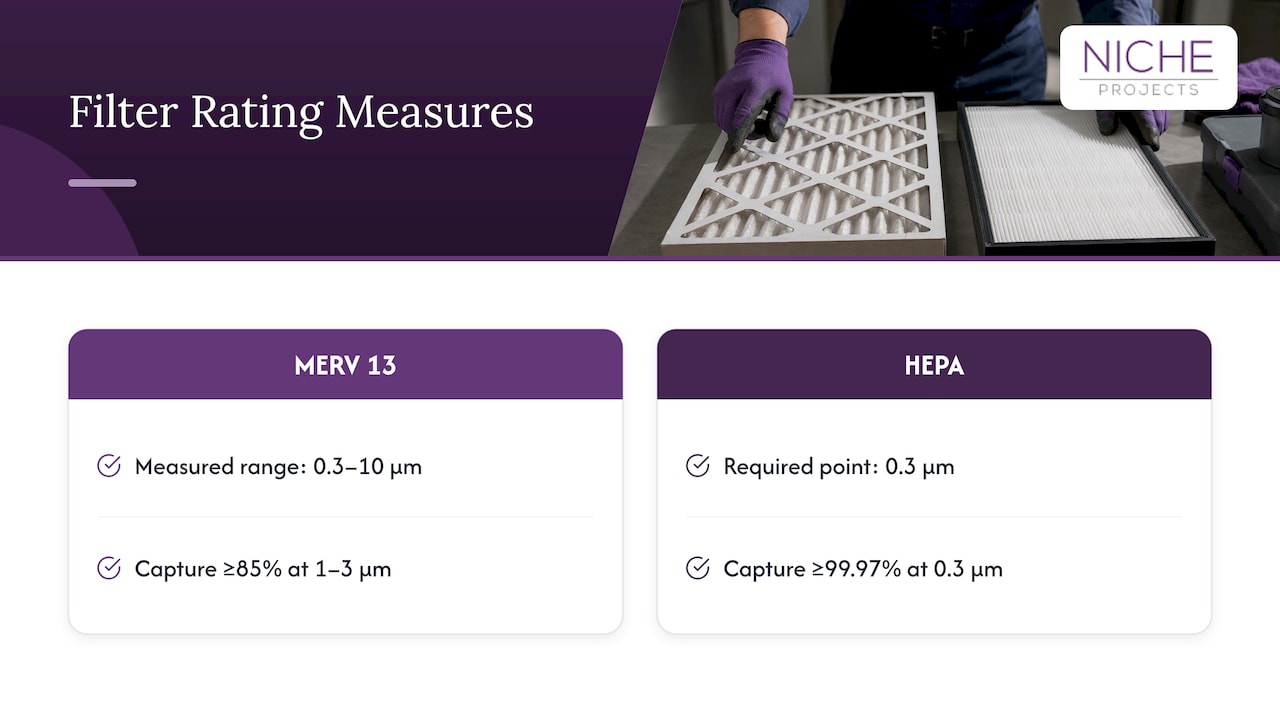
MERV stands for Minimum Efficiency Reporting Value. According to the US EPA, it reports a filter’s ability to capture particles between 0.3 and 10 µm, which makes it useful for comparing one filter against another. Higher numbers mean finer capture. A MERV 13 filter is designed to trap at least 85% of particles in the 1 to 3 µm range, which covers a lot of the fine dust, smoke and respiratory droplets that circulate indoors.
HEPA stands for High-Efficiency Particulate Air. It is a performance definition rather than a rating on a ladder. The standard used by the US Department of Energy requires a HEPA filter to remove at least 99.97% of airborne particles at 0.3 µm. That size is chosen because it is among the hardest for a filter to catch. HEPA filters typically use a pleated fibreglass core, which is dense by design.
You will sometimes read that HEPA is “the same as MERV 17 to 20”. Treat that as a rough guide only. MERV tests and HEPA tests are different procedures, so the comparison is approximate. The useful point is that HEPA sits above the top of the usual MERV range in efficiency, and well above it in resistance.
MERV 13 vs HEPA at a glance
| Factor | MERV 13 | HEPA |
|---|---|---|
| Test basis | Capture across particle size bands (0.3 to 10 µm range reported) | At least 99.97% of 0.3 µm particles |
| Fine-particle capture | At least 85% of 1 to 3 µm particles | Highest available in common building use |
| Typical resistance | About 0.1 to 0.3 inches WC | About 0.5 to 1.5 inches WC |
| Fit in standard central HVAC | Usually compatible, subject to the unit | Often not without fan or duct changes |
| Typical office role | Central system filter | Portable units in high-risk or high-density spots |
| Running cost | Lower | Higher, through fan energy and filter replacement |
The resistance figures come from a HEPA-in-HVAC technical review. Your own equipment will differ, so read them as ranges, not promises.
Why more efficient is not always better
It is tempting to assume the highest-efficiency filter is the safest choice. In a building, that assumption can backfire.
Every filter resists airflow. Dense media catches smaller particles, and it also makes the supply fan work harder. ASHRAE’s filtration guidance says the ultimate choice needs to suit the capability of the system, and that is the heart of the matter. Its current recommendation for HVAC systems is a MERV 13 filter, with MERV 14 or better preferred where the system can handle it.
What goes wrong when a filter is too restrictive:
- Reduced airflow. Less air reaches the floor, so you may be cleaning the air better per pass but delivering less of it.
- Higher energy use. Fans compensate for the resistance and draw more power.
- Noise. Strained systems and bypass leakage around the filter frame can be louder.
- Premature failure. Motors and belts work outside their design range.
- Bypass. Air takes the easy route around a filter that does not seal, so the rating on the box is not what the room gets.
HEPA is the extreme case. Fitting it to a standard air handler often needs expensive fan upgrades, duct reinforcement or a severe cut in airflow. That is why HEPA lives in hospital theatres and cleanrooms, which are designed around it from the start, rather than in typical open-plan offices.
The lesson is to match the filter to the machine. A MERV 13 filter that fits and seals properly will usually serve your people better than a HEPA filter that starves the system.
What about MERV 14, 15 and 16?
This is the other question readers ask: is it worth stepping up from MERV 13 to MERV 16?
MERV 14 to 16 filters capture finer particles again, and they also increase pressure drop. Whether your system can take that depends on the blower, the filter bank size and the duct design. In some buildings, a MERV 14 filter in a deeper or larger-area frame performs comfortably. In others, even MERV 13 is a stretch.
A sensible way to think about it:
- Start from the system, not the rating. Ask what static pressure capacity your air handler has to spare.
- Consider filter area. A larger filter face, or a deeper pleated filter, lowers resistance for a given grade.
- Test before committing. An engineer can measure pressure drop across the existing filters and predict the effect of a change.
- Step up only if the data supports it. MERV 16 makes sense for a particular risk profile and a system with headroom. It is not a default.
For most offices, MERV 13 is the point where filtration performance, energy use and airflow balance out.
The Australian context
A few points matter specifically for workplaces here.
Standards. Mechanical ventilation in Australian buildings is designed to AS 1668.2, which sets ventilation rates with health and amenity in mind. The standard has been revised since the 2012 edition, and filtration references in newer editions follow different rating systems. Ask your engineer which edition your building was designed to and what it requires for recirculated air. MERV 13 is commonly used as a benchmark in commercial buildings, but it is not a substitute for compliance with the standard that governs your system.
Health and safety duties. Under work health and safety laws, an employer has a duty to manage risks to workers’ health. Air quality belongs in that risk assessment. A formal assessment looks at the whole system: ventilation rates, maintenance, seal integrity and whether air recirculates between zones. A filter swap on its own does not discharge that duty. Our guide for office managers on proving ventilation standards compliance covers how to document this.
Healthcare is a different case. The national safety and quality body’s guidance on ventilation is written for healthcare settings. It notes that HEPA or high-MERV filters in central systems may help, but that is aimed at clinical environments. A consulting office or a creative agency has different needs, and the guidance should not be read as a recommendation to install HEPA across an ordinary floor.
Building ratings. If you manage a building working toward a NABERS rating, indoor air quality is part of the picture. See our steps for NABERS Indoor Environment.
Where HEPA does make sense in an office
HEPA is not the wrong tool. It is the wrong tool for the central system. Used as a portable unit, it gives you high-efficiency cleaning exactly where you want it, with no change to the building’s mechanical plant.
Good candidates:
- Meeting rooms that are small, full and used for long sessions.
- Reception and waiting areas with constant foot traffic.
- Health and wellbeing rooms, first aid rooms or any space where a vulnerable person may spend time.
- Dense collaboration zones such as project rooms and hot-desk pockets.
- Areas next to renovation work, where dust is temporarily high.
Placing stand-alone, portable HEPA units close to where people congregate delivers localised cleaning without modifying central systems. Size the unit to the room volume, check that its stated clean air delivery suits the space, and keep it away from walls and furniture that block the intake.
Portable units do add noise, a power point and a filter replacement schedule. Think about where they sit during the design stage and not after the carpet is down.
A practical decision path
Use this order of questions when you are choosing for a floor or a whole tenancy.
- What does the current system allow? Get the air handler’s specifications and the existing filter grade. If the filter frames are standard, MERV 13 may simply drop in, but confirm the fan can manage the added resistance.
- Is the system recirculating? If air moves between zones, filtration of the return air matters more.
- Who is in the space? A standard office population has different needs from a space with vulnerable occupants or very high density.
- Is there a risk assessment? Document it, with an engineer’s input.
- Can you improve ventilation first? Increasing outdoor air and improving distribution to dilute contaminants often delivers more than a filter upgrade, and engineering guidance points to ventilation rates and airflow distribution as the priorities.
- Add portable HEPA only where it is needed. Treat it as a targeted layer.
- Schedule maintenance. A clean MERV 13 filter changed on time beats a neglected premium one.
CDC and NIOSH guidance says to upgrade central HVAC filter efficiency to MERV 13 or better, with the important qualifier: when this is compatible with your HVAC system. That qualifier is the whole job.
Common mistakes
Swapping to a higher grade without checking the fan. Changing the filter without assessing the blower’s static pressure capacity is a frequent error that leads to premature filter failure, noise and reduced ventilation.
Ignoring the seal. Gaps around the frame let unfiltered air through. Check gaskets and housings at every change.
Treating the filter as the whole strategy. Maintenance, coil cleaning, zoning and outdoor air supply all count.
Buying on the label alone. Rating claims vary, and some products are marketed loosely as “HEPA-type”. Look for a stated test standard and performance data.
Leaving it until after the fit-out. Filter choice, plant capacity and the layout of walls and ceilings interact. Decide early.
Why this belongs in your fit-out brief
Air quality is shaped by decisions made during design: where partitions go, how many people share a zone, where return air travels and what plant space exists for larger filter banks. Putting a filter on a system after the fact is the hardest way to address it.
If you are planning a refurbishment, the layout and the air-conditioning should be designed together. Our article on office design and air-conditioning explains how partition layouts, meeting room density and ceiling services affect comfort and air distribution. For the wider wellbeing picture, see prioritising workplace wellness in your fit-out.
On fit-out projects we coordinate design, construction management and trades, which means the questions that affect air quality get raised before walls go up. Mechanical specification and engineering sign-off remain the work of qualified mechanical or ventilation engineers, and we bring them into the project early. If you are scoping a Sydney workplace, our office fit-out and refurbishment service is the place to start, and our facility maintenance team covers ongoing building upkeep.
FAQ
Is MERV 13 good enough for an office?
For most offices, yes. ASHRAE’s current recommendation is a MERV 13 filter for HVAC systems, and the EPA notes that MERV 13 captures at least 85% of particles from 1 to 3 µm. The condition is that it suits your system and is installed with a good seal.
Can I put a HEPA filter in my office air-conditioning?
Usually not without changes. HEPA filters create much higher resistance than MERV 13, so a standard unit may lose airflow or need fan and duct upgrades. Ask a qualified mechanical or ventilation engineer to assess the system first. Portable HEPA units are the simpler route.
Is MERV 16 better than MERV 13?
It captures finer particles, but it also raises pressure drop, and your system may not cope. Whether the extra efficiency is worth it depends on the blower’s spare capacity and the risk profile of the space. An engineer’s measurement is the reliable way to decide.
What can HEPA filters not remove?
HEPA filters are built for particles, so they do not remove gases, odours or volatile organic compounds on their own. Those need ventilation or other media such as activated carbon. Check the product specification for what a unit is designed to handle.
Do portable HEPA units replace good ventilation?
No. They add local cleaning but do not bring in fresh outdoor air. Think of them as a layer on top of correct ventilation rates and a well-maintained central system.
Sources
- What is a MERV rating? (US EPA)
- Filtration and Disinfection FAQ (ASHRAE)
- HEPA Filtration in HVAC Systems: Applications and Limitations
- High Efficiency Particulate Air Filter overview (ScienceDirect Topics)
- AS 1668.2-2012 preview (Standards Australia)
- Improving Air Cleanliness (CDC NIOSH)