

A prime cost (PC) item is an allowance for something you will choose after signing, such as tapware, carpet tiles or light fittings. A provisional sum (PS) is an allowance for work that cannot be priced yet, such as demolition behind a wall or an air-conditioning upgrade. Both are placeholders, not prices, and the final cost moves up or down once the real figure is known. On an office fit-out or refurbishment, the fewer of them in your contract and the more realistic each one is, the closer your signed number is to what you will pay.
At Niche Projects we run workplace strategy, office design and construction management under one roof, so selections and site unknowns can be resolved during design rather than left as open allowances. This guide explains the difference in plain terms and shows how to read these lines before you commit.
TL;DR
- A prime cost item is a product or fitting you have not yet selected. The allowance covers the supply cost of that item.
- A provisional sum is a budget for work whose scope or cost cannot be defined at signing. It can cover labour and materials, so it can swing further.
- When the real cost differs from the allowance, the contract price is adjusted: up if it is higher, down (a credit) if it is lower. Check whether the builder adds a margin on any increase.
- The most reliable defence is a finished design and specification before pricing, so allowances shrink to a handful.
- Most official guidance in Australia is written for home building. For a commercial fit-out, your contract’s own clauses decide how allowances work, so read them closely.
Table of Contents
- The short answer: what separates the two
- Prime cost items in detail
- Provisional sums in detail
- How allowances change your final cost
- Where the rules come from, and what that means for an office project
- What to check before you sign
- Fixed price, allowances and the contract you are signing
- How to keep allowances small on an office project
- Where Niche Projects fits
- FAQ
- Sources
The short answer: what separates the two
The quickest way to separate them is to ask what is unknown.
- Prime cost item: the unknown is which product you will choose. The work of installing it is usually known and priced.
- Provisional sum: the unknown is the work itself, its extent, its method or its price.
Victoria’s consumer regulator puts it this way: a prime cost item is a fitting, such as a basin, included in the contract but not selected, or with an unknown price, at signing. A provisional sum is a reasonable estimate for work where a definite price cannot be given, such as supplying and installing air conditioning (Consumer Affairs Victoria).
The Queensland Building and Construction Commission describes prime cost items as fixtures and fittings the client selects after the contract is signed, for example kitchen and bathroom fixtures, carpet or tiles (QBCC guidance statement).
In an office, translate that into your own terms:
| Prime cost item | Provisional sum | |
|---|---|---|
| What it allows for | A product you have not chosen yet | Work that cannot be priced yet |
| Typical office examples | Pantry tapware, reception pendant lights, carpet tile, kitchen appliances, door hardware | Make-good of hidden services above the ceiling, an unknown amount of asbestos or slab remediation, upgraded air-conditioning, specialist AV or acoustic treatment |
| Source of uncertainty | Your choice | Site conditions or unfinished design |
| What the number usually covers | Supply of the item | Supply and labour for the whole task |
| Typical risk | Choosing a nicer finish than the allowance | A scope that turns out larger than assumed |
The examples in the office column are our illustration of how the principle applies to commercial space. The definitions beside them come from the regulators cited in this article.
Prime cost items in detail
RMIT’s BuildRight learning resource describes a prime cost sum as the cost of an item that has not been selected, or whose price was unknown when the contract was entered into. The builder must make a reasonable allowance based generally on their past experience and the client’s budget, and the amount can change until the client decides exactly what they want (RMIT BuildRight, prime cost sum).
The same resource gives a simple picture of the adjustment. If the chosen item costs less than the allowance, the builder pays the client the difference. If it costs more, the client pays the difference plus a profit margin as stated in the contract. Its example is a toilet, which can range from $100 to $1,200, so the allowance needs to reflect the grade you actually expect.
What a PC allowance does not tell you
A PC line has two numbers hiding in it: the allowance and the quality it is meant to buy. A $1,000 allowance for an oven and cooktop sounds fine until you want a commercial-grade unit for a staff kitchen. QBCC’s own example runs the same way: a contractor allows $20 per metre for tiles, the consumer picks $30 per metre tiles, and the consumer pays the increase (QBCC).
The fix is cheap. Ask for each PC item to be tied to a described standard (brand range, finish, size) so you can see what the number buys. Then make the selection early.
Provisional sums in detail
RMIT’s resource explains that a provisional sum is an estimate of the cost of particular work, including the materials it needs. It is used when, after all reasonable enquiries, the builder cannot give a definite amount at signing. Its example is earthworks, where what lies underground is unknown (RMIT BuildRight, provisional sums). The ACT Government gives a similar description: money in the contract sum for work where the extent cannot be precisely detailed, typically site costs such as unexpected rock (ACT Government).
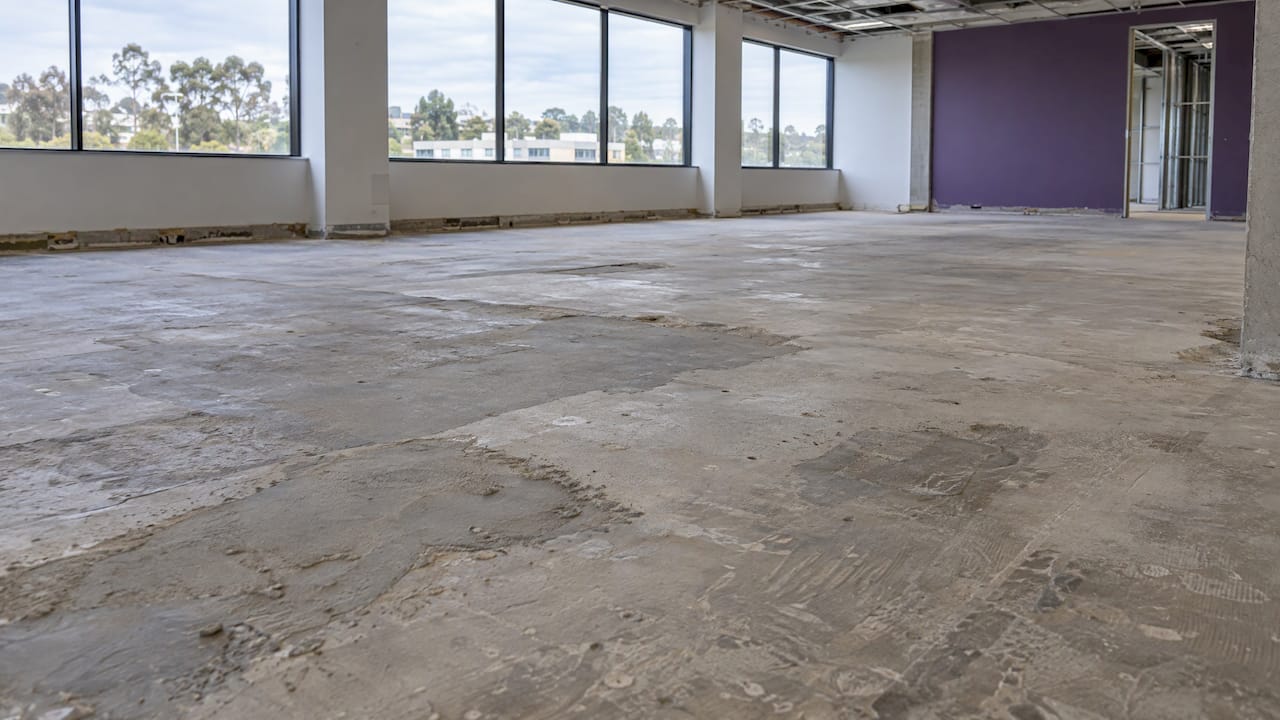
Office projects have their own versions of the buried rock. A ceiling that looks sound and is not. Services that are not where the as-built drawings say. A floor that needs levelling before new finishes go down. These are the places where a provisional sum is a fair tool, because nobody can price what they cannot see.
Why provisional sums can move further
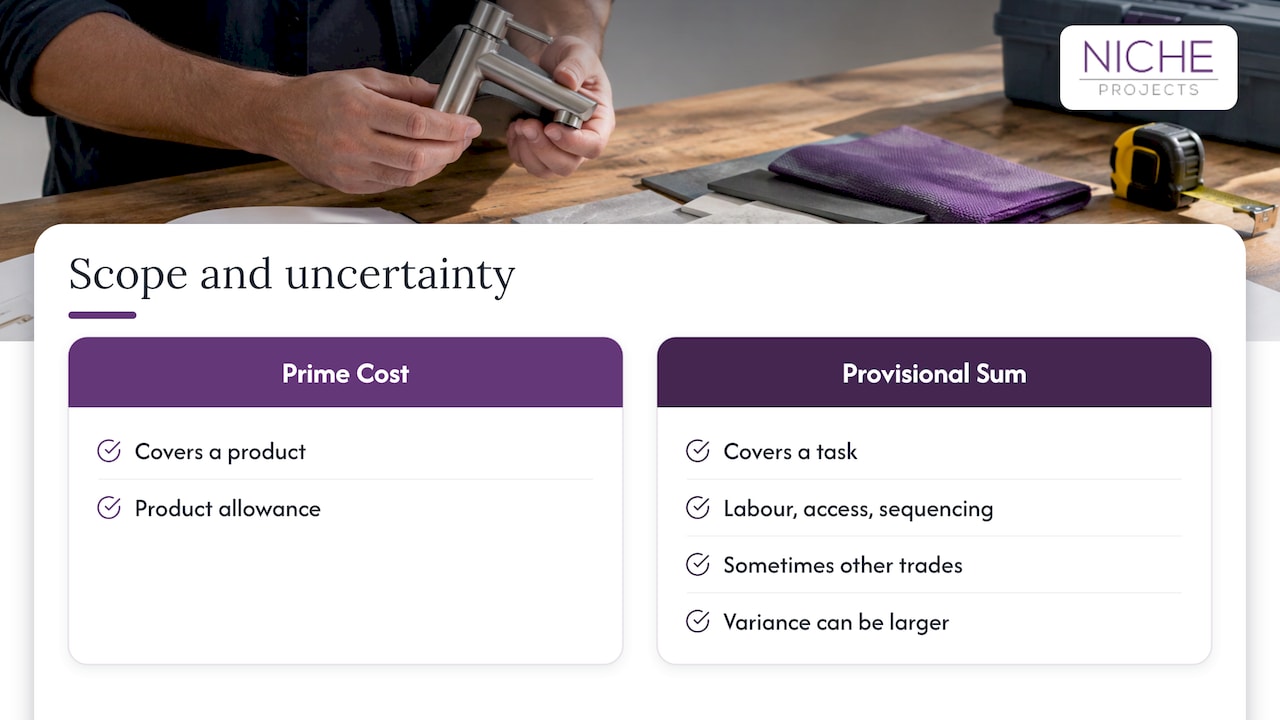
A PC item covers a product. A provisional sum covers a task. A task has labour, access, sequencing and sometimes other trades, so the variance can be larger. That is why a provisional sum deserves more scrutiny than a PC line, even when its dollar figure is smaller.
How allowances change your final cost
The mechanism is the same in principle for both. The allowance sits inside the contract price. When the real cost is known:
- Higher than the allowance: the difference is added to your price, often with a margin on top.
- Lower than the allowance: you receive a credit for the difference.
QBCC’s guidance states that when provisional sum work costs more than the estimate, the increase is an additional cost to the consumer. When it costs less, the consumer receives a credit. If a PC or PS allowance is not used up, the contractor should issue a credit for the unused amount (QBCC).
A worked example (illustrative figures)
Suppose a fit-out contract carries a $6,000 PC allowance for meeting-room pendant lights and a $15,000 provisional sum for ceiling remediation, with a 15% margin on any excess.
- You select lights costing $7,500. The excess is $1,500, plus 15% margin ($225), so your price rises by $1,725.
- Another selection comes in at $5,200. That is $800 under, so the price drops by $800.
- Once the ceiling is opened up, remediation costs $22,000. The excess is $7,000, plus 15% ($1,050), so your price rises by $8,050.
The lights moved the price by less than two thousand dollars. The ceiling moved it by eight. That asymmetry is the reason to keep provisional sums few and well researched.
In Queensland home-building contracts, HIA explains that PC and PS allowances must be a reasonable estimate based on the builder’s information at signing. If an item costs more than the allowance, the builder can claim the actual cost plus a 20% margin on the excess, where nothing else is stated (HIA, 14 April 2025). That is a residential rule, but it shows what to look for in any contract: whether margin applies only to the excess, and at what percentage.
Where the rules come from, and what that means for an office project
Most published Australian guidance on these terms comes from home-building regulators. Victoria’s Domestic Building Contracts Act, Queensland’s QBCC and the ACT’s planning directorate all describe the concepts clearly, and the definitions carry over. The protections do not automatically carry over. A commercial fit-out is typically governed by the terms of the contract you sign, so the clauses are where your protection lives.
It is still worth knowing what the regulators consider fair practice, because it is a good yardstick:
- Consumer Affairs Victoria says a home contract must include a detailed list of PC and PS items, with the estimated quantity and unit cost for each. If the builder intends to charge more than the actual cost increase, the contract must show how the extra is calculated. The builder must provide invoices or receipts for each item as soon as possible (Consumer Affairs Victoria).
- The same page notes that the client has a legal right to a reasonable estimate, and that the builder must make a reasonable allowance for the nature and location of the site.
- HIA notes that when the items and a reasonable estimate of their costs are identified in the contract, and the contract sets out how to adjust them, no variation is needed to make the adjustment (HIA help centre). In other words, allowances change the price automatically, without a separate negotiation.
That last point catches people out. A variation is a formal change to scope that you approve. An allowance adjustment is built into the contract and can happen without that approval step, so you need visibility before it occurs.
What to check before you sign
You do not need a lawyer’s vocabulary to read an allowance schedule. You need six questions.
1. How many are there, and why?
The ACT Government advises keeping the number of PC items small and selecting the rest upfront to avoid disputes and additional costs (ACT Government). Consumer Affairs Victoria goes further and says it is better to specify everything so a fixed price can be given (Consumer Affairs Victoria). A long allowance list usually means design was not finished when pricing began.
2. Is each allowance realistic for what you want?
Compare the allowance to the finish you have in mind. If your brief calls for acoustic ceiling tiles and the allowance would only buy a basic grade, the headline price is flattering and the final price will not be.
3. What does each number include?
Ask whether it covers supply only, or supply and installation, and whether delivery and waste are in. Installation of a PC item is normally in the base price, but confirm it in writing.
4. How is the adjustment calculated?
Look for the margin percentage, whether it applies to the whole cost or just the excess, and whether credits for savings come with the same margin treatment as increases.
5. Will you be told before an allowance is exceeded?
A fair contract has the builder flag a likely overrun while you can still choose a cheaper option. Without a notification step, you learn about the overrun on the invoice.
6. When do you need to decide?
PC selections have deadlines because lead times on joinery, glazing and furniture-grade fittings can hold up the program. A late selection can cost you money twice: once in the price and once in the schedule.
Fixed price, allowances and the contract you are signing
A fixed-price contract is only as fixed as its allowances. A low, headline-friendly number built on thin allowances will rise through adjustments. A slightly higher number with realistic allowances is often the cheaper one on completion day. When you compare tenders, line up the allowance schedules first and the totals second.
Some Victorian rules are also moving. According to a 2026 legal guide, amendments to the Domestic Building Contracts Act commence on 1 December 2026 at the latest, and restrict cost escalation clauses to contracts of $1 million or more, with a 5% cap on the price increase (Building.legal). These apply to Victorian domestic building contracts, not to commercial work in Sydney, but they show regulators pushing toward price certainty.
How to keep allowances small on an office project
The strongest lever is sequence. Allowances shrink when design is resolved before the project is priced.
- Settle the brief first. Headcount, work settings, meeting-room ratios and technology needs drive most selections. Our workplace strategy work is built around getting those decisions made before drawings start.
- Finish the design and specification. A named finish for every surface and fitting converts PC items into fixed items.
- Investigate the site. Inspect the ceiling void, services and floor condition before pricing. Whatever can be seen can be priced. Whatever cannot remains a provisional sum.
- Choose selections early. Decide the long-lead items first and lock them in.
- Hold a contingency separate from allowances. Allowances are expected adjustments to known items. Contingency is for surprises. Our guide to office refurbishment costs and contingency shows how to size it.
- Clarify landlord requirements. Base building works and landlord contributions can add lines that look like allowances but behave differently. Our note on landlord fit-out contributions and GST covers the checks.
Where Niche Projects fits
Our offer for Sydney businesses combines creative design with construction expertise, so the people who shape your space are in the same conversation as the people who build it. For you, that means selections and site questions are raised during design, when they are cheapest to resolve, instead of surfacing as open lines in a price. If you are planning a move or a refresh, look at our Sydney office fitout and refurbishment service or our Sydney office design service and talk to us about the allowances your project would carry.
FAQ
What is the difference between a prime cost item and a provisional sum?
A prime cost item is an allowance for a product you have not yet selected, such as a fitting or finish. A provisional sum is an allowance for work that cannot be priced at signing because its scope or cost is unknown. Prime cost items are about your choice. Provisional sums are about site conditions or unfinished design.
What does provisional sum mean in a contract?
It is an estimate of the cost of particular work, including the materials it needs, written into the contract because a definite price cannot be given yet. Victoria’s rules describe it as a reasonable estimate made after all reasonable enquiries (RMIT BuildRight). The final amount replaces the estimate once the work is carried out.
Do I get money back if the item costs less than the allowance?
Under the models described by RMIT and QBCC, yes. If the real cost is lower, the difference is credited to you and an unused allowance should be credited too. Check that your contract says so, and how the credit is applied.
Can the builder charge a margin on top of the extra cost?
Often yes, at a percentage written into the contract. In Queensland home contracts, HIA states the default is 20% on the excess where nothing else is stated (HIA). In a commercial contract, the percentage and what it applies to are whatever the document says, so read that clause.
How many allowances is too many?
There is no magic number, but the guidance points one way: keep them few and select everything else upfront (ACT Government). A short list of well-described allowances is a sign the design is resolved.
Sources
- Consumer Affairs Victoria: Changing a domestic building contract price
- QBCC: Guidance statement on prime cost and provisional sum items
- RMIT BuildRight: Prime cost sum
- RMIT BuildRight: Provisional sums
- HIA: Prime cost and provisional sums
- HIA help centre: Prime cost and provisional sum items explained
- ACT Government: Costs to consider
- Building.legal: Domestic building contract changes in Victoria