
Choose coworking if your team is small, your headcount is uncertain or you need to be working within weeks. Choose a traditional office if you need privacy, brand control, a fit-out built around how your people work, and a base you will keep for years. The right answer depends less on price than on how predictable your team is and how much control you need over your space.
This guide compares the two on cost, lease terms, privacy, culture and productivity, using Australian data. It also covers the question that follows once you have chosen: hot desking or assigned seating.
TL;DR
- Coworking suits small or fast-changing teams: month-to-month terms, bundled services and low upfront spend.
- A traditional lease suits teams of stable size that need privacy, branded space and a purpose-built layout, but it brings a multi-year commitment and a fit-out budget.
- In Sydney CBD, the median coworking desk was $485 a month and a private-office desk $879 a month in November 2026, excluding GST.
- Research on Australian offices suggests that interaction, storage, personalisation and comfort shape productivity more than whether a desk is owned.
- Many businesses land in between: a leased office designed for flexible, shared seating.
Table of Contents
- Coworking vs traditional office at a glance
- What coworking and a traditional office actually mean
- Cost: what you really pay
- Contract terms and flexibility
- Privacy, control and brand
- Culture, collaboration and productivity
- Which teams suit which option
- Hot desking vs assigned seating
- The third option: a leased office designed to flex
- How we can help
- A simple way to decide
- FAQ
- Sources
Coworking vs traditional office at a glance
| Factor | Coworking | Traditional office |
|---|---|---|
| Commitment | Month-to-month up to 6 to 12 months | Commonly 3 to 5 years |
| Upfront spend | Low, often a deposit or first month | Fit-out, furniture, IT, possible bank guarantee |
| Pricing | Per desk, per month | Per square metre, per year, plus outgoings |
| Privacy | Shared areas, lockable private rooms available | Fully private |
| Branding and layout | Limited to the operator’s design | Yours to design |
| Scalability | Add or remove desks quickly | Fixed until lease events |
| Community | Built in, with events and mixed industries | Your own people only |
The table is a starting point. The sections below explain what sits behind each row.
What coworking and a traditional office actually mean
A coworking space is a shared workplace run by an operator. You pay for access to a desk, a private room or a team suite, and the operator handles the building, cleaning, internet and meeting rooms. Australian coworking guides describe hot desks as shared first-come spaces, dedicated desks as set up for one user, and private offices as lockable rooms inside a coworking centre.
A traditional office is space you lease directly from a landlord for your business alone. You pay rent and outgoings, then fund and manage the fit-out, furniture, technology, cleaning and maintenance yourself.
Between the two sit serviced and managed offices, where you get a private suite with the operator handling services. If your team wants a private floor without a fit-out project, this middle option deserves a look. Our own view of the shift is in why flex offices are so popular.
Cost: what you really pay
The two models are quoted in different units, which makes a direct comparison easy to get wrong. Flexible offices are commonly quoted per desk per month with rent, outgoings, utilities, internet, cleaning, reception and meeting-room credits bundled, while conventional leases are quoted per square metre per year and may be gross or net.
Coworking pricing in Sydney
According to Rubberdesk’s November 2026 data, the median Sydney CBD coworking desk is $485 a month, and a private-office desk is $879 a month, with figures excluding GST. The national median for a private-office desk is $667. Treat these as benchmarks, not quotes: location, floor and building grade move prices a lot.
Flexibility has a price. Month-to-month agreements may carry a 10 to 20% premium compared with longer commitments, and longer terms can attract discounts.
Traditional lease pricing in Sydney
Rubberdesk gives a simple Sydney CBD example: 60 square metres at $1,000 per square metre per year works out to $5,000 a month in rent, before outgoings such as building management, electricity and internet, with GST added.
That is the base rent. The costs people forget sit around it:
- Fit-out. Partitions, ceilings, joinery, power, data and furniture. If you want to see how budgets are broken down in another market, a look at tenant fit-out costs shows how large this line item can be. Sydney figures depend on scope and building, so get a scoped estimate.
- Security deposit. Conventional commercial leases may require a bank guarantee of 3 to 6 months’ rent.
- Make-good. The same source notes make-good obligations at the end of the lease, meaning you return the space to the condition the lease specifies.
- Services. Cleaning, maintenance, utilities and IT are yours to fund and manage.
A quick cost test
For a team of eight in Sydney CBD, the coworking median of $485 per desk is a useful reference point for a hot-desk setup, and the private-office median of $879 per desk for a team suite. For a lease, take your required square metres, multiply by the annual rate, add outgoings and amortise the fit-out over the lease term. Compare the monthly totals, not the headline rates. Our guide to how much square meterage you need helps with the area figure.
Contract terms and flexibility
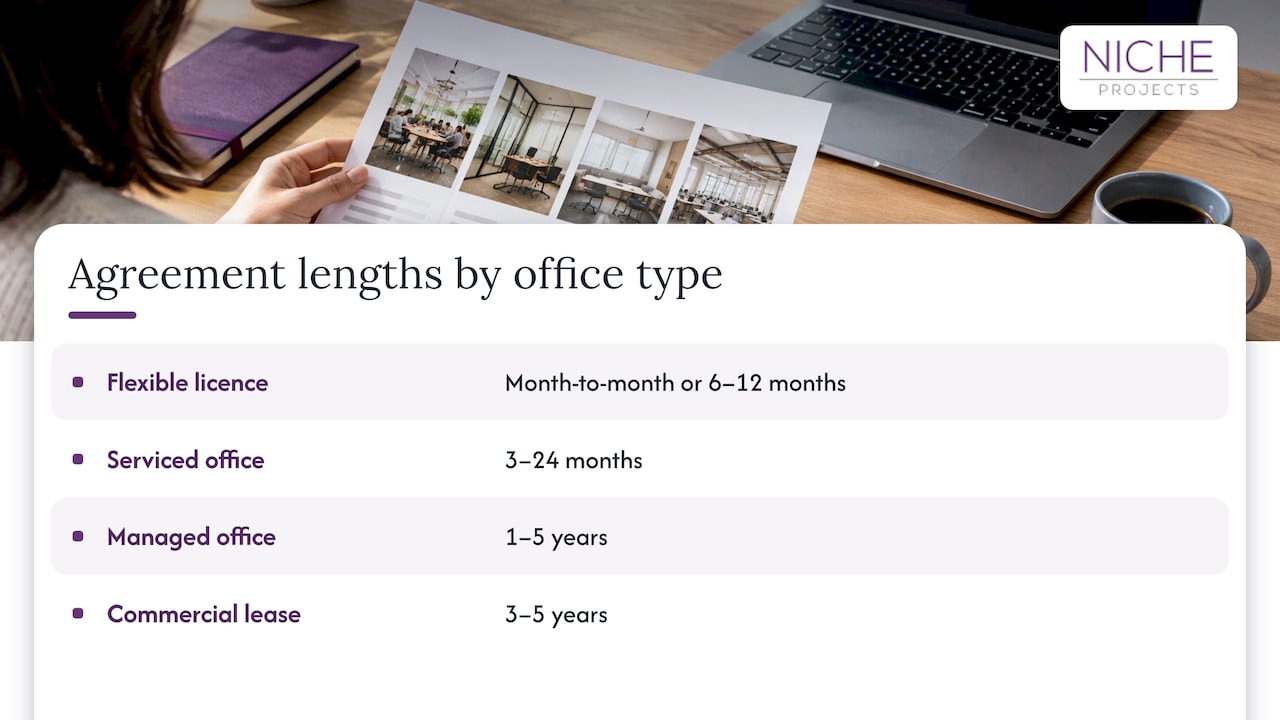
This is where the models differ most. Flexible-office licences commonly run month-to-month or for 6 to 12 months, with one month’s notice, while conventional commercial leases commonly run 3 to 5 years. Rubberdesk notes that serviced offices commonly run 3 to 24 months and managed offices 1 to 5 years.
The trade-off is simple. A multi-year lease gives you stability and the freedom to shape the space, but it reduces your ability to adapt. A short-term licence lets you scale up or down, but you give up control and may pay more per desk.
If your headcount could change by a third in the next 12 months, short terms are worth the premium. If you are confident in your team size for three years or more, a lease with a smart fit-out usually gives more for your money.
Privacy, control and brand
In a traditional office you decide who enters, what is on the walls, how the meeting rooms sound and where client files live. That matters for law, accounting, advisory, health and any business handling confidential material. Open-plan coworking areas can challenge confidentiality, although private rooms within coworking centres address part of the issue.
Control also covers the physical environment: acoustics, lighting, air-conditioning zones, ergonomics and accessibility. When you design the space, you can plan for all of these. Our guides on ergonomic office design and office design and air-conditioning show what that looks like in practice.
Brand is the last piece. A client walking into your own reception sees your business. In coworking, they see the operator’s brand with your name on a door or a screen.
Culture, collaboration and productivity
Coworking spaces are designed around community. UTS research on Australian coworking design found that layouts emphasise community, spontaneous encounters, collaboration and multipurpose spaces, commonly through open collaborative areas, events and knowledge-sharing settings. That suits freelancers, start-ups and small teams who gain from meeting people in other industries. Coverage in the Australian property press notes that networking can include people from different industries, coffee meet-ups and guest speakers, but can become a distraction if poorly managed.
A traditional office builds a different culture: one team, one identity, shared rituals. You design collaboration areas around how your people work, not around a generic mix of tenants. Look at our notes on creating better collaboration areas and collaborative space for small groups.
What the evidence says about productivity
Neither model wins on productivity by default. A few findings worth knowing:
- An Australian study on desk ownership found that spatial factors such as interaction, personalisation and storage played a bigger role in self-assessed productivity than desk ownership.
- A UNSW report on hybrid work in the Australian Public Service found that productivity did not appear to be harmed by hybrid working, while proximity bias and technology gaps remained challenges.
- A Swedish study of 15 public employees found that well-designed coworking spaces provided social interaction and community, but participants preferred home when the space lacked users or a suitable environment.
The common thread is that design quality matters more than the label on the lease. A thoughtfully planned office and a well-run coworking centre can both work. A poorly planned version of either will not.
On inclusion, an office you design yourself can address accessibility, quiet rooms, prayer or wellbeing spaces and neurodiverse needs from day one. See office design and mental health for ideas.
Which teams suit which option
There is no single rule, but patterns help.
Coworking tends to suit:
- Start-ups and small teams still finding their size, especially under about ten people.
- Consultants and independent professionals whose work is mostly focused and solo.
- Companies opening a first Sydney presence, or a satellite team close to clients.
- Project teams that need space for a defined period.
- Hybrid businesses where most staff work from home and need a place to meet occasionally.
A traditional office tends to suit:
- Teams of stable size that are in the office several days a week.
- Businesses handling confidential client information.
- Companies where brand, client hosting and culture are part of the offer, such as agencies, advisory firms and professional services.
- Teams with specialised needs such as labs, studios, server rooms or heavy equipment.
- Growing businesses that want a space they can shape and add to over time. Our page on office design for startups covers how early-stage firms approach this.
A useful self-check: if you could not describe next year’s headcount within about 20%, lean to coworking. If you can, and you need control, lean to a lease.
Hot desking vs assigned seating
Once you have a space, the next decision is how people sit in it. Hot desking means employees have no permanently assigned desk and choose an available workspace first-come or by reservation, while assigned seating gives each person a permanent workstation.
The market has moved. CBRE’s 2025 Australian occupier survey reports peak office utilisation averaging 67%, and 53% of employees in unassigned seating in 2025 compared with 30% in 2019. RLB Oceania’s February 2026 report found only 16% of desks were occupied for more than five hours a day. With hybrid attendance, a one-desk-per-person layout often leaves a lot of space idle.
| Hot desking | Assigned seating | |
|---|---|---|
| Space use | Fewer desks than staff, less idle space | One desk per person, more idle space on hybrid days |
| Best for | Hybrid teams, mobile roles | Daily attendance, roles needing set-ups |
| Personalisation | Limited, relies on lockers | High |
| Collaboration | Mixed teams, but colleagues harder to find | Easier to locate colleagues |
| Focus | Needs quiet zones | Familiar, predictable |
Hot desking can reduce unused space and support hybrid work, while assigned seating offers routine and personalisation, though hot desking can make collaboration, finding colleagues and focus harder. The Australian desk-sharing research is encouraging on this point: flexi-desk users rated 16 of 18 indoor-environment items more positively than fixed-desk users, with storage and workspace amount the exceptions.
Making hot desking work
The practical lessons from the research are consistent:
- Set clear booking rules and use desk-booking technology.
- Create team zones so colleagues sit near each other.
- Provide quiet and private spaces for focused work and calls.
- Solve storage with lockers and clean-desk rules.
- Offer ergonomic flexibility, so every desk adjusts to different people.
- Ask for feedback regularly and adjust.
These steps are drawn from Indeed Australia’s guidance for employers. Our own guides go further: how to design the perfect hot-desking office and a hot desking policy that works.
The third option: a leased office designed to flex
The choice is rarely a pure either-or. Many Sydney businesses lease a smaller traditional office and design it with coworking logic: shared desks, bookable meeting rooms, project zones, quiet booths and lockers. You keep the control and brand of a lease, with the space efficiency of flexible seating.
This is where design matters. Planning layouts around how people really work, rather than a headcount-to-desk ratio, is what makes a smaller footprint viable. Read our take on what makes an agile workspace and our hybrid workplace strategy playbook.
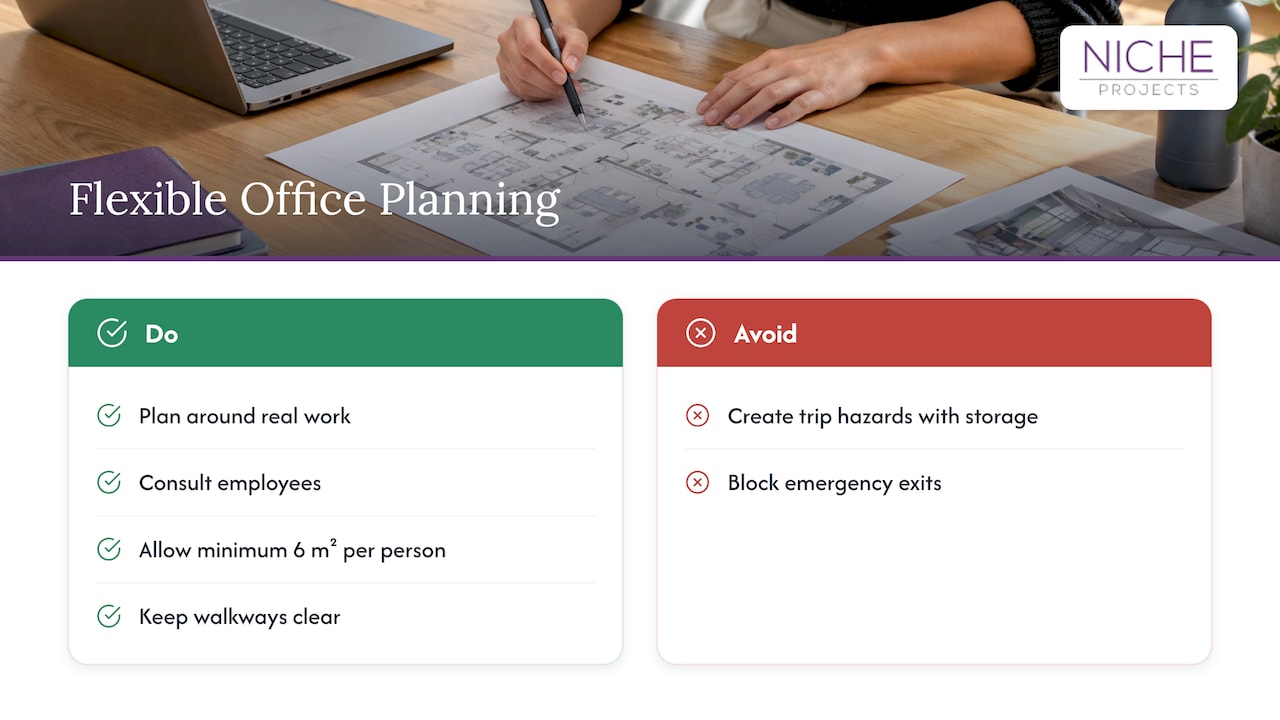
One rule applies whichever way you go. Plan with consultation and real use in mind. WorkSafe Victoria’s office layout guidance says planning should consider work tasks and employee consultation, along with movement, privacy, safety and future needs. It also suggests a minimum of 6 square metres per person for tertiary workspace and says walkways must stay clear, because storage can create trip hazards or block emergency exits. That is Victorian guidance; check the requirements for New South Wales and your building with your designer and the relevant authority.
How we can help
If you are leaning towards your own space, or you already have one that no longer fits, Niche Projects combines workplace strategy, office design and construction management in one team. We start with how your people work, then design and build the space to suit, whether that is a new Sydney office fitout, a refurbishment, or a flexible layout inside a leased floor. If you want to work through the strategy first, start with our workplace strategy service. For a coworking operator or a business building flexible space, see our page on Sydney coworking fit-outs.
A simple way to decide
Work through these five questions with your leadership team:
- How sure are you of headcount for the next three years? Unsure points to coworking; sure points to a lease.
- How confidential is your work? High confidentiality points to a private office or lease.
- How much do brand and client hosting matter? A lot points to your own space.
- How often will people attend? Two to three days a week suggests shared seating wherever you are.
- What can you fund upfront? Limited capital favours coworking or a managed suite; capital available favours a fit-out amortised over the lease.
If the answers split, shortlist one option from each side, cost them over the same three-year period and compare total monthly cost, flexibility and control side by side.
FAQ
Is coworking cheaper than a traditional office?
In the short term it usually is, because you avoid fit-out, furniture and a bank guarantee, and fees bundle services. In Sydney CBD the median coworking desk was $485 a month in November 2026, excluding GST. Over several years with a stable team, a lease can compare well once you spread the fit-out across the term, so compare on the same time frame.
Is hot desking better than assigned seating?
Neither is better in every case. Hot desking suits hybrid teams because Australian offices often have a lot of unused desk time. Assigned seating suits roles with daily attendance, specialised equipment or a need for routine. Good storage, quiet zones and clear booking rules matter more than the label.
How long is a typical commercial lease compared with coworking?
Conventional commercial leases commonly run 3 to 5 years, sometimes with a bank guarantee and make-good obligations. Flexible-office licences commonly run month-to-month or for 6 to 12 months with one month’s notice. Check the actual terms in any agreement before signing.
Can a small team have its own office instead of coworking?
Yes. Many small teams lease a modest floor and design it for shared seating, bookable rooms and a few private spaces. The fit-out is the main upfront cost, so scope it early with a designer and builder who can give you a clear estimate.
When should we move from coworking to our own office?
The usual signals are a stable headcount, a need for privacy or branded client space, and monthly fees that exceed what a lease would cost over a few years. A workplace strategy review can help you test the numbers before you commit.
Sources
- Australia’s Coworking Guide: Spaces, Costs and How to Choose, Rubberdesk
- Australia’s Office Space Price Guide, Rubberdesk
- Flexible Office vs Lease in Sydney: Contracts, Terms, SquareFoot
- Coworking vs Traditional Office: Key Differences, Servcorp Australia
- Coworking space or traditional office, Commercial Real Estate Australia
- COWORKING: The New Design of Workplaces, UTS
- Desk ownership in the workplace, ResearchGate
- Hybrid Working: From the new normal to business as usual, UNSW
- Addressing work-from-home challenges through coworking, Frontiers
- Hot Desking: Pros and Cons for Employers, Indeed Australia
- 2025 Australian Office Occupier Survey, CBRE Australia
- How hybrid work has reshaped Australian offices, RLB Oceania
- Office health and safety: Office layout and design, WorkSafe Victoria
- Tenant fit-out costs in Ontario