
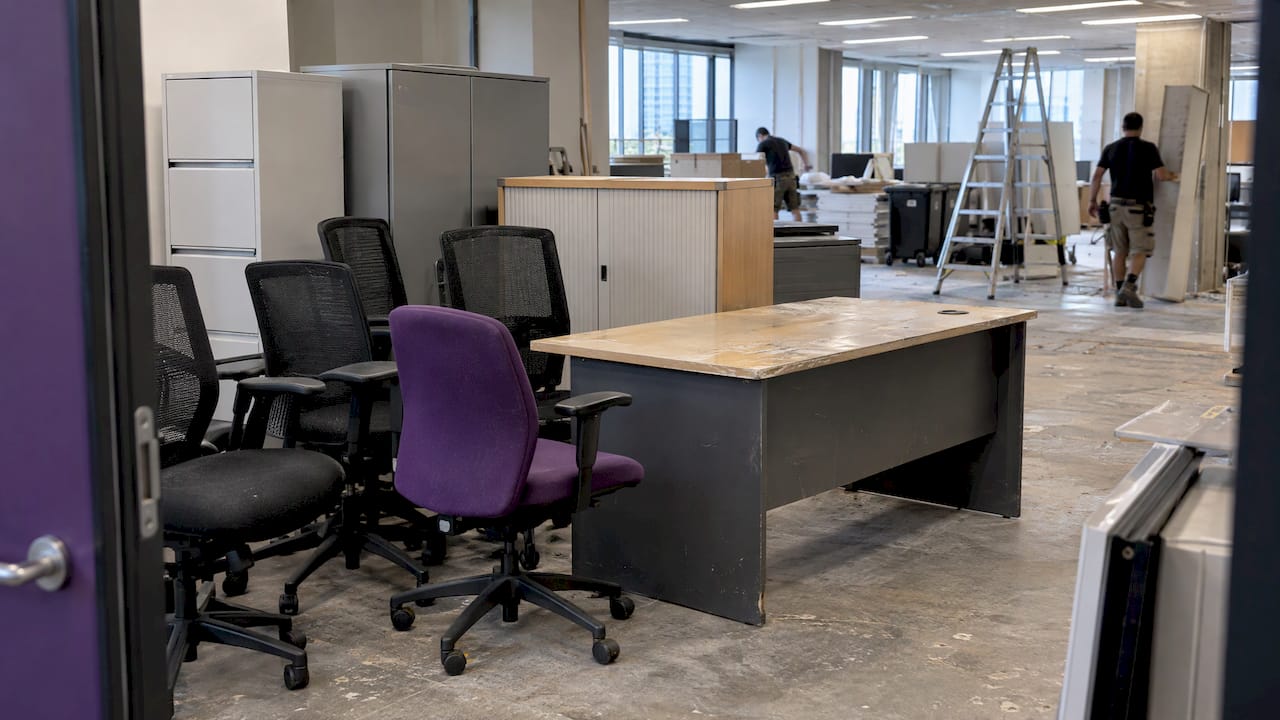
Most offices that refit or relocate throw out more usable furniture than they need to. The reliable way to avoid it is to decide what stays before the design is locked, so the layout, the budget and the construction program all work around the pieces you keep. That is how we approach it at Niche Projects: furniture reuse is a design and planning decision made at the start of a fit-out, not a clear-out done at the end.
TL;DR
- Audit every asset first, zone by zone, and give each one a destination: reuse, refurbish, donate, recycle or replace.
- Reuse means using a piece again as it is. Refurbishment restores or updates it, for example with new upholstery or a new top.
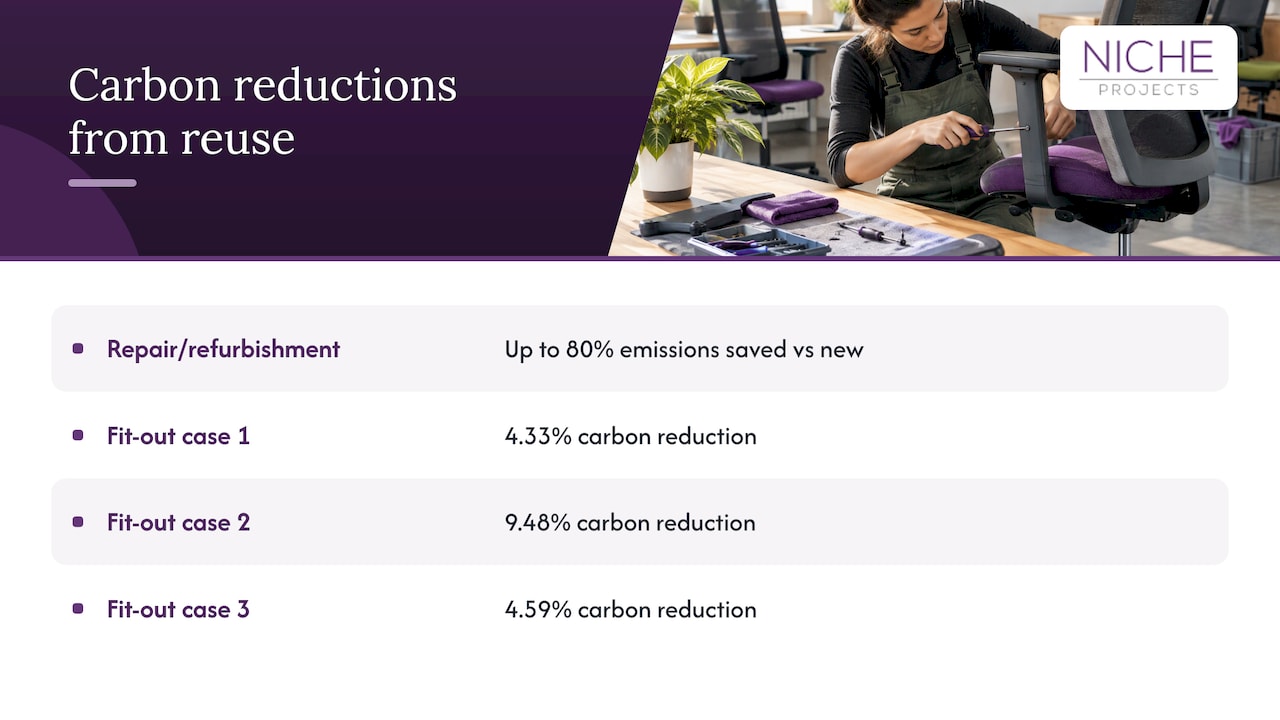
- Refurbishing can save up to 80% of the embodied emissions of making a new product, according to the Australian Government.
- Chairs and workstations still need to meet current Australian Standards and your accessibility obligations, whether old or new.
- Plan reuse inside the fit-out design so kept furniture suits the new layout, not just the old one.
Table of Contents
- Reuse and refurbishment are different decisions
- Why reuse is worth the effort
- How to audit what you have
- Safety, ergonomics and accessibility checks
- Reuse versus new: how to decide
- Plan reuse into the fit-out, not around it
- Choosing new pieces well when you do buy
- Working with Niche Projects on a Sydney refresh
- FAQ
- Sources
Reuse and refurbishment are different decisions
The two terms get mixed up, and the difference changes your budget. WRAP’s furniture guidance defines re-use as using a product again for the purpose it was made for, without repair or refurbishment, including passing it to another user. Refurbishment modifies a product to restore or lift its performance, such as replacing upholstery, repainting, or fitting a different top or seat.
In practice:
- Reuse: a swivel chair in good order moves to a new floor unchanged.
- Repair: a damaged tabletop is replaced so the desk works again.
- Refurbish: a run of chairs is reupholstered, or desks are refinished, so they suit the new look. The Hunter Joint Organisation toolkit gives refinishing worn office desks and reupholstering chairs instead of buying new as examples.
The IBA Forum notes the lines blur depending on context, so do not get stuck on labels. What matters is that each item gets a clear action and a cost.
Why reuse is worth the effort
Cost
The Australian Government’s furniture sustainability note describes reuse as cost effective and cites the University of Melbourne’s furniture reuse service, which saved an estimated $20 million in retail replacement value between 2012 and 2022 and kept 838 tonnes out of landfill. That is a large institution, so treat it as proof of the principle rather than a figure for your office. Your saving depends on how much of your stock is in serviceable condition.
Carbon
The same note says repair or refurbishment can save up to 80% of embodied emissions compared with manufacturing a new product. A 2026 peer-reviewed life-cycle assessment of four Green Star Interiors-certified Australian office fit-outs found retaining, reducing and reusing offered the greatest embodied-carbon potential. Reused furniture and equipment contributed carbon reductions of 4.33%, 9.48% and 4.59% in three of the cases.
Charitable Reuse Australia’s NSW report makes a useful point for anyone reporting on this: the main environmental benefit comes from avoiding the manufacture of new products, not from keeping items out of landfill. So the carbon case is strongest when a reused piece genuinely replaces a purchase.
Waste
Australia generates around 30,000 tonnes of commercial furniture waste a year, and furniture is only recyclable here when it is wholly metal, plastic or untreated timber, per the same DCCEEW note. Everything that cannot be reused, repaired or upcycled tends to end up in landfill. Strip-outs also happen before products reach the end of their service life, a point the Circular Fitout Toolkit for Offices makes about office fit-outs.
How to audit what you have
An audit turns a vague feeling that the furniture is tired into a list of decisions. A workable sequence, drawn from published audit guidance:
- Set the scope. Whole floor, one department or the full tenancy.
- Work zone by zone. Record and photograph each asset: type, quantity, make where visible, location.
- Grade condition consistently. Use the same scale for every item and the same person or team where you can.
- Check fit with the new workplace. Does the piece suit the tasks, the headcount and the layout you are heading towards?
- Assign a destination. Every asset gets one: reuse in place, redeploy, refurbish, donate, recycle or replace.
- Identify gaps last. Only after you know what you are keeping do you work out what to buy.
Turn grades into actions
A grading scale only helps if each grade maps to an action. One asset management approach uses four grades:
| Grade | Condition | Typical action |
|---|---|---|
| A | As new | Redeploy first |
| B | Serviceable, light wear | Redeploy or donate |
| C | Repairable | Refurbish where cheaper than replacing, otherwise strip for parts |
| D | End of life | Recover components, recycle materials |
The same guidance observes that most estates have a large share of grade B: furniture that is serviceable but unfashionable, not worn out. That matters because a tired look is often fixed by a new finish, new upholstery or a fresh layout rather than a new suite.
The disposal order
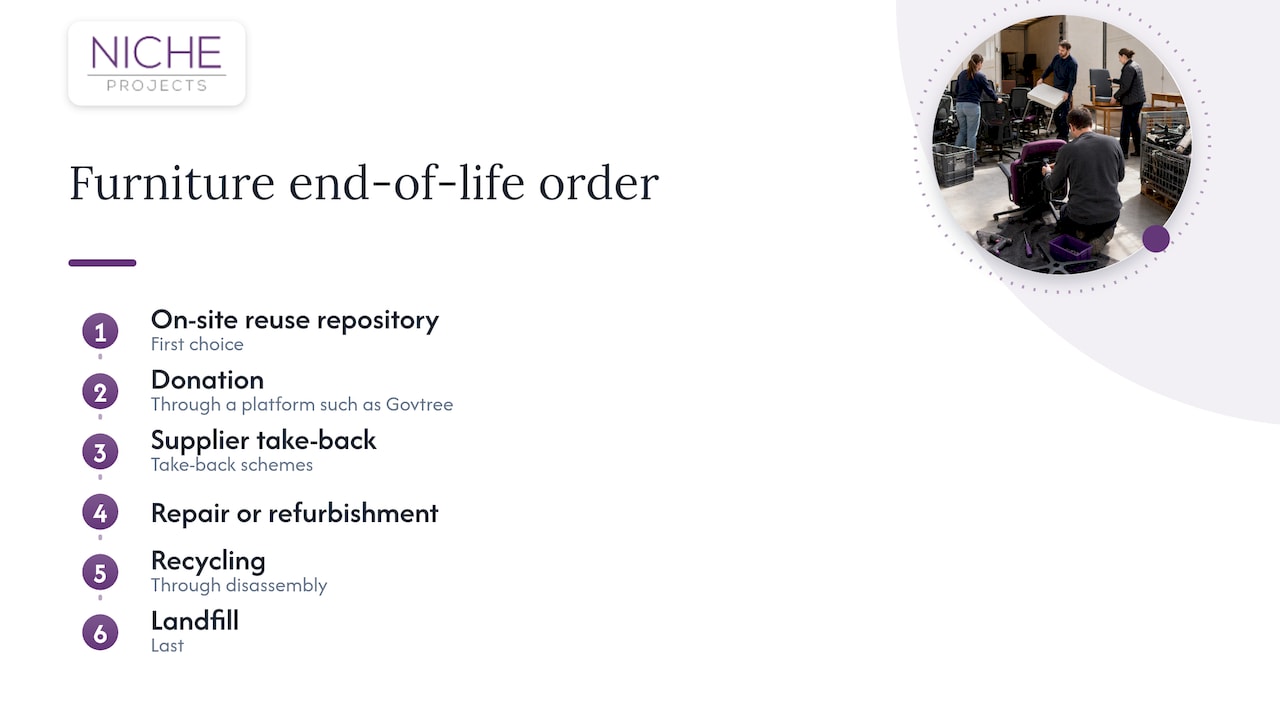
For furniture you will not keep, the Australian Government’s end-of-life hierarchy ranks the options: an on-site reuse repository first, then donation through a platform such as Govtree, then supplier take-back schemes, then repair or refurbishment, then recycling through disassembly, with landfill last (DCCEEW). In 2023, IP Australia listed surplus furniture from a downsizing on Govtree, and the Department of Climate Change, Energy, the Environment and Water adopted it, saving $300,000 in new-product value according to the same note.
RMIT’s 2026 furniture standards show what a disciplined approach looks like: consider reuse before buying new, divert at least 90% from landfill, and only store items for reuse if they are in excellent condition, in working order and still under warranty. Storing furniture with no plan to use it just moves the cost into rent.
Safety, ergonomics and accessibility checks
Reused furniture has to meet the same workplace standards as new. Keep these checks in your audit:
- Chairs. Flinders University’s guidance says chairs should meet current Australian Standards, and that AS/NZS 4438 applies both when ordering new chairs and when assessing existing ones. Work chairs should also be ergonomically sound and fully adjustable.
- Layout. Assess furniture positions against the tasks people do, foot traffic and screen glare. Screens sit at 90° to windows where possible.
- Accessibility. Queensland Health’s fit-out standards require Universal Design with accessibility to AS 1428.1 and AS/NZS 1428.4. Those are public-sector rules, but they are a sound benchmark for any inclusive office.
- Stability and materials. RMIT’s standards check stability, structural capacity, flammability and low VOCs (volatile organic compounds, the chemicals that off-gas from some finishes and adhesives).
If your stock is old, a refurbishment can bring a piece up to standard, for example replacing worn components, while a layout review fixes ergonomics and circulation. Our page on ergonomic office design covers the workstation side in more detail.
Reuse versus new: how to decide
There is no blanket answer, but a few tests settle most items.
| Question | Points to reuse or refurbish | Points to replace |
|---|---|---|
| Condition | Structurally sound, grade A to C | Unstable, broken, grade D |
| Standards | Meets current chair and accessibility requirements | Cannot be brought up to standard |
| Layout fit | Suits the new floor plan and task mix | Wrong size or configuration for the new use |
| Cost | Refurbishment costs less than replacement | Repair costs approach the price of new |
| Look | A new finish or upholstery fixes it | Style clashes and cannot be updated |
Be honest about the last row. WRAP notes that the remanufactured furniture market sits mostly in offices because organisations replace whole suites for aesthetic or rebranding reasons. If branding is the driver, ask whether new finishes on sound frames deliver the same result.
A mixed approach usually works best. Keep high-quality task chairs and storage, refinish desks, update the reception and meeting areas with new pieces where the impression matters, and donate or recycle the rest.
Plan reuse into the fit-out, not around it
Furniture reuse fails when it is bolted on late. If the floor plan is drawn around new furniture dimensions, the old pieces will not fit and end up in a skip. The Circular Fitout Toolkit for Offices, produced by the Better Buildings Partnership with Aurecon and the Green Building Council of Australia, gives fit-out teams practical circular strategies, and recommends its first two modules for anyone starting out.
A sequence that works:
- Brief and workplace strategy. Settle how people will work before choosing furniture. Our guide to integrating workplace strategy into a refurbishment explains why.
- Audit and grade the existing stock, as above.
- Design around what stays. Space planning uses the real dimensions and quantities of kept furniture.
- Schedule refurbishment so pieces are refinished or reupholstered before the move-in, and stored or moved in the right order during construction.
- Route the surplus by the disposal hierarchy and keep records of what went where.
There is a practical advantage in having design and construction under one roof. Our approach combines creative design with construction expertise, so decisions about kept furniture, joinery, finishes and the build program are made together. Related reading on our site covers minimising waste in a Sydney fit-out, recycled furniture and recycled materials in a fit-out.
Choosing new pieces well when you do buy
Some items will need replacing. The Australian Government’s note suggests choosing products designed with fewer parts or quick disassembly, built to last and inclusive in design, and favouring recycled-content or single-material options such as FSC-certified timber, bamboo or recycled steel. It ranks ecolabels such as GECA above environmental product declarations, and those above third-party certified claims, as protection against greenwashing (DCCEEW). Buying for longevity and future reuse is how today’s purchase becomes tomorrow’s grade A asset.
Working with Niche Projects on a Sydney refresh
If you are planning a refurbishment or fit-out in Sydney, we can fold furniture reuse into the workplace strategy, design and construction from the start. Our services cover workplace strategy, Sydney office design and office fit-out and refurbishment, delivered through consistent communication and a set delivery methodology. We work with businesses across the Sydney CBD, North Sydney, Ryde, Macquarie Park and Greater Western Sydney.
FAQ
Is refurbishing office furniture cheaper than buying new?
Often, when the frame or base is sound and only the surface, upholstery or top has worn. The Australian Government says refurbishment can reduce disposal and procurement costs. The comparison to make is the refurbishment quote per item against the replacement price, and the audit gives you the numbers.
Can I reuse old office chairs?
Yes, if they meet current Australian Standards, with AS/NZS 4438 applying when assessing existing chairs, and suit the people using them. Chairs should be ergonomically sound and adjustable. Worn or unstable chairs can often be reupholstered or repaired, or replaced where they cannot.
What should I do with furniture I cannot reuse?
Follow the hierarchy: redeploy on site, donate through a platform such as Govtree, use supplier take-back, refurbish, then recycle. Furniture is generally only recyclable in Australia if it is wholly metal, plastic or untreated timber, so reuse or donation keeps more out of landfill.
How much carbon does furniture reuse save?
Refurbishment can save up to 80% of the embodied emissions of making a new product. In a 2026 study of four Australian fit-outs, reused furniture and equipment contributed 4.33% to 9.48% reductions in three cases. Results depend on how much new purchasing the reuse actually displaces.
Sources
- WRAP: Giving Furniture a Second Life
- Hunter JO Circular Procurement Toolkit
- IBA Forum: Statement on the circular economy
- DCCEEW: Sustainability ideas for furniture
- Life cycle assessment of office fitouts (2026)
- Charitable Reuse Australia: Measuring Reuse Activity and Impacts in NSW
- Better Buildings Partnership: Circular Fitout Toolkit for Offices
- Office furniture audit guidance
- Furniture asset management guidance
- RMIT 2026 Furniture Standards
- Flinders University: Office safety and workstation assessments