
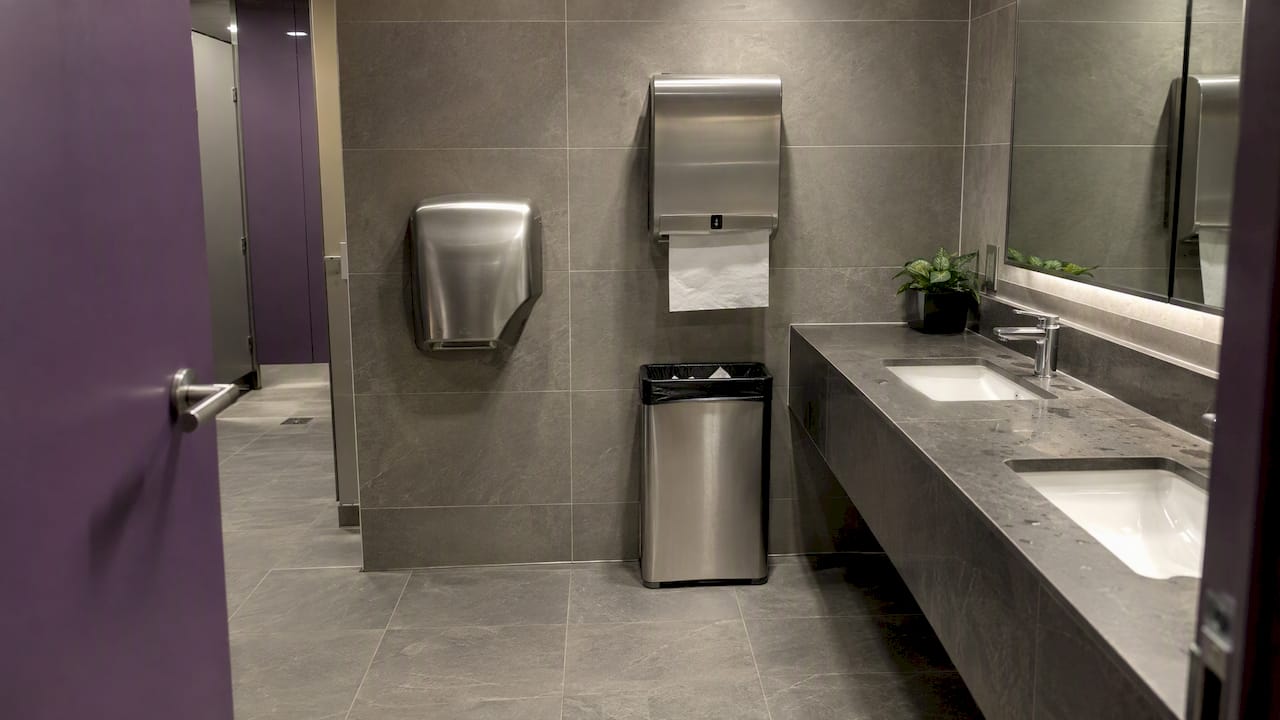
For clinical areas, single-use paper towels are the recommended choice, while high-speed dryers are often the better fit for busy non-clinical washrooms on cost and carbon. The evidence is mixed. A scoping review of the literature, the Australasian Health Facility Guidelines and life-cycle studies point in different directions, so traffic, maintenance and local energy inputs decide the outcome.
TL;DR:
- Australasian guidance requires paper towels at clinical basins, discourages hot air dryers in clinical areas and staff amenities, and allows high speed dryers elsewhere.
- High speed dryers typically take 10 to 12 seconds, warm air models need 20 to 40 seconds, and paper towels absorb moisture nearly immediately.
- Environmental rankings depend on grid emissions, towel sourcing, and disposal; busy sites on clean power often favor dryers, while recycled towels can reverse the result.
- For high traffic washrooms, dryer electricity costs a fraction of a cent per use, versus roughly 1 to 3 cents for towels and handling.
Table of Contents
- What does the research say about hand dryer and paper towel hygiene?
- How fast does each drying method work in practice?
- How do life-cycle assessments compare dryers and paper towels?
- How do you calculate the total cost of ownership?
- What usability and maintenance issues affect real-world performance?
- When should you choose paper towels, dryers or a mix?
- How do you turn the evidence into a procurement brief?
- Does the drying method affect productivity and employee satisfaction?
- What space and installation factors apply in an office?
- How does drying fit with hygiene and maintenance protocols?
- Which option gives more design flexibility in office washrooms?
- Planning a washroom upgrade as part of a fit-out?
- FAQ
- Sources
What does the research say about hand dryer and paper towel hygiene?
The honest summary is that the literature does not hand us a clean winner. A scoping review of peer-reviewed studies found mixed results: some studies favoured electric dryers, several favoured paper towels, and many found no significant difference. The reviewers concluded that the breadth of data does not support a uniform conclusion about which method is safer. That finding should shape how you read every confident headline on the topic, including the ones that suit a product someone is selling.
Part of the problem is how the studies were built. A critical review in the Journal of Applied Microbiology reports that many foundational hand-drying studies lacked consistent design, statistical power or a clear definition of infection risk. Different labs used different contamination methods, different dryer models, different hand-washing protocols and different sampling distances. Comparing one study’s numbers to another’s is often not valid.
Where the studies disagree
Some work supports paper towels. A review of hygienic efficacy summarises the argument that paper towels are likely to remove bacteria more effectively because friction physically lifts contaminants from the skin, whereas hot air and jet dryers cannot remove microbes in the same way. Other studies found no meaningful difference in bacterial counts on hands after drying, and some measured the opposite of what the mechanical-removal argument would predict.
Aerosol studies add another layer. Laboratory work using tracer particles or viruses shows that some dryers disperse droplets further than towels do. Clinical hand hygiene guidance, including the national hand hygiene manual, draws on experimental data in which warm-air dryers produced far more viral plaques than paper towels in certain tests, and it advises that air dryers should not be placed in clinical or patient areas.
Why lab results do not equal infection risk
Detecting more particles in a controlled test is not the same as more illness in a real building. The critical review warns that generalising laboratory aerosol results to real-world washrooms is problematic, because the studies rarely connect particle counts to the dose a person needs to become infected. It calls for standardised quantitative microbial risk assessment (QMRA) as the proper way to turn contamination data into health impacts.
For a facility decision maker, that has three practical consequences:
- Treat any single study as one input, not a verdict.
- Be wary of vendor material that quotes a lab result as proof of safety or danger.
- Weight setting-specific guidance more heavily than general contamination data, because guidance bodies assess the whole risk context.
What Australasian guidance requires
Where the stakes are highest, the guidance is clear. The Australasian Health Facility Guidelines Part D on infection prevention and control says single-use paper towels should be provided at all hand basins, and that hot air hand dryers are not recommended in clinical areas or staff amenities. High-speed dryers may be considered in non-clinical areas. It also advises designers to avoid tapware with integrated air drying in non-clinical areas because of aerosolisation risk.
The takeaway: the review literature is inconclusive on general washrooms, but clinical guidance is unambiguous: single-use paper towels at hand basins.
That split is the backbone of this guide. In clinical areas, a precautionary rule makes sense because the people exposed are vulnerable and the cost of being wrong is high. In an office or retail washroom, the uncertainty is real, so cost, carbon, usability and maintenance can legitimately drive the decision.
How fast does each drying method work in practice?
Speed matters more than it first appears. A method that leaves hands damp pushes people to wipe them on clothing, skip drying entirely or leave the washroom still wet, and wet hands spread contamination more readily than dry ones. Speed also sets how many people can use a washroom in a given period.
Paper towels absorb moisture almost immediately, and how dry hands feel depends on how many sheets the person takes. High-speed jet dryers commonly take around 10 to 12 seconds, which is the figure used in the experimental and life-cycle sources behind most comparisons. Conventional warm-air dryers often need 30 seconds or more to leave hands acceptably dry. Real users rarely wait that long.
- Paper towels: near-instant absorbency, with dryness depending on towel quality and the number of sheets used.
- High-speed dryers: roughly 10 to 12 seconds, fast enough that most people complete the cycle.
- Warm-air dryers: around 20 to 40 seconds, which can make users less willing to wait for the full cycle.
Why dry time shapes compliance
People judge a washroom by how it feels to leave it. If drying takes too long, a share of users will stop partway, and the behaviour you designed for (wash, dry, leave) becomes wash, partly dry, wipe on trousers. That undermines whatever hygiene advantage the equipment was meant to deliver.
Dry time also affects perceived cleanliness. A visibly overflowing towel bin, or a floor wet from dripping hands, changes how staff and visitors rate the whole facility. Fast dryers avoid the bin problem but introduce noise, which we cover under usability. Neither option is free of trade-offs, which is exactly why the context matters.
Throughput and queues in busy washrooms
In a washroom serving a large floor plate or a venue with peak periods, seconds per user add up. If each person spends a relatively long time at a warm-air dryer, a bank of dryers may clear people slowly, and queues can build at the exits rather than the basins. A jet dryer cuts that dwell time sharply, and a paper towel dispenser removes it nearly altogether, since users can take towels and keep moving.
The specification lesson is to match the drying method to the peak load, not the average. A design that works at 10 am on a Tuesday can fail at lunch or at the end of an event.
Pro Tip: When comparing dryers, ask suppliers for measured dry time under test conditions, not the marketing claim. A cycle that takes 10 seconds on the data sheet but needs two cycles in practice is a 20 second dryer.
How do life-cycle assessments compare dryers and paper towels?
Life-cycle assessments (LCAs) sound like they should settle the question. They do not, because the answer depends on the inputs. A study of hand-drying options covering waste management, carbon emissions and operating costs reports that outcomes vary strongly with the local energy grid, the manufacturing footprint of the towels and how used towels are disposed of.
The range in the evidence: depending on the LCA model, some scenarios show paper towels with a 6-fold to 27-fold lower environmental impact than various warm-air or high-speed dryers, while other models show high-speed dryers reducing impacts markedly. There is no single universal green solution.
That spread is the finding. It tells you that anyone claiming a flat answer, in either direction, has chosen their assumptions.
What drives the numbers
For dryers, the main driver is electricity. The carbon cost of a dry depends on how the power is generated, so the same machine looks cleaner on a low-carbon grid and worse on a coal-heavy one. Dryer manufacture and eventual disposal add a smaller share, spread over the unit’s service life.
For paper towels, the drivers sit upstream and downstream: fibre production, towel manufacture, transport to site and disposal of the used product. Fibre source matters a great deal. Recycled-content towels carry a much lighter production burden than virgin-fibre ones, and disposal routes (landfill, composting or recovery) change the picture again.
Where each option tends to win
High-speed dryers can have lower carbon footprints in many scenarios, particularly in high-traffic washrooms where the per-dry electricity use is low and the towel volumes would be large. But the gap can narrow or reverse when towels are recycled or come from a low-impact supply chain, and when the grid is carbon-intensive.
The practical reading is that neither side owns the sustainability argument. A busy washroom on a clean grid favours the dryer. A low-traffic washroom using recycled towels may favour paper.
What to include in a site-specific LCA
If sustainability is a deciding criterion for your building, ask for an assessment built on your inputs rather than a generic one. Include:
- Expected traffic by washroom, including peak periods.
- Your electricity supply and its emissions profile.
- Towel sourcing, fibre content and delivery distance.
- Your waste contract, including how used towels are collected and processed.
- Dry-time assumptions and how many towels users really take.
This is also where the wider fit-out decisions come in. Our guidance on office fit-outs and sustainability and tips for a green office fit-out covers how to treat washroom choices as part of a whole-building approach rather than a stand-alone purchase.
How do you calculate the total cost of ownership?
Cost comparisons go wrong when they compare a dryer’s purchase price to a towel carton’s purchase price. The honest comparison is total cost of ownership over the equipment’s life, across every cost category. A good model forces you to list them all.
- Capital and installation: the purchase price of dryers or dispensers, plus electrical work, wall preparation, mounting and any recessing or cladding.
- Energy per dry: electricity used per cycle multiplied by your tariff and expected number of dries.
- Consumables: towel purchase, delivery and storage, which scale directly with usage.
- Labour: restocking dispensers, emptying bins and cleaning around the equipment.
- Waste handling: bin liners, collection frequency and disposal charges for used towels.
- Maintenance and service: dispenser repairs, jam clearing, dryer filter cleaning, replacement parts and call-out fees.
Typical per-dry economics
Heavy-traffic washrooms are where the per-dry arithmetic shows its pattern. Electricity for a high-speed dryer works out to a fraction of a cent per dry. Paper towels typically cost roughly 1 to 3 cents per dry once you include the consumable and the handling around it. That difference is small per use but can become substantial at high volumes, making the running-cost gap an important part of the model.
Where traffic is low, the equation flips. A dryer’s capital cost is spread over few uses, while a towel dispenser’s running cost stays modest because few towels are used. Break-even depends on volume, which is why traffic data belongs at the start of any specification exercise.
Assumptions that distort the model
A common modelling error is assuming users take the same number of towels every time. Actual towel use varies, and higher use raises both cost and waste. Dryer consumption, by contrast, is predictable, which makes budgeting easier over the long term. Use the more realistic towel behaviour in your modelling, not the manufacturer’s optimistic figure.
Test at least two or three towel-use scenarios (for example one, two and three sheets per dry) and see how sensitive the conclusion is. If the answer flips between scenarios, you have learned that behaviour management matters as much as equipment choice.
Pro Tip: Add a row for the cost of a failed washroom: a dispenser out of stock, a dryer out of service or an overflowing bin. A model that assumes perfect operation understates what each option costs when it is run by real people on real schedules.
What usability and maintenance issues affect real-world performance?
The best specification on paper can fail if the washroom is unpleasant to use or hard to keep running. Operational realities decide whether a choice holds up over time.
- Noise: high-speed dryers are loud, which suits busy public washrooms but can grate in quiet offices, libraries or consulting rooms next to washrooms. Check the stated noise level in dB(A) and consider the adjacent rooms, not just the washroom itself.
- Accessibility: mounting height, reach range and control type matter. Sensor-activated dryers and dispensers need to be usable by people with limited reach, dexterity or vision, and positioned so a wheelchair user can approach them. Provide an alternative where one option excludes someone.
- Dispenser reliability: towel dispensers jam, run out or deliver multiple sheets at once. Choose a dispenser that suits the towel format and have a plan for restocking before it empties.
- Bin capacity: under-sized bins overflow, which is both unhygienic and visually off-putting. Size the bin to peak use and your collection frequency, not average use.
- Cleaning regimes: dryers need their intakes and surrounds cleaned, and towel areas need frequent bin and floor attention. Choose surfaces that wipe down easily.
- User behaviour: multiple-towel taking inflates cost and waste, and poor washing technique undermines any drying method. Clear signage and basic education help.
As one expert overview of the debate puts it, the right technology depends on the building’s traffic flow and energy mix, and behaviour (for example the number of towels taken) drives real-world outcomes more than the equipment alone.
When should you choose paper towels, dryers or a mix?
The decision is easier when you map room type and risk to a default, then check it against a short audit. Start with the risk, then the traffic, then the practicalities.
- Clinical areas: specify single-use paper towels at every hand basin, in line with the Australasian infection prevention guidance. Do not specify hot air dryers in clinical areas or staff amenities.
- High-traffic public or commercial washrooms: specify high-speed dryers where your cost and LCA modelling supports them. The guidance accepts high-speed dryers in non-clinical public toilets, and heavy use is where their running-cost and carbon advantages are strongest.
- Low-traffic or sustainability-led rooms: consider recycled-content towels or a mixed approach. With few uses, a dryer’s capital cost is hard to recover, and a recycled towel supply can keep the environmental case competitive.
- Mixed provision: offering both in a large washroom gives users a choice, reduces queueing at peak times and gives you a fallback if one system fails. It costs more to maintain, so use it where the traffic justifies it.
- Avoid integrated air-drying tapware: the guidance advises designers to avoid it in non-clinical areas because of aerosolisation risk.
A site audit checklist
Before committing, gather:
- Traffic profile by washroom, including peak periods and events.
- Your electricity source and tariff.
- Your waste contract and collection frequency.
- Acoustic limits for the washroom and neighbouring rooms.
- Accessibility requirements and the users you need to serve.
- Maintenance capacity: who restocks, cleans and repairs, and how often.
Pro Tip: Run the audit on your busiest washroom first. If the dryer wins there, test whether it still wins in your quietest one. The answer often differs, and a split specification can beat a single standard.
How do you turn the evidence into a procurement brief?
A brief translates the above into requirements a supplier can be held to. Vague specifications produce vague tenders, so name the metrics.
- Measured dry time: require test-condition dry times, not marketing claims.
- Power per dry: require energy use per cycle so you can model running cost.
- Noise: require a dB(A) figure at a stated distance.
- Accessibility features: specify mounting heights, sensor type and reach compliance.
- Cleaning-friendly surfaces: require smooth, wipeable finishes and accessible filters or dispensers.
- Tender checks: ask bidders to state their LCA assumptions, maintenance intervals and service terms, so you can compare like with like.
- Operational tasks: set restocking frequencies, bin sizing rules and cleaning checklists, and assign them to named roles.
- Post-install monitoring: track towel take rates and dryer faults for the first few months and adjust.
Pro Tip: Put the assumptions behind any LCA or cost figure into the tender as a required appendix. Two suppliers can reach opposite conclusions from the same product simply by assuming different towel counts or grid mixes.
If the washroom upgrade sits inside a broader refit, plan it alongside the rest of the project. Our guide to managing your office fit out covers how to sequence trades and decisions so washroom specifications are settled before services are roughed in.
Does the drying method affect productivity and employee satisfaction?
Drying method influences staff experience in small, repeated ways. Washrooms are among the most used shared spaces in an office, and staff visit them several times a day. A slow dryer, a dispenser that is often empty or a noisy unit near a meeting room will register as a minor irritation each time, and minor irritations accumulate into a view of how well the workplace is run.
Time is the obvious factor. Short waits for a free dryer during the morning and lunchtime peaks cost little individually but are noticeable, and they affect people who are already time-pressed. A fast dryer or towels at the exit keeps flow smooth. Noise matters in open-plan offices where washrooms adjoin work areas, and staff in adjacent rooms will notice a jet dryer at every use.
Satisfaction also follows reliability and cleanliness more than the technology itself. An out-of-stock dispenser or an overflowing bin reads as neglect. Our thinking on how strategic design supports productivity and business outcomes applies here: small details that work consistently contribute to how people feel about their workplace.
What space and installation factors apply in an office?
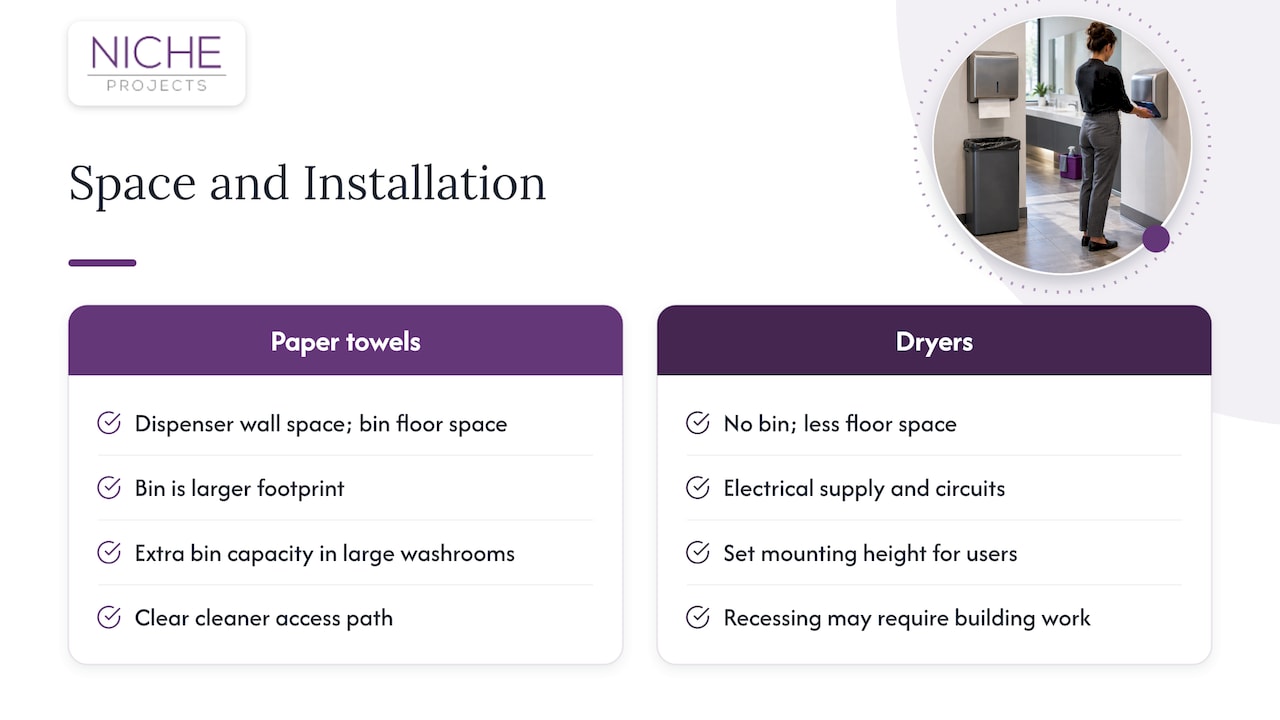
The two options occupy space differently. A paper towel system needs wall space for the dispenser and floor space for a bin positioned within easy reach. Larger washrooms may need additional bin capacity to prevent overflow. The bin is the larger footprint, and it needs a clear path for the cleaner to service it.
Dryers need less floor space because there is no bin, but they need electrical supply, which means planning power points and circuits early. Wall-mounted units must be set at suitable heights for the users you serve, and some models are recessed into the wall, which affects the substrate and can require building work. Positioning matters because a dryer discharges air and moisture outward, so it should not sit directly beside a doorway or mirror where spray becomes a nuisance.
Both options need clear wet-area surfaces beneath them, since drips from hands collect on the floor below either one. Wall finishes behind dispensers and dryers should resist moisture and be easy to wipe. Coordinating these elements with partitions, floor finishes and services is straightforward when decided at design stage and far more expensive to retrofit after the washroom is built.
How does drying fit with hygiene and maintenance protocols?
Hand drying should be part of the washroom’s overall cleaning and maintenance routine, not an afterthought. Each option creates its own tasks, and the protocol should name them.
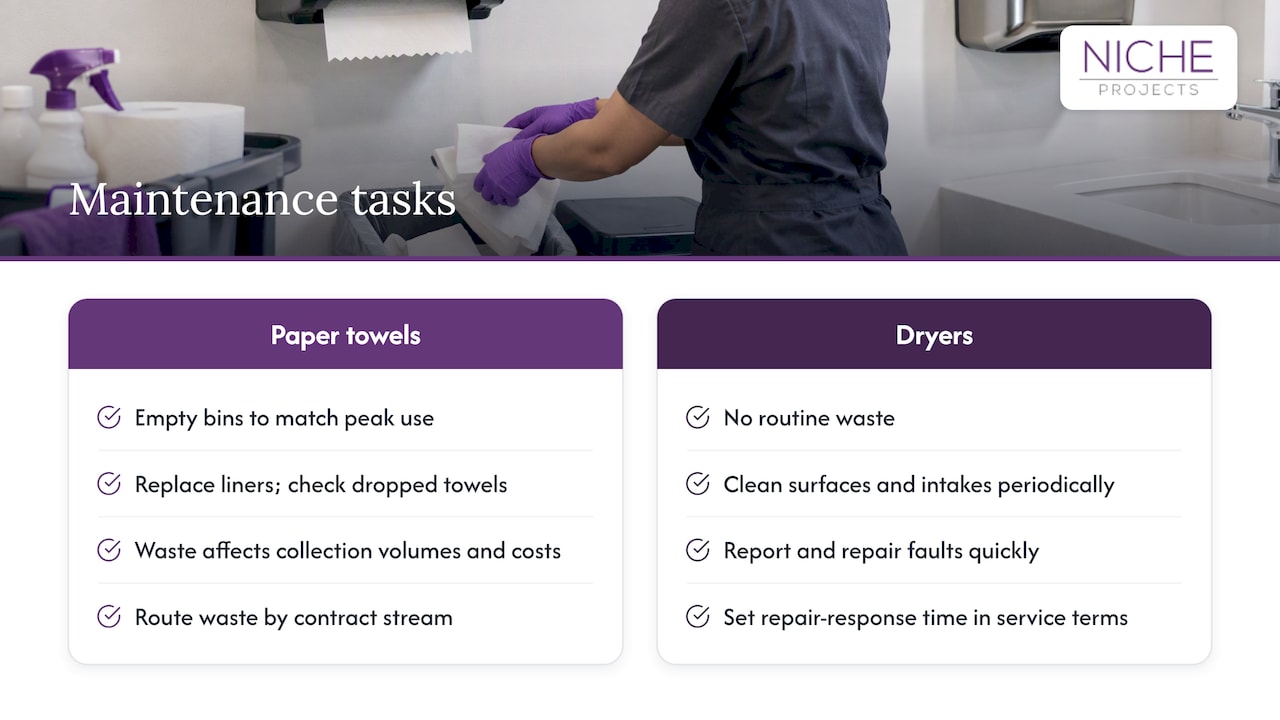
Paper towels generate a waste stream. Bins need emptying on a schedule matched to peak use, liners replaced and surrounding floors checked for dropped towels. The waste goes into your general or recovery stream depending on your contract, so it affects collection volumes and costs. Our tips on recycling in the office cover how to reduce and divert that stream where your contractor allows.
Dryers generate no routine waste but need periodic cleaning of the surfaces and intakes, and a process for reporting and repairing faults quickly. A dryer out of order sends everyone to the remaining units or to the towel dispenser, so a repair-response time belongs in your service terms.
Whichever you choose, build the tasks into the cleaner’s checklist, record when they are done and review the logs. Where ongoing servicing is outsourced, our facility maintenance services cover related building fabric and finishes, which helps keep washrooms consistent.
Which option gives more design flexibility in office washrooms?
Dryers and towel dispensers shape the look of a washroom differently. Dispensers are available in a range of finishes and sizes, and a recessed or semi-recessed dispenser with a built-in bin can sit flush with the wall for a clean line. The visible bin is the design challenge, because it needs to be accessible yet not dominate the room.
Dryers range from bulky surface-mounted units to slim and recessed designs. A well-chosen dryer can be a deliberate feature, and with no bin the vanity zone looks tidier. The trade-off is that the unit’s shape, colour and mounting position become part of the design, so they need to suit the finishes around them.
Both can be integrated into joinery and wall systems if planned early, and both can be specified in finishes that match taps, mirrors and partitions. Flexibility is greatest when the choice is made before the vanity and wall layout are fixed. That is where our office design work and broader thinking on future-proof, sustainable office design helps teams settle washroom decisions alongside everything else.
Planning a washroom upgrade as part of a fit-out?
If you are weighing hand dryers against paper towels as part of a larger project, we can help you settle the specification alongside the layout, services and finishes. At Niche Projects, we combine creative design with construction expertise, so the drying decision is coordinated with power, plumbing, joinery and wall finishes from the start, rather than patched in later.
We work with executives and facility teams on workplace strategy, design and delivery, and we can translate the audit steps above into a clear brief for your washrooms. If your project is a wider refit, our Sydney office fitout and refurbishment services cover the build side, and ongoing servicing is handled through our facility maintenance team. Talk to us about your washroom brief and we will map the options to your traffic, budget and building.
FAQ
Are hand dryers or paper towels more hygienic?
Neither wins everywhere, because the research is mixed. A scoping review found some studies favouring dryers, several favouring paper towels and many finding no significant difference. In clinical areas, guidance recommends single-use paper towels.
Which is better for the environment, hand dryers or paper towels?
It depends on your inputs. Life-cycle assessments vary with the energy grid, towel fibre source and disposal method, and the Springer study shows scenarios in both directions. High-speed dryers often do well in busy washrooms, while recycled towels can narrow the gap.
Are hand dryers allowed in clinical areas?
Hot air dryers are not recommended in clinical areas or staff amenities under Australasian health facility guidance. Single-use paper towels should be provided at all hand basins. High-speed dryers may be considered in non-clinical areas.
Are hand dryers cheaper than paper towels?
In high-traffic washrooms, dryers usually cost less to run, because electricity per dry is small compared with consumables, labour and waste handling. In low-traffic rooms the capital cost is harder to recover. Model at least two or three towel-use scenarios before deciding.
Why do hand dryer studies give conflicting results?
Study designs differ widely in contamination method, dryer type and sampling. A critical review found many foundational studies lacked consistent design or statistical power, and it recommends standardised quantitative microbial risk assessment.