

A landlord fitout contribution is a payment, credit or in-kind works package a landlord provides to help a tenant build out a commercial space, and the single thing every party must fix in writing is the amount, the payment timing and the GST treatment. Get those three details wrong in the heads of agreement, incentive deed or lease, and disputes over tax and cash flow usually follow, something the ATO’s guidance on lease incentives addresses directly.
TL;DR:
- Reimbursement structures can force tenants to fund the full build first; negotiate staged drawdowns or direct builder payments tied to invoices and compliance certificates.
- A contribution treated as consideration for the lease may attract GST, and reconciling actual fitout costs against estimates can trigger an adjustment event.
- If ownership passes to the tenant, the contribution is likely assessable income; landlord ownership generally gives the tenant tax free use but no depreciation claim.
- Clawback clauses that exceed a genuine estimate of loss may be unenforceable, so negotiate a clear amortization formula and check whether approved assignments trigger repayment.
- Compare incentives by subtracting each incentive’s value from total lease rent, then dividing by the lease term to calculate annual effective rent per square meter.
Table of Contents
- What a fitout contribution is and how it differs from other incentives
- How fitout contributions are commonly structured
- GST, tax and accounting treatment in Australia
- Payment timing, drawdown mechanics and required evidence
- Clawback, assignment and make-good: what to watch for
- Security and bank guarantees when a landlord funds fitouts
- How to compare incentives and negotiate: effective-rent method and checklist
- Practical checklist from a fitout provider: delivering a contribution-funded project
- How we help when a landlord offers a fitout contribution
- FAQ
- Sources
What a fitout contribution is and how it differs from other incentives
Landlords offer fitout contributions to win or retain tenants, particularly in competitive retail and office markets where a bare shell is unappealing to incoming businesses. Rather than discounting rent, the landlord puts cash or works towards the cost of building out the space, which lets them keep headline rent high for valuation and refinancing purposes while still making the deal attractive.
A fitout contribution behaves differently from other common incentives in practice:
- A rent-free period reduces outgoings early in the lease but does nothing to help fund the upfront fitout bill.
- A cash incentive paid at lease signing gives the tenant flexibility but is rarer and often taxed differently from a contribution tied to building works.
- A fitout contribution is usually conditional on the tenant actually completing agreed works, so it solves the funding problem but creates a drawdown and evidence burden.
Tenants with strong cash reserves sometimes prefer rent-free periods for simplicity, while tenants facing a genuine funding gap for construction tend to need the contribution structure, even though it comes with more paperwork and more conditions attached.
How fitout contributions are commonly structured
The mechanics vary a fair amount between landlords, and the structure chosen affects who carry the funding risk during construction.
- Lump sum paid upfront: the landlord pays a fixed amount before works begin, which is the most tenant-friendly structure but least common because it exposes the landlord if the tenant does not finish the fitout.
- Lump sum paid on completion: the landlord pays the agreed figure once the fitout reaches practical completion, shifting funding risk onto the tenant during construction.
- Reimbursement up to a cap: the tenant pays contractors directly and claims back costs against invoices, capped at an agreed ceiling, which is common but cash-flow intensive for the tenant.
- Rent credit or amortised incentive: instead of cash, the landlord offsets the contribution against rent over an agreed period, effectively financing the fitout through the lease term.
- Landlord-performed works: the landlord’s own contractors build the fitout to an agreed scope, removing the tenant’s funding burden but creating disputes if the scope or quality falls short of expectations.
Each structure needs its own drafting approach, particularly around what evidence triggers payment and what happens if costs run over the agreed figure.
GST, tax and accounting treatment in Australia
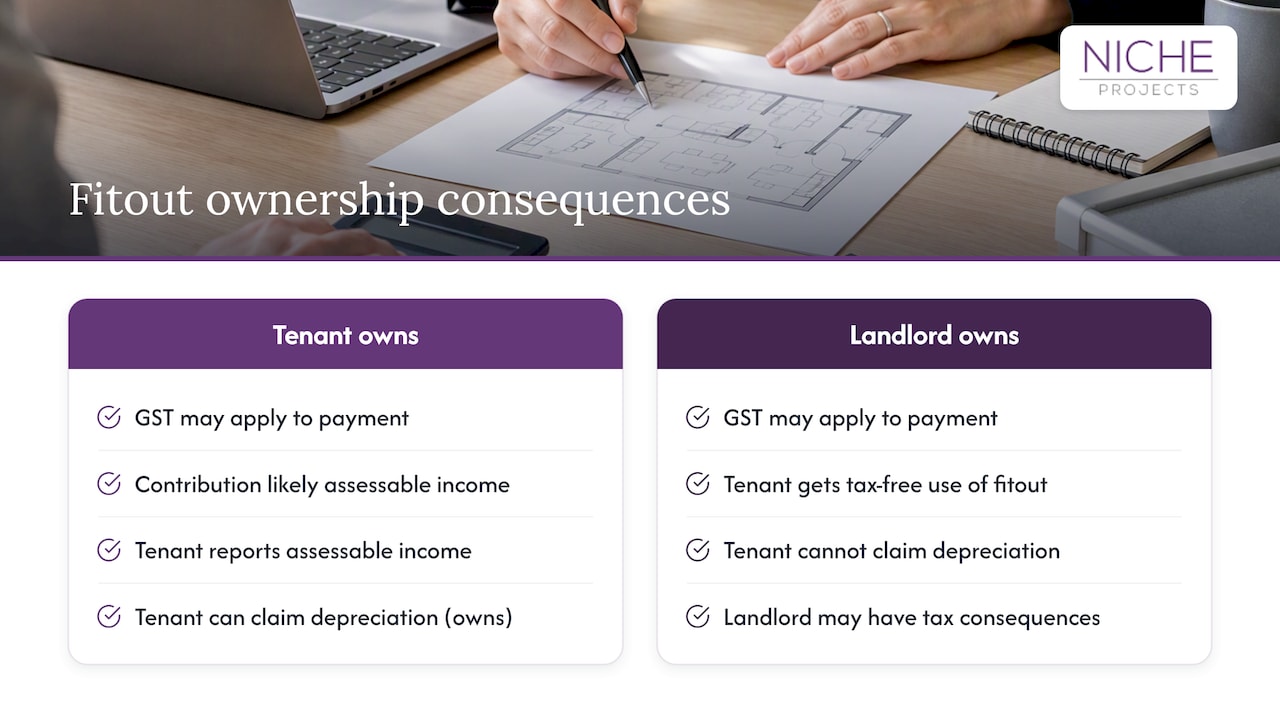
Tax treatment depends heavily on who ends up owning the fitout, and this is where many lease negotiations go wrong because the commercial terms get agreed before anyone checks the tax consequences. ATO guidance treats a fitout contribution as potentially a taxable supply when it is consideration for entering into the lease, which means GST can apply to the payment and can trigger adjustment events when final costs reconcile against the original estimate.
A landlord fitout contribution can carry GST and income tax consequences that turn on ownership, a point ATO guidance sets out directly: this changes who can claim input tax credits and who reports the payment as assessable income.
The ATO’s taxation ruling IT 2631 adds a further distinction. If ownership of a free fitout passes to the tenant, the contribution is likely to be assessable income in the tenant’s hands. If the landlord retains ownership of the fitout, the tenant generally gets tax-free use of it but cannot claim depreciation on assets it does not own.
Before signing anything, both parties should confirm invoice wording matches the agreed GST treatment, understand when a reconciliation of actual costs against the estimate becomes a GST adjustment event, and get their own tax advice rather than relying on the other side’s accountant. These rules are specific to each deal’s facts, so a blanket assumption about GST treatment is risky.
Payment timing, drawdown mechanics and required evidence
Most landlords will not hand over a fitout contribution on trust. Payment is usually tied to a trigger such as practical completion, the store or office opening to trade, or submission of a formal payment claim with supporting invoices.
Some landlords pay in stages as construction progresses, which helps tenant cash flow considerably. Others only reimburse after the entire fitout is finished, which means the tenant has to fund the whole build and wait to be repaid, something Prosper Law flags as a common trap when the heads of agreement is vague on timing.
Typical evidence landlords ask for includes compliance certificates for electrical, fire and building work.
- Tax invoices from the builder and subcontractors matching the agreed scope.
- Compliance certificates for electrical, fire and building work.
- Proof of occupancy or trading commencement where the lease ties payment to opening.
- Photographic or inspection evidence confirming the works match the approved plans.
Pro Tip: Negotiate for the landlord to pay the builder directly for at least part of the contribution, rather than reimbursing the tenant after the fact, to avoid funding the full build out of your own pocket.
Clawback, assignment and make-good: what to watch for
Many fitout contributions come with repayment obligations if the tenant leaves early, assigns the lease or defaults. These clawback clauses typically amortise the contribution on a straight-line or pro-rata basis over an agreed period, so leaving in year two of a five-year term might mean repaying three-fifths of the original amount.
Marino Law’s commentary warns that clawback clauses drafted as blanket penalties rather than genuine pre-estimates of loss risk being unenforceable, because Australian courts generally refuse to enforce penalty clauses that go beyond compensating actual loss.
Points worth negotiating before signing:
- Insist on a defined amortisation period and a clear formula, not a vague “repayable in full” clause.
- Check whether assignment to an approved new tenant still triggers clawback, since this can catch out a business sold mid-lease.
- Clarify who owns the fitout at lease end, because ownership affects both the tax position under IT 2631 and make-good obligations when the tenant vacates.
- Where a speculative fitout was landlord-installed before the tenant arrived, confirm whether make-good even applies to those elements.
Security and bank guarantees when a landlord funds fitouts
A landlord putting real money into a tenant’s fitout usually wants more security in return, not less. The logic is straightforward: the larger the upfront exposure, the more the landlord wants covered if the tenant defaults early.
Guidance on commercial lease bank guarantees notes that landlords typically ask for security equivalent to several months’ rent, and a significant fitout contribution can push that figure higher again.
- Ask whether the security amount can step down once the clawback liability amortises to a lower figure.
- Offer staged payment of the contribution tied to construction milestones, which reduces the landlord’s peak exposure and can support a lower security ask.
- Check whether the landlord will accept a bank guarantee instead of a cash bond, since this keeps the tenant’s cash available for the fitout itself.
Security is usually returned once the lease ends cleanly and make-good obligations are satisfied, so tie its release explicitly to those conditions in the lease.
How to compare incentives and negotiate: effective-rent method and checklist
Comparing a fitout contribution against a rent-free period on headline dollars alone is misleading. Guidance on comparing lease incentives recommends calculating the effective rent across the full lease term instead.
- Add up total rent payable over the lease term under each incentive scenario.
- Subtract the dollar value of the incentive (rent-free months, or the fitout contribution amount).
- Divide by the lease term to get an effective annual rent per square metre.
- Compare that figure against market rent for similar space to see which incentive genuinely costs the landlord more.
Pro Tip: Run the effective-rent numbers before you negotiate the fitout contribution amount, because a landlord offering a bigger contribution often recovers it through higher base rent.
Before signing, settle the GST treatment, the payment triggers, the clawback formula and whether the heads of agreement, incentive deed and lease are consistent on every figure.
Practical checklist from a fitout provider: delivering a contribution-funded project
Running a fitout against a landlord contribution adds a layer of approvals and evidence on top of the usual build program, and mismatched timing between landlord sign-off and builder milestones is where most projects lose money.
- Align the builder’s milestone schedule with the landlord’s approval dates before works start, not after.
- Build a drawdown evidence pack upfront: tax invoices, compliance certificates and progress photos keyed to each payment trigger.
- Keep an asset register during the build so ownership and make-good obligations are clear well before lease expiry.
- Flag long-lead items, like mechanical or fire services approvals, early so they do not stall a milestone payment.
- Work to a documented fit out timeline so the tenant is never funding weeks of unreimbursed work while waiting on landlord sign-off.
How we help when a landlord offers a fitout contribution
We help tenants turn a landlord fitout contribution into a finished space without carrying unnecessary funding risk along the way. Through workplace strategy, office design and full office fitout and refurbishment delivery, we manage the build program so milestone payments, compliance certificates and approvals line up with what your incentive deed actually requires.
- We plan construction milestones against the landlord’s payment triggers so you are not left funding the gap.
- We assemble the evidence pack, invoices, certificates and photos, that landlords expect before releasing each payment.
- We coordinate the trades, from partitions and ceilings to mechanical and fire services, so nothing stalls a drawdown.
If you have a fitout contribution on the table and want a feasibility assessment before you sign, get in touch about your office fitout and we will map the build program against your incentive terms.
This article is general information, not a substitute for advice from a qualified financial advisor. Consult a qualified financial professional about your own circumstances before acting on anything here.
FAQ
What is the 30% rent rule in Australia?
In residential contexts the figure sometimes refers to housing affordability benchmarks, so in a commercial lease negotiation it is best treated as informal shorthand rather than a legal threshold, and tenants should confirm any such figure against the actual lease terms and professional advice rather than assuming it applies.
How much can a landlord increase rent in Australia?
Rent increase limits depend on what the lease itself specifies, such as a fixed percentage, a CPI link or a market review clause, and on the retail or commercial tenancy legislation in the relevant state or territory. There is no single national cap, so the governing figure is whatever the lease specifies, read alongside the applicable state retail leases act.
What is a landlord fitout contribution and who pays for it?
A landlord fitout contribution is money, a rent credit or landlord-performed works that a landlord provides to help fund a tenant’s fitout, paid from the landlord’s own capital rather than the tenant’s. The amount, timing and GST treatment should be fixed in the heads of agreement, incentive deed and lease, as outlined in ATO guidance.
Is a landlord fitout contribution taxable?
It depends on ownership and structure. Under IT 2631, a contribution is likely assessable income to the tenant if ownership of the fitout passes to them, while a landlord-owned fitout generally gives the tenant tax-free use without a depreciation claim.
When do landlords usually pay a fitout contribution?
Payment is commonly tied to practical completion, the business opening to trade or submission of invoices and compliance certificates, rather than paid upfront. Legal commentary on lease incentives notes that tenants often need to fund construction first and claim reimbursement afterwards unless they negotiate staged drawdowns.