
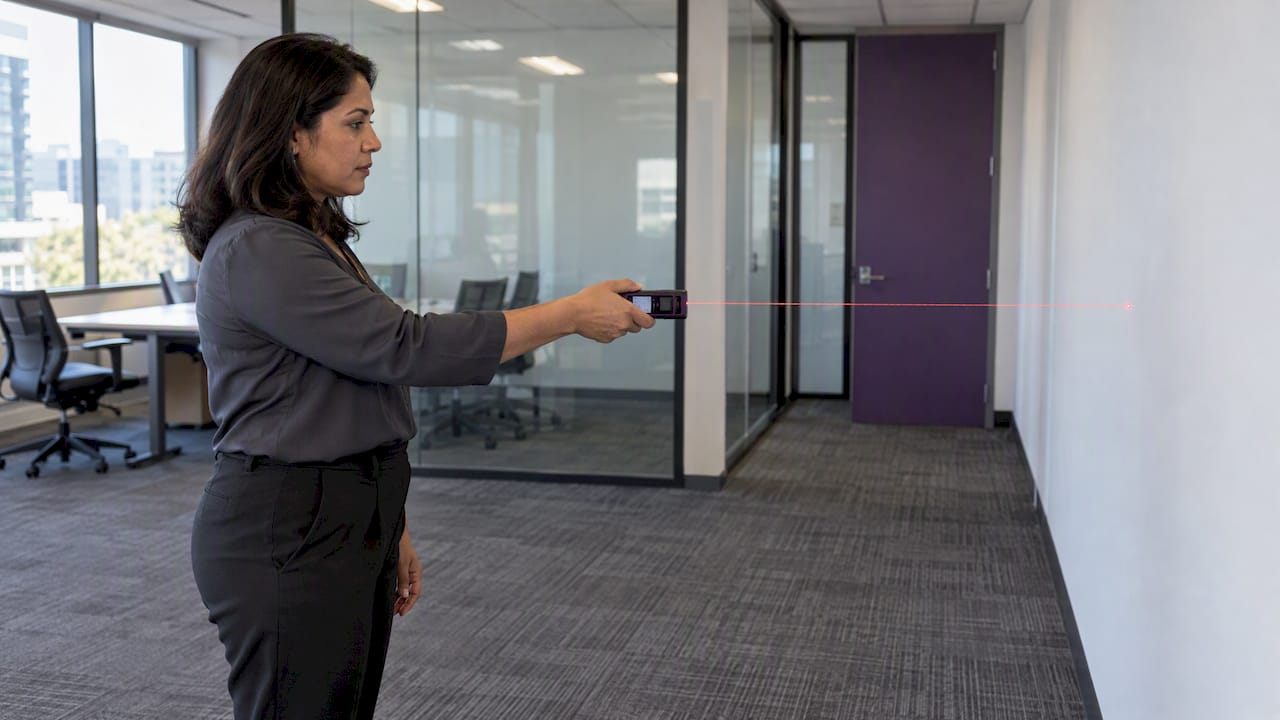
Net lettable area (NLA) is the floor area of an office tenancy that you lease and pay rent on. In Australia it is measured under the Property Council of Australia’s method, and it leaves out shared areas such as lift lobbies, toilets, stairs and plant rooms. If you are leasing, renewing or planning a fit-out, NLA sets your rent, your starting point for space planning and the figure every other number is divided by.
This guide explains what NLA is, how it is measured, what counts and what does not, how it differs from gross lettable area, and what to check before you sign. It is written for the people who commission the space: business owners, executives, office managers and HR leads.
TL;DR
- NLA is the lettable floor area of an office tenancy, and the Property Council of Australia uses it to calculate tenancy areas for office tenants.
- It is measured to the Property Council’s Method of Measurement, from the internal finished surfaces of permanent walls, and it excludes common areas.
- Gross lettable area (GLA) is a different measure, typically used for warehouses, industrial buildings and showrooms.
- Agree the measurement method and the area before you negotiate the rental rate, then compare rents only on the same basis (gross or net, with incentives stated).
- NLA is not the same as usable space. Plan your fit-out from the measured plan, then test how many people it actually seats.
Table of Contents
- What net lettable area means for an office
- How NLA is measured in Australia
- What is included in NLA and what is not
- NLA versus gross lettable area and other measures
- How NLA drives rent
- From NLA to a workable office
- Questions to ask before you sign
- Where NLA shows up beyond rent
- Planning a fit-out once you know your NLA
- FAQ
- Sources
What net lettable area means for an office
In plain terms, NLA is the part of a building you can occupy and be charged for. The Property Council’s glossary says NLA is used to calculate tenancy areas for office tenants, and it points readers to the Method of Measurement for the rules.
That makes NLA the number that appears in your lease schedule, in the agent’s marketing brochure and in the rent calculation. If an agent says a floor is 450 m², they should be telling you its NLA, and you should be able to see how it was measured.
The term is part of everyday leasing language, so you will also see it written as “NLA office space” in listings. It means the same thing: the lettable office area on offer.
How NLA is measured in Australia
NLA is measured using the Property Council of Australia’s guidance, which the industry treats as the standard for measuring property for lease. The Property Council describes its Method of Measurement: Commercial as guidelines for measuring floor space in leased premises, covering office, industrial and retail, with the aim of a consistent, practical and cost-effective approach.
For office buildings, the practical rules work like this:
- Internal finished surfaces. NLA is measured from the internal finished surfaces of permanent internal walls and of the dominant portions of permanent outer building walls.
- Columns are in. Freestanding and engaged columns are included in the area, while ducts, accessways and recessed door areas are excluded.
- Low ceilings are recorded separately. Zones with less than 1.5 metres of height clearance are measured and recorded on their own, according to the same source.
- Shared walls. Australian methodology measures walls between tenancies at the mid-point. The Pacific Rim Real Estate Society notes that this differs from some European and UK practice, which measures to the internal face of the tenancy wall.
That last point matters if your head office overseas quotes space in a different convention. A floor plate that looks smaller or larger on paper may simply be measured differently.
Why the method matters
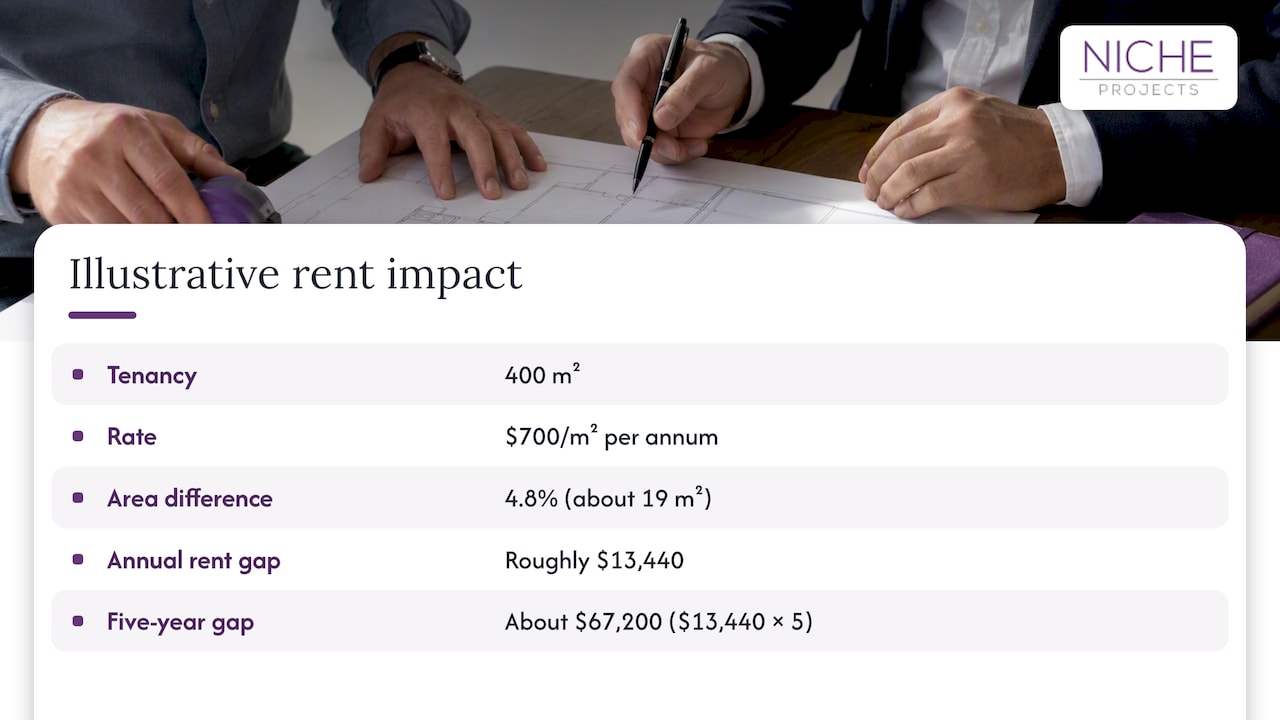
Two valid-looking measurements of the same floor can disagree. The same academic paper reports that differences in measurement method can cause lettable area variations of up to 4.8%, which is significant in rental or capital value terms.
Here is an illustration, not a real lease. A 400 m² tenancy at $700 per m² per annum costs $280,000 a year. If a different method added 4.8%, that is about 19 m² more, or roughly $13,440 a year at the same rate. Over a five-year term the gap is large enough to be worth a surveyor’s time.
What is included in NLA and what is not
The general pattern is that NLA counts the space dedicated to your tenancy and excludes the building’s shared services. Based on the Property Council method as summarised by a Sydney property group:
| Usually included in NLA | Usually excluded from NLA |
|---|---|
| Structural columns and piers | Lift lobbies |
| Window mullions and frames | Toilets |
| Internal office, meeting and open-plan areas within the tenancy | Tea rooms in common areas |
| Internal storage and support space inside the tenancy | Stairs and plant rooms |
| Thoroughfares and other shared circulation |
Two practical notes follow from this.
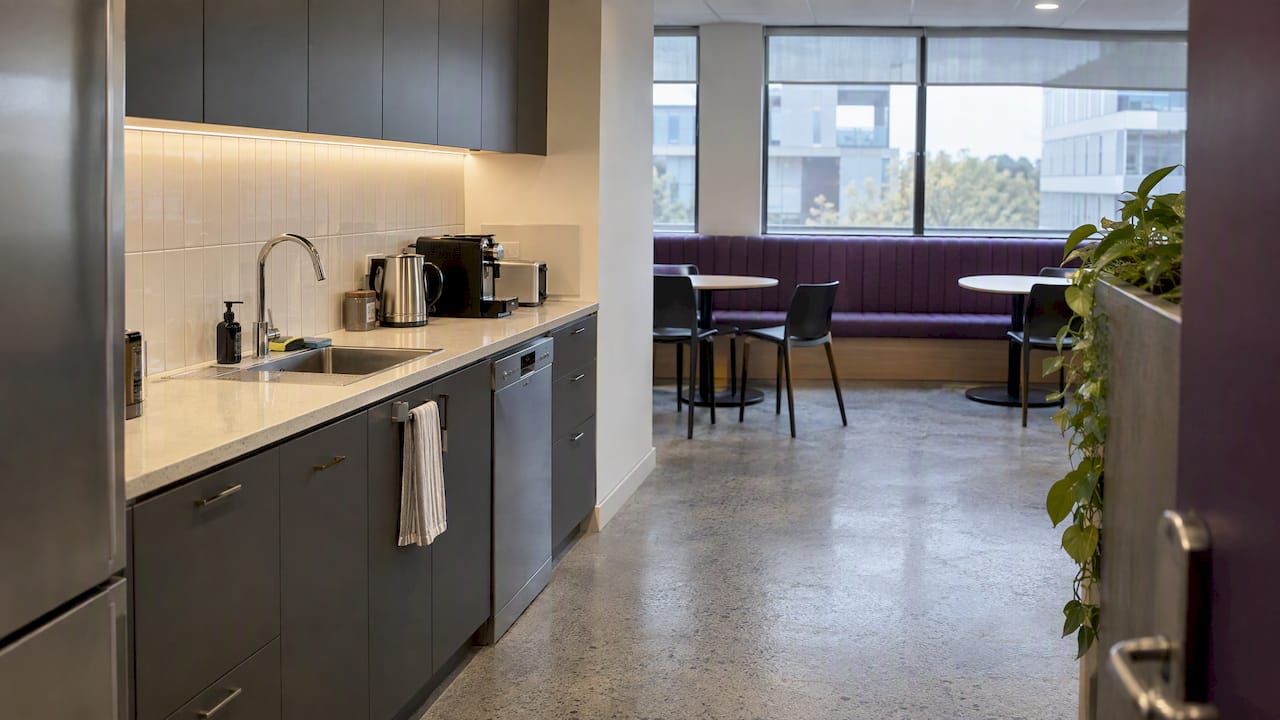
First, your own kitchenette, breakout area and print room sit inside the tenancy, so they are part of NLA and you pay rent on them. Under the Commercial Building Disclosure Program, office space is defined to include areas used for information-based work such as administration, as well as support facilities like kitchenettes and breakout areas.
Second, building services that serve the whole floor, such as a riser or a shared amenity core, belong to the landlord’s common areas. They are not yours to plan around, and they are not in your rent calculation.
NLA versus gross lettable area and other measures
NLA is the office measure. Gross lettable area (GLA) belongs mostly to other property types. The Property Council’s glossary states that GLA is used for warehouses, industrial buildings, free-standing supermarkets and showrooms. GLA also includes internal features and services such as toilets, which is why a GLA figure is usually larger than an NLA figure for a comparable space.
The practical consequences:
- If you are leasing a warehouse with an office or mezzanine, expect GLA language for the main space and check how the office portion is described.
- Do not compare an office quoted in NLA with a showroom or industrial unit quoted in GLA without adjusting for what each counts.
- When a listing just says “area”, ask which measure it is and which edition of the guidance was used.
If your plan involves adding an office inside a warehouse, our guide to mezzanine offices for Sydney warehouses covers how that space is typically configured.
How NLA drives rent
Rent is usually quoted per square metre per annum on the NLA, so the formula is simple: NLA multiplied by the rate. A real example is a New South Wales government office lease that lists 1,881 m² of NLA measured under Property Council guidelines, at $995 per m² per annum plus GST. That works out to $1,871,595 a year before GST. It is one lease from one period, not a market benchmark, but it shows how the lease document ties area and rate together.
Agree the area before the rate
The best-practice order recommended by the Property Council is to agree the measurement method first, agree the resulting measurements second, and negotiate the rental rate third. Negotiating a rate on an unverified area means you may win a discount on the wrong number.
Compare like with like
NLA alone does not make two offers comparable. The Property Council’s rent definitions distinguish gross, net, face and effective rents, and they cover how outgoings and incentives are treated. A building offering a lower face rent with a big fit-out contribution can cost differently from one with a higher face rent and none. If you want a general primer on how net and gross structures split costs, net versus gross lease structures are laid out clearly for small businesses weighing commercial property.
A simple comparison checklist:
- Confirm each space’s NLA and the method used.
- Convert every offer to the same basis (gross or net of outgoings).
- Note incentives, rent-free periods and fit-out contributions.
- Calculate cost per workstation, not just per square metre.
From NLA to a workable office
NLA tells you what you are paying for. It does not tell you how many people the space will comfortably hold. Circulation, meeting rooms, collaboration areas and storage all draw from the same area, so the ratio of NLA to headcount depends on how you work.
A few ways to move from the lease figure to a plan:
- Start with peak attendance, not total headcount. If your team is hybrid, the number of people in on your busiest day is the real design load. Our piece on peak day office density and the 14 m² benchmark shows how to work that out.
- Allocate by role. Different roles need different space, which we cover in office space standards at 9 to 14 m² and in smart office space allocation.
- Size the lease to the plan. If you are still deciding how much to lease, how much square metreage you need in Sydney walks through the question before you commit to an area.
A useful habit is to test two or three layouts on the measured plan before signing. A floor with awkward column positions or deep floor plates can lose more usable space than the NLA figure suggests, even though the columns count toward your rent.
Questions to ask before you sign
Before you commit to a lease, put these to the agent or landlord’s representative:
- Which measurement method and edition was used, and is the stated area a measured figure or an estimate?
- Is there a floor plan marked up with the measured boundaries?
- Are there any areas with low ceiling heights that have been recorded separately?
- Does the rent quote include outgoings, and how are they calculated?
- What incentives apply, and how are they reflected in the effective rent?
- At lease end, what are the makegood obligations? For industrial and warehouse premises, see our notes on warehouse makegood in the Sydney CBD.
If the area matters to your budget, an independent measurement survey is a modest cost relative to a multi-year lease. Surveyors who work to the Property Council method can check the landlord’s figure against the plans.
Where NLA shows up beyond rent
NLA is also used as a threshold in regulation. Under the Commercial Building Disclosure Program, NLA determines whether a building has an obligation to disclose energy efficiency information, with a 1,000 square metre threshold for office spaces. If you lease close to that size, check the current program requirements with the official program.
There is a separate rule for Commonwealth tenants. The Department of Finance states that from 1 January 2025, a lease of at least 1,000 m² NLA for four or more years entered into by a non-corporate Commonwealth entity must contain a Green Lease Schedule. That is a government compliance rule, not a general requirement for private-sector offices.
The figure also feeds industry reporting. For example, applicants to the 2026 Property Council awards for best office development report NLA split by office, retail and other uses.
Planning a fit-out once you know your NLA
Once the area is confirmed, the next questions are how the space should work and what it will cost to build. Our team handles that sequence from workplace strategy through design and construction. We start by working out how your people use the space, then design and deliver the fit-out within the tenancy you have leased.
If you are weighing a lease and want the space tested against your needs before you sign, talk to us about workplace strategy. If you already have the premises, see our Sydney office design and Sydney office fitout and refurbishment services. For a closer look at the build side in the city centre, see commercial fit out in the Sydney CBD.
Fitting out within a measured tenancy also helps to keep scope clear. When the plan, the NLA and the layout agree, quoting, approvals and construction sequencing tend to be simpler, and surprises on site are easier to avoid.
FAQ
What does NLA stand for in commercial property?
NLA stands for net lettable area. It is the floor area of a tenancy that can be leased and rented, measured under the Property Council of Australia’s guidelines. It excludes common areas such as lift lobbies, toilets and stairs.
Is NLA the same as usable floor area?
Not exactly. NLA is a leasing measure, so it includes things like columns and your own internal support areas, which you pay rent on but cannot fill with desks. How many people the space seats depends on layout, circulation and how your team works, so plan from peak attendance as well as the lease figure.
What is the difference between NLA and GLA?
NLA is used to calculate tenancy areas for office tenants. GLA is typically used for warehouses, industrial buildings, free-standing supermarkets and showrooms, and it includes internal features and services such as toilets. The two are not interchangeable, so confirm which one a listing uses.
Who measures the NLA, and can I check it?
The landlord or their agent normally supplies the area, measured to the Property Council method. You can ask for the marked-up plan and the method used, and you can engage an independent surveyor to verify it before you negotiate rent.
Does NLA include my kitchen and meeting rooms?
Yes, if they sit inside your tenancy. Spaces inside the leased boundary count toward NLA, while shared amenities in the building’s common areas do not.
Sources
- Glossary of Terms, Property Council of Australia
- Method of Measurement: Commercial, Property Council of Australia
- Gross Lettable Area vs Net Lettable Area, Aegis Property Group
- Net Lettable Area Survey, Realserve
- Benchmarking Corporate Real Estate, Pacific Rim Real Estate Society
- Definition of an office, Commercial Building Disclosure
- NSW government office lease, Level 19 Tower 2 Darling Park
- Green Lease Schedules, Department of Finance
- 2026 Award Criteria, Award for Best Office Development, Property Council of Australia
- Triple Net vs Gross, FBDC