
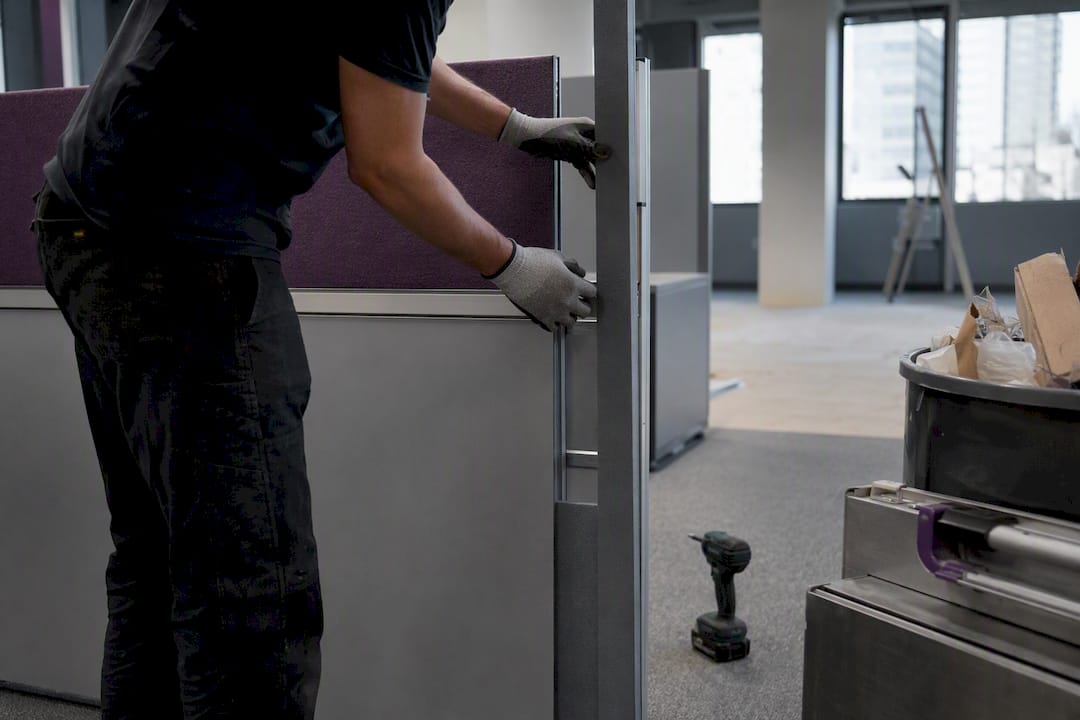
An office make good is your lease obligation to return the premises to the condition agreed when you signed, minus fair wear and tear. The moment your lease end date comes into view, pull out the lease document and any entry condition report, and flag the clause to whoever manages your budget.
Do this first:
- Read the make-good clause word for word, including any schedule attached to the original fitout approval.
- Locate the entry condition report or schedule of condition from when you moved in.
- Notify your landlord or agent early and nominate one person to own the project.
Ballpark figure: office make-good costs typically fall somewhere between $80 and $350 per square metre, depending on scope. Budget conservatively and start planning well in advance before your lease ends.
Key Takeaways
Meeting an office make-good obligation successfully depends on early lease review, documented condition evidence, realistic budgeting, and a 6 to 12 month planning window.
| Point | Details |
|---|---|
| Check your lease first | Make-good scope depends entirely on lease wording, not a standard industry definition. |
| Get condition evidence | An entry condition report with dated photos is the strongest defence against disputed claims. |
| Budget realistically | Expect roughly $80 to $350 per square metre depending on scope and location. |
| Start early | Begin planning 6 to 12 months out for medium or large offices, 3 to 6 months for smaller ones. |
| Negotiate before you strip out | Cash settlements and lease-integrated reuse can cut costs versus full reinstatement. |
| Use a specialist partner | Nicheprojects scopes, prices, and delivers make-good works or supports a negotiated settlement. |
Table of Contents
- What does office make good mean under Australian law?
- Who pays for make good and how is the cost worked out?
- What work does an office make good usually involve?
- How much does an office make good cost in Australia?
- When should you start planning your office make good?
- How can you cut make-good costs and waste?
- What should you do if you disagree with the landlord’s claim?
- Get a fixed-price make-good assessment from Niche Projects
- Frequently asked questions about office make good
- Sources
What does office make good mean under Australian law?
There’s no single legal definition of make good. It’s whatever your lease says it is, which is exactly why so many disputes start with someone assuming the clause means something it doesn’t. Most clauses require removing tenant fitout, repairing damage beyond fair wear and tear, and reinstating the space to base building or another agreed benchmark, as the Queensland Small Business Commissioner explains.
Queensland tenants and landlords should also be aware that the Property Law Act 2023 (Qld) reshapes parts of commercial leasing law in that state, so lease drafting needs to be read alongside current statutory provisions rather than assumed to follow older conventions. Courts elsewhere lean heavily on the plain wording of the clause when disputes arise, and ambiguous drafting is a recurring cause of disagreement.
The single most effective way to prevent a make-good dispute is an agreed schedule of condition, complete with dated photographs, signed off by both parties at lease commencement.
Pro Tip: Dig up the original fitout approval letter, not just the lease. Landlord consent to your fitout sometimes carries its own reinstatement conditions that bind you even if the main lease clause looks general, a detail that catches plenty of NSW tenants off guard.
Who pays for make good and how is the cost worked out?
Generally, the tenant pays where the lease or a statutory default imposes the obligation. Where the clause is silent or genuinely ambiguous, outcomes depend entirely on how a court or mediator construes the lease as a whole.
Landlords measure loss in one of two ways: the actual cost to reinstate the space, or the diminution in the value of their interest. In New South Wales, section 133A of the Conveyancing Act can cap what a tenant owes to that diminution figure, which matters when a landlord plans to re-lease the space as-is rather than rebuild it.
Claims usually arrive in one of two formats:
- A schedule of make good, itemising each task and its estimated cost.
- A Scott schedule, used once a dispute is underway, setting the tenant’s position against the landlord’s item by item.
Typical cost components include:
- Strip-out labour and disposal fees
- Structural and surface repairs
- Base services reinstatement (power, data, HVAC)
- Compliance upgrades where required
- Project management and professional fees
What work does an office make good usually involve?
Scope tends to scale with how much you altered the space. A tenant who kept the original layout might face little more than a paint refresh and carpet clean. A business that built out private offices, a boardroom, and a server room is looking at full strip-out.
Common tasks, roughly in ascending order of scope:
- Professional cleaning and minor patching
- Repainting walls and touching up skirting
- Carpet cleaning or full replacement
- Ceiling tile and lighting reinstatement
- Removal of partitions, joinery, and built-in cabinetry
- Reinstatement of base building services altered during your tenancy
Full structural or compliance remediation gets requested when fire services, HVAC, or emergency lighting were altered without proper sign-off. If you added a kitchenette with its own extraction, expect that to come up.
How much does an office make good cost in Australia?
Reported industry benchmarks place typical office make-good costs between roughly $80 and $350 per square metre, with CBD sites often tracking towards the higher end because of access restrictions, after-hours work requirements, and building management fees.
| Cost driver | Impact on price |
|---|---|
| Extent of fitout removal | More partitions and joinery mean more labour and disposal |
| Base building condition | Older buildings often need more remedial repair |
| Specialist services | Fire, HVAC, and electrical work require licensed trades |
| Compliance upgrades | Required only if the lease demands current-code compliance |
| Site access and scheduling | After-hours or weekend work adds overtime costs |
| Waste and heritage constraints | Heritage-listed buildings often restrict methods and add cost |
A small 150 square metre suburban office with light fitout might land toward the lower end of the range. A 1,200 square metre CBD floor with a full glass-walled office suite, a boardroom, and altered mechanical services will sit well above it, purely because of the scale and trade complexity involved.
Pro Tip: Get your scope agreed in writing before anyone picks up a tool. Vague scope is the fastest way to blow a make-good budget, because every ambiguous line item becomes a negotiation later.
When should you start planning your office make good?
Start 6 to 12 months before lease expiry for medium and large offices. Smaller tenancies can often manage on 3 to 6 months, but don’t assume that buys you room to relax.
- Review your lease and locate the entry condition report.
- Commission or review a schedule of condition if one wasn’t done at the start.
- Open discussions with your landlord about scope and expectations.
- Get quotes and finalise the scope of works.
- Program the works, including any permits or building management approvals.
- Complete a handback inspection and get written sign-off.
Coordination matters as much as the calendar. Nominate a single project contact, confirm after-hours access windows with building management, check your insurance covers the works period, and factor in occupational health and safety obligations for anyone on site.
Pro Tip: Council or building management approvals can take weeks, not days. Factor that lead time in before you commit to a handback date with your landlord.
How can you cut make-good costs and waste?
Reuse beats reinstatement every time cost and sustainability are both on the table, as explained in this fitout sourcing discussion. RICS Australia’s make-good guidance recommends planning for waste minimisation from day one of a fitout, not just at exit.
- Choose carpet tiles over broadloom so damaged sections can be swapped, not replaced wholesale.
- Specify modular joinery that can be relocated to your next office.
- Use lease-integrated fitout options where the landlord agrees upfront to retain certain elements.
- Ask suppliers about take-back schemes for furniture and fixtures.
- Get documented landlord sign-off for anything you want to leave behind rather than strip out.
Negotiation levers worth raising early include cost-sharing for improvements that benefit the next tenant, and negotiated caps or exclusions written into a lease variation. Recycled furniture options can also reduce disposal costs at handback while cutting your carbon footprint.
Pro Tip: If you’re planning a new fitout now, design it with your eventual exit in mind. A handover-friendly office design saves real money down the track.
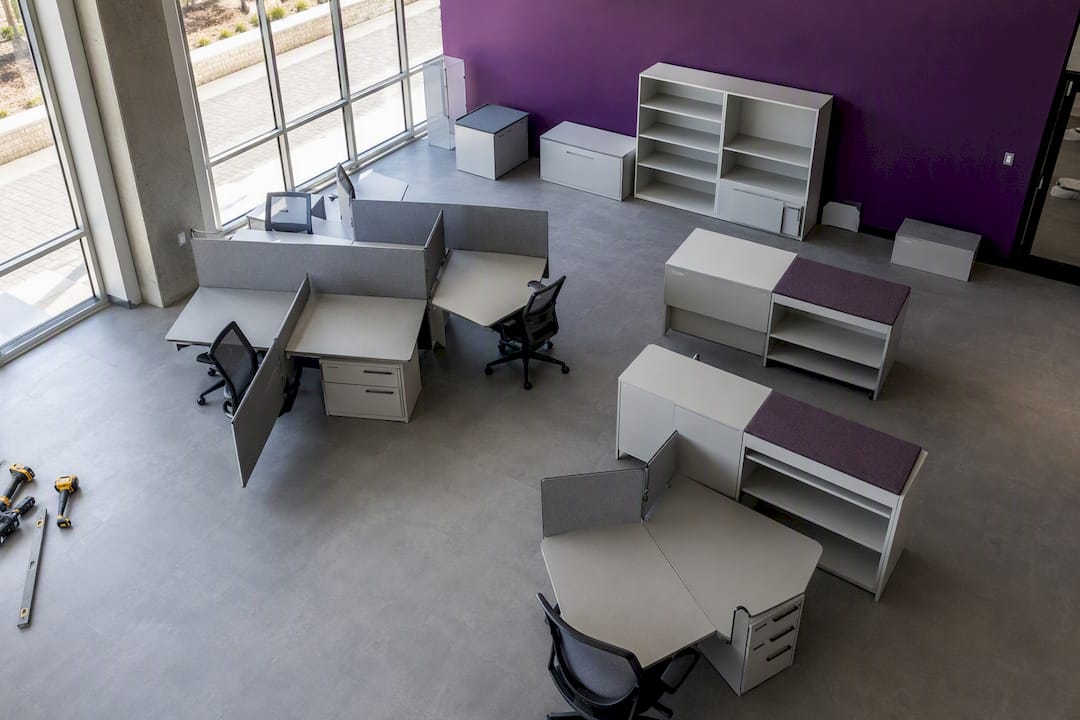
What should you do if you disagree with the landlord’s claim?
Gather your evidence before you argue a number. That means your entry condition report, dated photos, correspondence about fitout approvals, and independent quotes for the disputed works.
Checklist to assemble:
- Original entry condition report and any updates
- Photos taken at both move-in and move-out
- Copies of landlord consent for any fitout alterations
- Independent contractor quotes for disputed items
- Insurance and bond documentation
If the landlord’s figure looks inflated or scope creeps beyond what the lease actually requires, work through this sequence:
- Open direct dialogue with the landlord or their agent first.
- Commission an independent dilapidations report if positions don’t align.
- Exchange a Scott schedule setting out each disputed item side by side.
- Escalate to mediation, a tribunal, or formal legal advice if agreement still isn’t reached.
Cash settlements are often faster and cheaper than physical works for both sides, particularly where the landlord intends to re-lease or redevelop the space anyway.
Get a fixed-price make-good assessment from Niche Projects
Chasing quotes from three different trades while trying to decode your own lease clause is how make-good projects blow out. Nicheprojects works as a single point of contact for the whole process: reviewing scope against your lease, pricing the works accurately, and building in reuse options where the landlord will accept them, so you’re not paying to strip out joinery that could have stayed.
Where full reinstatement isn’t the smartest outcome, Nicheprojects can also help you build the case for a negotiated settlement, backed by proper condition evidence rather than guesswork. If you’d rather explore whether an office refurbishment makes more commercial sense than a full strip-out, that’s worth raising with your landlord before you sign off on a scope.
Get in touch with Nicheprojects for a site inspection and fixed-price make-good quote before your lease clock runs down.
Frequently asked questions about office make good
Does “fair wear and tear” get excluded from my make-good obligation?
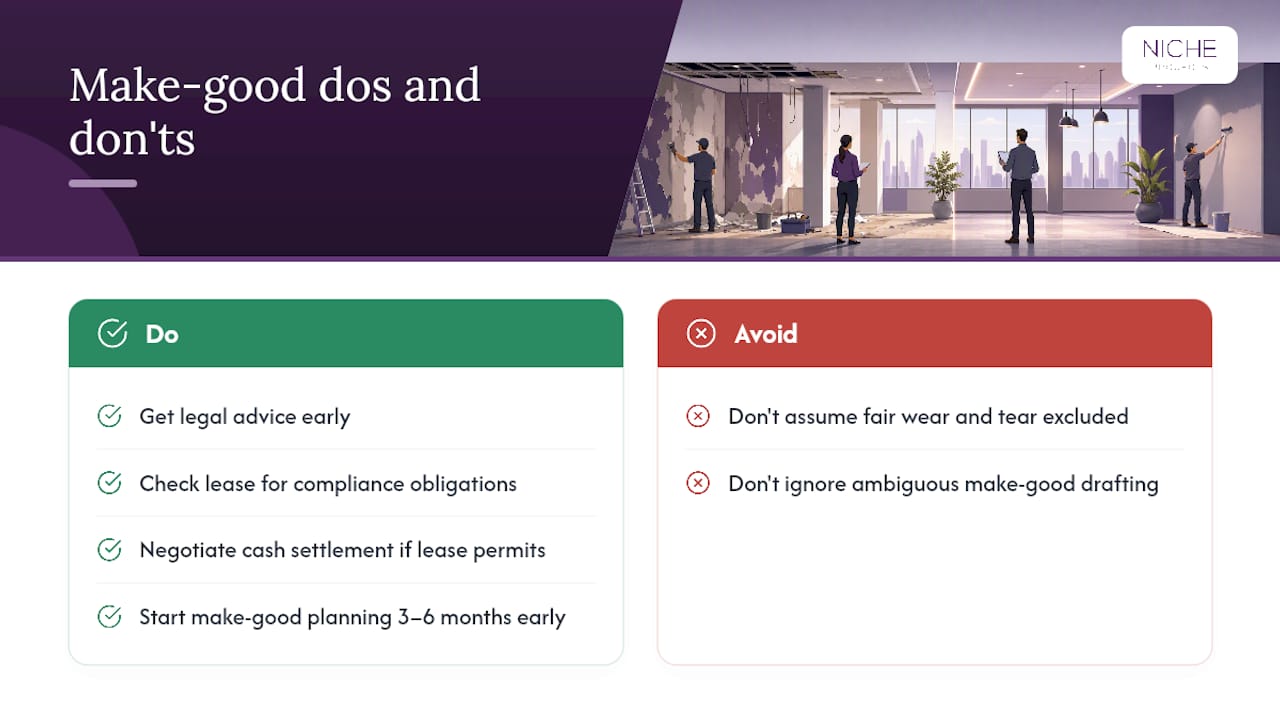
Yes, most Australian commercial leases exclude reasonable wear and tear from make-good obligations, though what counts as “reasonable” after several years of tenancy is often where disputes start.
Can I negotiate a cash settlement instead of doing physical works?
Often, yes. Many landlords prefer a cash settlement, particularly if they’re re-leasing or redeveloping the space, though this depends on what your lease actually permits.
What happens if my lease doesn’t clearly define make good?
Ambiguous drafting is a common source of dispute, and courts will interpret the term based on context and the lease as a whole, so getting legal advice early is worthwhile.
Do I need to upgrade fire or compliance systems as part of make good?
Only if your lease specifically requires compliance with current laws at expiry. Otherwise, obligations are typically limited to restoring the premises to their original compliant condition.
How early should a small office start make-good planning?
Smaller tenancies can often work to a 3 to 6 month timeline, though starting earlier never hurts if your fitout included any structural changes.
This article is general information, not a substitute for advice from a qualified lawyer. Consult a qualified legal professional about your own circumstances before acting on anything here.
Sources
- Make good – Queensland Small Business Commissioner
- Make good: Australia, 3rd edition (RICS, Oct 2023)
- Make Good Obligations in NSW Commercial Leases: What Landlords and Tenants Need to Know – Jake McKinley
- Make Good Obligations In Commercial Leases – Landlord & Tenant – Leases – Australia