
The best workplace strategy examples in Australia share one move: they start from how people actually work, then shape the space, the policies and the change process around it. Mirvac, GPT Group, Unitywater and a construction company all did this in different ways, and each reported measurable results. Below you will find what they did, what they measured and how to turn the pattern into a brief for your own office.
TL;DR
- A workplace strategy links how your people work with the space they work in, so that property decisions follow business goals rather than the other way round.
- Mirvac’s Sydney pilot reported office attendance at twice the rate of its traditional floor, and GPT reported large cuts in paper, floor space and expected energy costs.
- Unitywater, Medibank and a construction company changed work patterns first and reported gains in engagement, retention and space use.
- The common thread is genuine involvement of staff and leaders, plus data gathered before any design or fit-out decision.
- You can use the same sequence: discover, test, design, build and review.
Table of Contents
- What a workplace strategy is, in plain terms
- Example 1: Mirvac’s Adaptive Workplace pilot (Sydney)
- Example 2: GPT Group’s Sydney office refurbishment
- Example 3: Unitywater’s flexible work trials
- Example 4: Four-day week trials at Medibank and Unilever
- Example 5: Construction companies redesigning how people work
- Example 6: Universal Store, Brisbane
- What the examples have in common
- Which example fits your situation
- How to build your own workplace strategy
- Where Niche Projects fits
- FAQ
- Sources
What a workplace strategy is, in plain terms
A workplace strategy is a plan that aligns where, when and how your people work with the physical environment you give them. One widely used definition describes it as the dynamic alignment of work patterns with the work environment to enable peak performance and reduce costs. It sits upstream of design. Before anyone picks a layout, the strategy answers questions such as how many people are in on a typical Tuesday, which tasks need quiet, which need a team around a table, and what the business wants the office to achieve.
That last point matters for executives. A strategy can aim at lower property costs, better retention, a stronger culture, a merger of two teams or a move to a smaller footprint. The examples below each had a different primary aim, which is why they look so different.
Example 1: Mirvac’s Adaptive Workplace pilot (Sydney)
The aim: bring people back to the office by making it a better place to do the work that is hard to do at home.
What they did: Mirvac launched an Adaptive Workplace pilot in May 2022 at its Sydney headquarters, running one floor on a different model alongside a traditional floor so the two could be compared.
What they reported: in its March 2023 Insight Report, Mirvac said employees returned to the pilot floor at twice the rate of the traditional floor, and its most successful team lifted office attendance by 40%. The same report found that, when working at home, employees judged an average of 41.5% of their tasks would have been better done in the office, while only 31.2% of office tasks would have been better done from home.
The lesson: the pilot ran on a real floor with a comparison group and asked people which tasks suit which place. That task-level question is the most useful single input to a strategy, and you can ask it in a short survey before you spend anything on design.
Example 2: GPT Group’s Sydney office refurbishment
The aim: transform how a large organisation uses its space, paper and energy.
What they did: GPT refurbished its Sydney office and redesigned the way people work in it, a project documented in the Green Building Council of Australia’s case study, The business of workplace transformation.
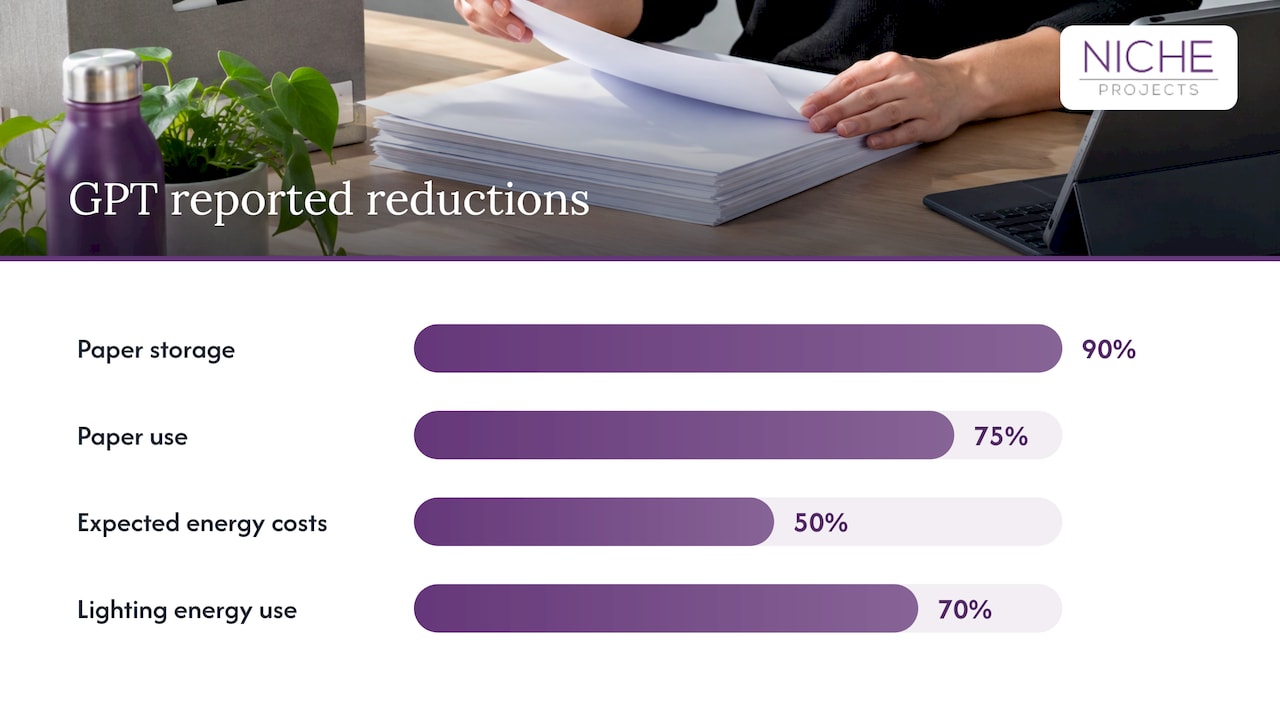
What they reported: the case study lists a 90 per cent reduction in paper storage (900 down to 90 lineal metres), a 75 per cent reduction in paper use, a 50 per cent expected reduction in energy costs, a 70 per cent drop in lighting energy consumption and lower rental costs through less floor space, all delivered at no additional cost to the business.
The lesson: space efficiency and sustainability come from the strategy, not from the fit-out alone. GPT’s head of sustainability, Rosemary Kirkby, is quoted in the same case study saying the key is to put people, not the built environment or technology, at the centre, and to involve everyone from the CEO down with genuine rather than token involvement. If your project is a refurbishment, that is a useful test of your own consultation plan.
Example 3: Unitywater’s flexible work trials
The aim: offer flexibility to every employee group, including field teams who cannot work from home.
What they did: Unitywater trialled nine-day fortnights, 19-day months, four-day work weeks and staggered start and finish times, with shift swapping so field staff could take part, as the Australian Water Association reported in August 2025.
What they reported: the same article says the culture survey showed employee involvement up 8%, turnover at 12% against a national average of 15%, office space utilisation up 21% per square metre and absenteeism trending down.
The lesson: a strategy does not have to be about desks. Unitywater changed work patterns and the space result followed, because a team on staggered schedules uses the same floor more evenly. For an office manager, this is the link between HR policy and floor plan: schedule patterns determine how many seats you actually need.
Example 4: Four-day week trials at Medibank and Unilever
Some organisations treat working time as the core of the strategy. Medibank began a four-day week trial in November 2023 with 250 employees and expanded it to more than 500 participants after strong results in engagement, wellbeing and performance. Medibank’s sustainability page says the program is independently evaluated by the Health and Wellbeing Research Unit at Macquarie University’s Business School.
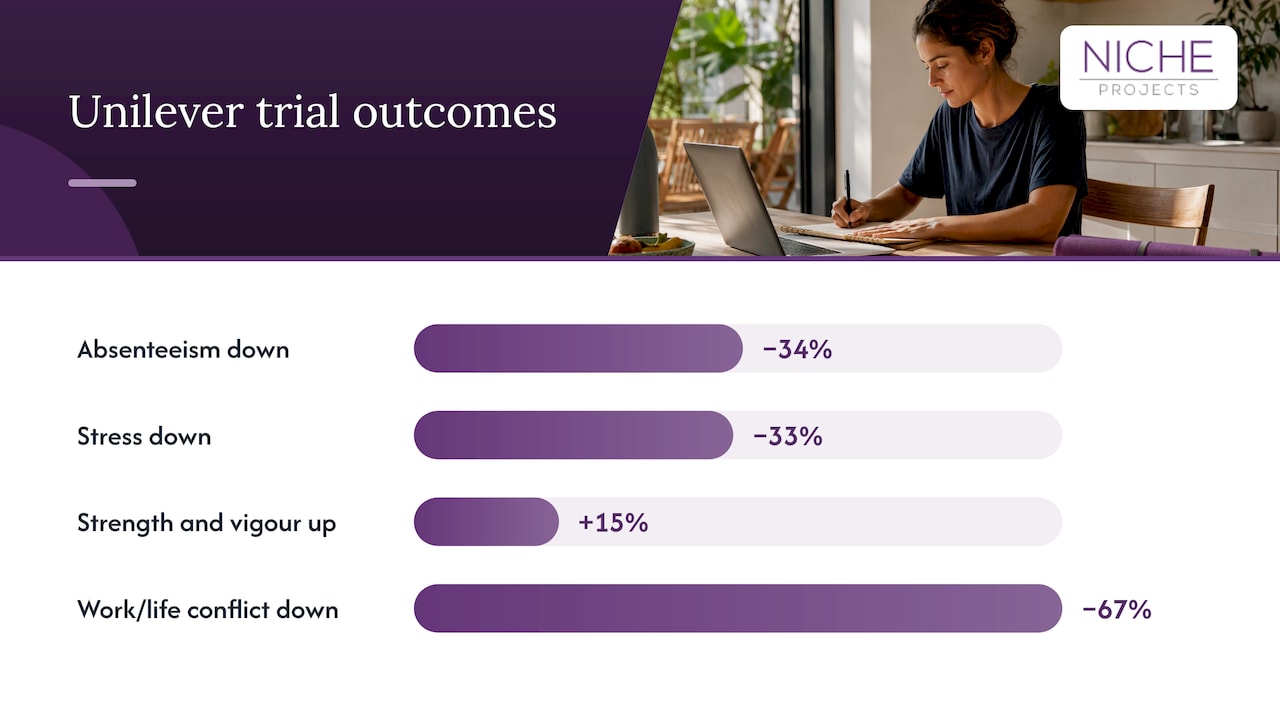
Unilever Australia and New Zealand extended its four-day week trial to Australia after an 18-month pilot in New Zealand. UTS research reported absenteeism down 34%, stress down 33%, feelings of strength and vigour at work up 15% and work/life conflict down 67%. Unilever’s Australia and New Zealand CEO tied the trial to a performance culture and to the wellbeing of both people and the business.
The lesson: both organisations framed the trial around a business goal and had it independently evaluated. If you test a new work pattern, decide in advance what you will measure and who will check it. The space implication follows: a compressed week changes peak-day occupancy, so the layout and desk ratios deserve a second look.
Example 5: Construction companies redesigning how people work
Construction is a hard test, because much of the work is on site. Three Australian examples stand out.
A construction company’s flexibility rollout. A peer-reviewed case study, Mainstreaming Workplace Flexibility, reports that about three-quarters of employees saw improvements in job satisfaction (72%), morale and motivation (73%) and commitment and loyalty (69%). Smaller shares reported more involvement in family life (46%), better health and wellbeing (45%) and improved work/life balance (45%). The company then made flexibility mandatory for all future projects and trained 217 managers to facilitate team-based flexibility.
Seymour Whyte’s My Time. This initiative, developed in consultation with the Construction Industry Cultural Taskforce, centres on individual My Time Plans for priorities such as fitness, childcare, professional development and community involvement.
The M7-M12 Integration project. The Australian HR Institute reported in July 2025 a turnover rate of four per cent against a construction industry average of 9.2 per cent, and 39 promotions since 2023. Its Flex Boards, placed around the site, let employees show how they are using flexibility so that teams can manage coverage among themselves.
The lesson for construction leads: the managers’ training and the visible, team-level coverage system did as much work as the policy. If you run project teams, build coverage rules into the plan from the start, and give leaders the skills to apply them.
If you are also drafting the health and safety side of a people-first plan, a worked example of a workplace safety policy shows how a written policy can be tied to day-to-day operations.
Example 6: Universal Store, Brisbane
A Taylor & Francis case study on Universal Store in Brisbane, published in June 2024, states that a high-performance workplace starts with a clear strategy that connects the space (design) with people (change management). It points to the role of data in building a vision, scenario planning, visible leadership and giving people the right spaces, tools and training.
This is the clearest statement of why design and change management belong in one plan. A beautiful fit-out without the change work around it leaves people with a new space and the old habits.
What the examples have in common
Lay the examples side by side and five patterns repeat.
| Pattern | Where it showed up |
|---|---|
| Test before committing | Mirvac’s two-floor pilot, Unilever’s 18-month pilot, Medibank’s trial |
| Ask which tasks suit which place | Mirvac’s task-level survey findings |
| Involve people genuinely | GPT, the construction company’s team-based redesign |
| Equip managers | 217 managers trained in the construction case |
| Measure against a goal | Attendance, turnover, absenteeism, energy, floor space |
Notice also that the aims differ. Mirvac wanted attendance, GPT wanted efficiency and sustainability, Unitywater wanted retention and engagement. Choosing the primary aim first stops a strategy becoming a list of nice ideas.
Which example fits your situation
You are an executive asking whether the office is worth it. Start with GPT and Mirvac: both tie space to measurable business outcomes, one on cost and efficiency, the other on attendance and task fit.
You are an HR manager working on inclusion and retention. Unitywater and the construction cases show how flexibility reaches groups who are usually left out, such as field staff. Include accessibility, neurodiversity and caring responsibilities in your discovery questions so the space supports the same people the policy does.
You are an office manager facing a seat-count problem. Use Unitywater’s lesson: schedules drive space need. Collect badge or desk-booking data for a few weeks and compare peak and average occupancy before you decide how much space to keep.
You are a business owner thinking of refreshing the office. Read the GPT case first. It shows that refurbishment can reduce floor space and running costs, and our guide on refurbishing versus relocating sets out the decision.
How to build your own workplace strategy
The sequence below is drawn from the examples above and from the way strategy and design projects usually run.
1. Set the business goal
Write one sentence: what should the workplace do for the business? Retain people, cut occupancy cost, support a merger, lift collaboration. Every later decision gets checked against it. The usual failure here is listing five goals that pull in different directions.
2. Gather data on how people work
Use occupancy data, a short task-based survey (the Mirvac question: which tasks are better done where?) and interviews with a cross-section of staff, including people who rarely speak up in meetings. The usual failure is relying on leadership’s assumptions or on the loudest voices.
3. Involve people early and genuinely
GPT’s lesson was involvement from the CEO down, genuine rather than token. Run workshops by team, share findings back and show what changed because of the input.
4. Test a pilot
Mirvac and Unilever both piloted. Pick one floor or one team, set two or three measures and a review date. A pilot lets you correct a layout before it is built across the whole office.
5. Translate the strategy into space
This is where the strategy becomes a brief: the mix of focus areas, meeting rooms, collaboration zones and quiet spaces, the seat ratio, and the services and finishes to support them. The way layouts have changed is covered in our piece on the evolution of office layouts, and our article on agile workspaces explains how flexible settings are planned.
6. Deliver the build and the change together
A fit-out or refurbishment is the moment people notice the strategy. Align the construction program with communications and manager briefings so staff know how the new space is meant to be used. Our guide to managing your office fit out walks through the delivery side.
7. Measure and adjust
Revisit the numbers you chose in step 1. Attendance, utilisation, turnover and survey scores all move slowly, so review at set intervals instead of after a few weeks.
Where Niche Projects fits
Niche Projects offers workplace strategy, office design, space planning, office fit-out, refurbishment and construction management for commercial clients in Sydney. Because creative design and construction expertise sit in one team, the strategy you agree is the strategy that gets built, with consistent communication through the project. If you are weighing up a strategy-led project, start with our workplace strategy service, or go straight to Sydney office design or office fit-out and refurbishment. For current thinking on layouts and materials, see our 2026 workplace design trends.
FAQ
What is an example of a workplace strategy?
Mirvac’s Adaptive Workplace pilot is a clear one. It redesigned a Sydney floor around the tasks people find better done in the office, ran it beside a traditional floor and reported attendance at twice the rate. The strategy covered the space, the work patterns and the measures together.
Do workplace strategy case studies show measurable results?
Yes, when the organisation chose its measures in advance. GPT reported cuts in paper use, expected energy costs and floor space, while Unitywater reported turnover, space utilisation and engagement results. Pick two or three measures tied to your goal before you start.
Is a workplace strategy only about hybrid work?
No. The examples above include a refurbishment aimed at efficiency and sustainability, four-day week trials, staggered schedules for field teams and a construction flexibility program. Hybrid work is one input, and the strategy also covers goals, culture, cost and the space itself.
Who should be involved in building a workplace strategy?
Leaders, HR, facilities or office management, and a cross-section of staff. GPT’s case study stresses involvement from the CEO down that is genuine rather than token. Add the people who will build and maintain the space early, so the design is practical to deliver.
Sources
- How to define and launch a global workplace strategy
- Mirvac Adaptive Workplace Insight Report, March 2023
- The business of workplace transformation, GBCA
- Unitywater’s flexible work approach, Australian Water Association
- Work. reinvented, Medibank
- UTS research on the Unilever four-day work week
- Mainstreaming Workplace Flexibility, IJBSS
- My Time flexible work initiative, Seymour Whyte
- M7-M12 flexible wellbeing program, Australian HR Institute
- Case study: Universal Store, Brisbane, Taylor & Francis