
A workplace pilot program is a time-boxed trial of a new way of working in a real, contained part of your office. A team uses a proposed layout for several weeks, you measure how it performs, and you use the results to decide whether to refine, expand or drop the design before committing to a full fit-out. Done well, it replaces opinion with evidence. At Niche Projects, workplace strategy, office design and construction sit under one roof, so a pilot can move from the first test zone to the final fit-out without a handover gap.
TL;DR
- A pilot (also called a pilot workspace or office pilot space) is a small, working section of the office set up in the proposed layout and used by a real team.
- Mirvac’s Sydney pilot rotated teams through every four to six weeks over 12 months. Its first trial teams saw an 18 per cent rise in utilisation over six weeks.
- Decide what the pilot must prove, choose a representative team, collect the same data before and after, and agree the decision rules in advance.
- Test behaviour as well as furniture: how people collaborate, focus and move between settings matters as much as the layout.
- A good pilot feeds straight into design and fit-out, so the lessons are built into the final space.
Table of Contents
- What a workplace pilot program actually is
- Why trial a design before you roll it out
- How to plan and run a workplace pilot
- How long should a pilot run, and what does it cost?
- What to measure
- Inclusion, collaboration and wellbeing in a pilot
- Deciding: refine, expand or end
- Turning a pilot into a finished workplace
- A short checklist before you launch
- FAQ
- Sources
What a workplace pilot program actually is
The phrase gets used for many things in Australia. Search it and you will find government employment schemes and four-day-week trials. This article is about the property kind: a pilot of a physical and behavioural change in your office.
The best-known local example is Mirvac’s Adaptive Workplace pilot at its Sydney headquarters, launched in May 2022. It was a 1,300 sqm hybrid, test-and-learn space. Teams from different business units rotated through every four to six weeks across a 12-month period, and the layout was adapted continuously according to feedback and insights.
You do not need 1,300 sqm to do the same thing in principle. An office pilot space can be a single meeting zone, a neighbourhood of 20 desks or one floor. What makes it a pilot rather than a refurbishment is that:
- it is used by real people doing real work;
- it has a defined start and end;
- it is measured against questions you set beforehand;
- the outcome genuinely changes what you build next.
Test behaviour, not just furniture
A pilot that only swaps chairs and desks answers a narrow question. Steelcase’s 2023 whitepaper on pilots and prototypes argues pilots should be broad enough to cover behavioural shifts, meaning how people interact with each other and with their work. That is the right frame. The layout is a hypothesis about behaviour: that people will book fewer rooms, collaborate across teams, or come in on the days that suit their work. The pilot tests that hypothesis.
Why trial a design before you roll it out
Fit-outs are expensive and hard to reverse. A pilot gives you a cheap place to be wrong.
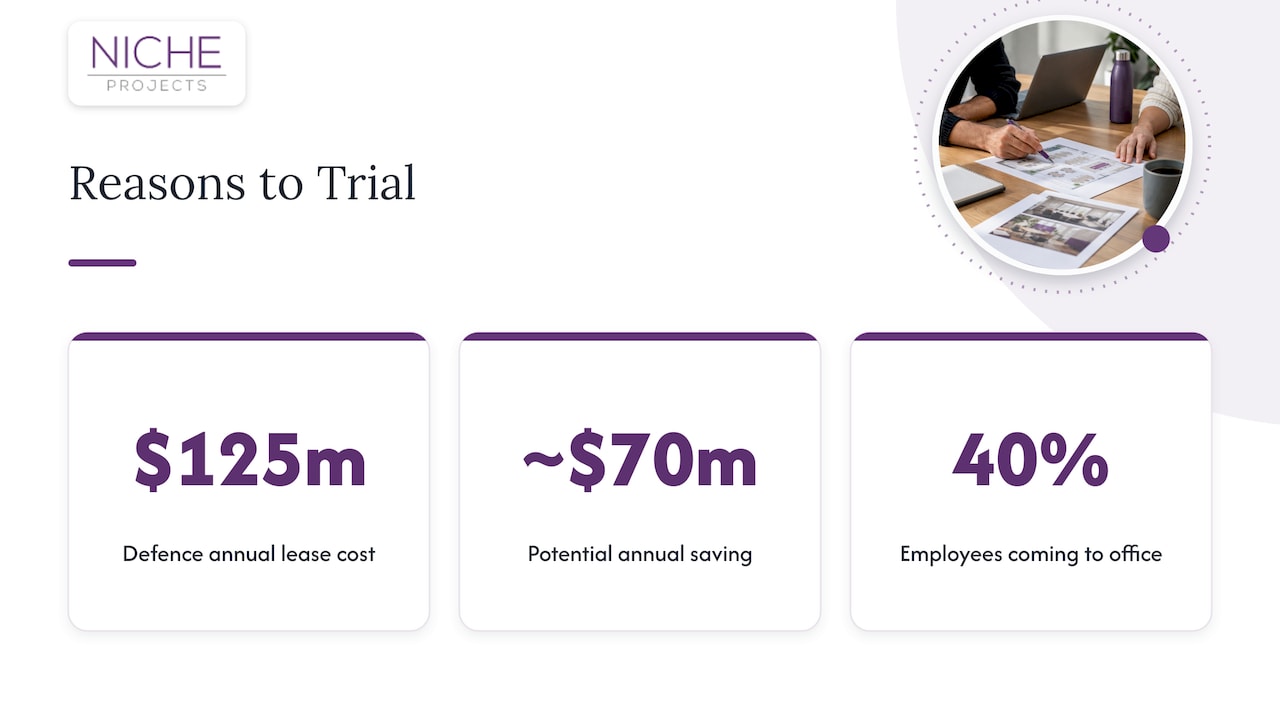
The Australian public sector shows the scale of the money involved. When the Department of Defence planned to trial activity-based working at its Brindabella Park office before a broader rollout, The Canberra Times reported that Defence leased 261,000 sqm at about 16.4 sqm per desk, costing around $125 million a year. An activity-based model could cut that to about 10 sqm per person, a potential saving of about $70 million a year. Few businesses operate at that scale, but the logic holds at any size: a small error in space per person is multiplied across every desk and every year of the lease.
The second reason is adoption. In Mirvac’s pilot, the most successful team recorded a 40% uptake in employees coming into the office, which the report attributes to proactive staff engagement and curation. A design is only as good as the way people are brought into it.
The third is advocacy. Building Design + Construction notes that effective change management turns pilot occupants into ambassadors, who promote the new workplace to colleagues through their own positive experience. Colleagues trust a peer more than a floor plan.
How to plan and run a workplace pilot
The steps below follow the order we would run them. Each shows what it takes and where it usually goes wrong.
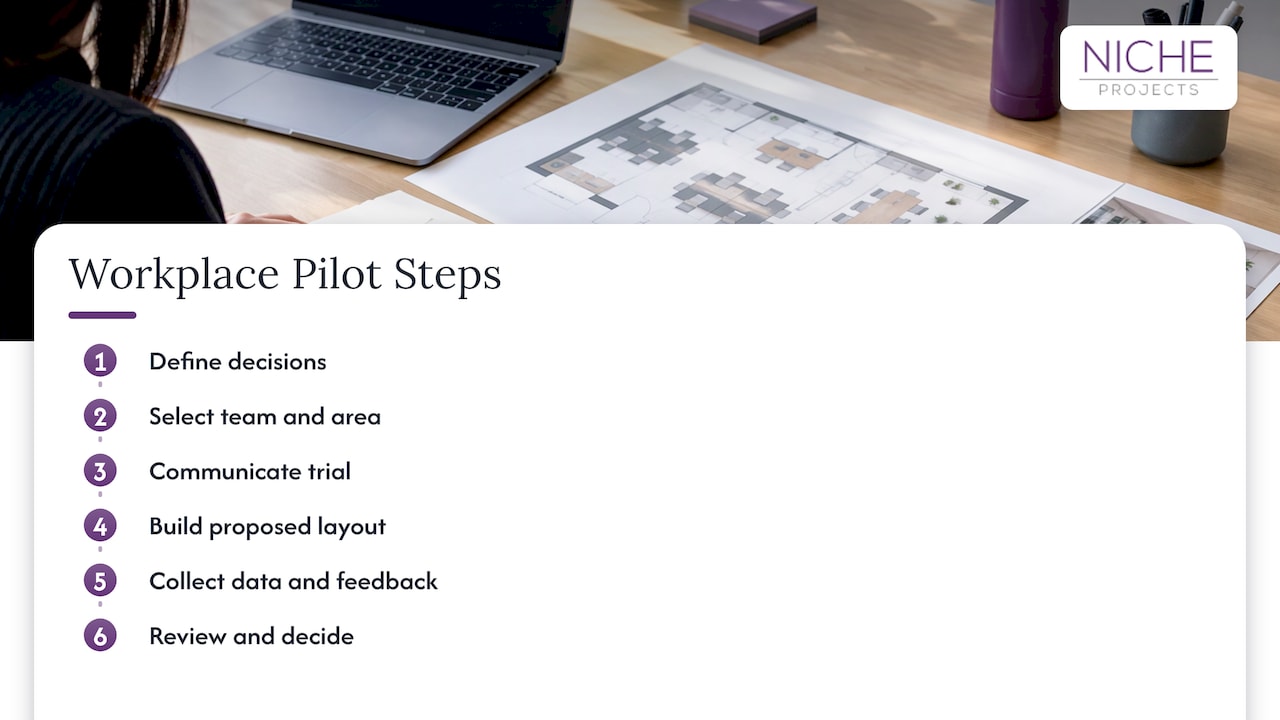
Step 1: Define the decisions the pilot must inform
Start with the decision, not the design. Examples:
- How many desks per person can we safely plan for?
- Do zone-based settings reduce noise complaints?
- Will a new collaboration area be used, or will it sit empty?
- Does the layout support the days our teams want to be together?
Where it goes wrong: pilots launched with a vague aim of “seeing how it goes” produce feedback that cannot settle anything. Write down three to five questions and the result that would answer each one.
This is the stage where workplace strategy does the heavy lifting. Our workplace strategy framework covers how hybrid work, wellbeing and technology shape those questions, and Niche Projects’ workplace strategy service is where we turn them into a brief a pilot can test.
Step 2: Pick a representative team and a contained area
Choose a team whose work reflects the wider organisation, not your keenest early adopters or the quietest department. Choose an area you can fence off, reconfigure and measure without disrupting everyone else.
Where it goes wrong: a pilot with enthusiasts proves the design works for enthusiasts. Include people whose work is demanding on the space, such as heavy phone users, people who need quiet focus, and people with accessibility needs.
Step 3: Tell people it is a test
Be plain that this is a trial and that feedback will shape the final design. It lowers the stakes, invites honest criticism and sets expectations that things will change mid-pilot. The Australian Taxation Office takes a similar approach, planning ongoing staff engagement during fit-out design, including prototype furniture so staff can test task chairs, workstations, storage and technology options and give feedback.
Where it goes wrong: people who think the decision is already made give polite feedback or none at all. Change management matters as much as the layout, which is why we treat change management and office design as one job.
Step 4: Build the pilot in the proposed layout
Build the space as close to the intended design as practical: the same zoning, the same ratio of focus to collaboration settings, the same technology. Use movable elements where you can, so the layout can change as you learn. Mirvac’s report describes a reconfigurable kit of parts that lets employees adapt spaces to tasks, and its zones were reconfigured 12 times during the trial to address noise and collaboration needs.
Where it goes wrong: a half-finished pilot with temporary power, poor acoustics or no wayfinding tests the shortcomings of the pilot, not of the design. Partitions, ceilings, flooring, joinery and services all affect how a space feels, and building them properly is where design and construction need to speak to each other. Our team handles office design and office fit-out and refurbishment together, so what is drawn is what gets built.
Step 5: Collect data and listen
See the measurement section below. Set up your baseline before the team moves in.
Step 6: Review, adjust and decide
Hold a short review at the midpoint and a formal one at the end. Adjust in between: a pilot that cannot change is just a small fit-out.
How long should a pilot run, and what does it cost?
There is no single correct length, but the evidence points to weeks rather than days. Mirvac’s rotation cycle was four to six weeks per team, and its first trial teams recorded an 18 per cent increase in utilisation over a six-week period. That is long enough for novelty to fade and habits to show, and short enough to keep momentum. If your question concerns seasonal patterns or several teams with different rhythms, rotating teams through, as Mirvac did, gives you a wider read.
A practical way to set the length:
| Pilot scope | Typical shape | What it can answer |
|---|---|---|
| One zone (for example a breakout or collaboration area) | Four to six weeks | Whether the setting is used and for what |
| One team’s neighbourhood | Six or more weeks | Desk ratios, noise, day-to-day workflow |
| A floor or several teams in rotation | Several months | Utilisation patterns, culture and change readiness |
The table is a planning guide rather than a published standard. Match the length to your questions.
Cost depends on the size of the area, the finishes, the technology and how much construction work sits behind the temporary setup, so we do not publish a figure here. The cost question that matters most is the comparison: a pilot is a fraction of the area you will eventually fit out, and it tests the assumptions the whole budget rests on. For a scoped estimate on your own floor, talk to us about a Sydney office design or fit-out. If you are returning teams to the office, our guide on piloting a return-to-office design in four to six weeks shows how a short pilot can be structured.
What to measure
Combine what people do with what people say.
Behavioural and space data
- Utilisation: how often desks, rooms and zones are occupied, and at what times. Mirvac tracked how the space was used, how teams collaborated and how leaders managed their teams.
- Attendance patterns: which days and which teams.
- Room and zone use: which settings fill, which sit empty, and why.
- Density: compare against a reference point. The Australian Government’s occupational density target is 14 m² per occupied work point, a useful benchmark if you are testing a leaner ratio.
Employee perception data
Thrive at Work recommends gathering perception data through surveys, interviews and focus groups, using affect questions (how people feel about the activity) and behavioural questions (whether it has changed how they think or behave at work). Both are worth asking. A space people like but do not use needs a different fix from one they use but dislike.
Use the same survey before and after
The NSW Public Sector Commission’s flexible working trial toolkit recommends using the same survey before and after the trial to obtain measurable results that can be communicated to others. It also recommends sending evaluation questions at the end of the trial period before deciding whether new arrangements become business as usual. That discipline works for any office pilot, not just flexible working.
Inclusion, collaboration and wellbeing in a pilot
A pilot is the cheapest moment to find out whether a design works for everyone. Mirvac’s report notes that pilot workspaces can support accessibility and neurodiversity through a diverse, equitable range of settings, and that a reconfigurable kit of parts helps people adapt spaces to their tasks and collaborate. It also stresses that workspace curation is as important as physical design for hybrid working success, which means active leadership during the pilot, not just a good layout.
Practical ways to build this in:
- Include people with different access, sensory and focus needs in the pilot group, and ask them specific questions.
- Offer a range of settings: quiet focus, small huddle, open collaboration, and places to retreat.
- Ask what is missing, not just what is used.
- Have leaders visibly use the space and encourage teams to do the same.
If breakout areas are a priority, our guide to piloting breakout space design in four steps walks through a focused version, and zone-based hybrid layouts show how different settings fit together.
Deciding: refine, expand or end
Agree the rules before the pilot starts, so the decision is not argued from scratch when emotions are running high. A simple structure:
- Expand when the pilot meets the success measures you set and feedback is broadly positive across different groups.
- Refine when use is good but specific settings (noise, booking, storage, technology) fail. Change them and run a further cycle on that element.
- End or redesign when the core hypothesis fails, for example when people avoid the new setting even after adjustments.
An ended pilot is not a failure. It is the cheapest possible answer to an expensive question.
The scale of the learning can be large. Westpac built pilot floors featuring activity-based working in Melbourne and Sydney ahead of a group-wide rollout. According to iTnews, more than 1,000 employees moved into 150 Collins Street in November 2014, and 350 staff on one level of the Kent Street offices in Sydney became the second corporate site to transition. Staff had no assigned desks or deskphones and used a WorkSmart app for meeting room booking, desk location and feedback. The technology and the feedback channel were part of the pilot, not an afterthought.
Researchers Cirillo and Rosenblatt describe the wider payoff as a learning-by-doing approach to corporate real estate, where piloting generates data that informs future plans and space types across a whole portfolio.
Turning a pilot into a finished workplace
The weak point in many pilots is the handover. The lessons are collected in a report, then a different team redraws the plans, and a third builds them. Details get lost.
Niche Projects offers workplace strategy, office design, space planning, office fit-out, refurbishment and construction management, combining creative design with construction expertise. For a pilot, that means the people who help you frame the questions can also design the zone and, once the results are in, carry the findings into the full project. The project side is covered in our guide to managing your office fit-out, and our office fit-out and refurbishment service is the next step once your pilot says go.
We work across Sydney, including the CBD, North Sydney, Ryde, Macquarie Park, Sydney Olympic Park and Greater Western Sydney.
A short checklist before you launch
- Three to five written questions the pilot will answer.
- A representative team and a contained, well-built area.
- A baseline survey and baseline utilisation data.
- A message to staff that this is a test and their feedback will shape the design.
- A named leader who will use the space and encourage others.
- A mid-point review date and a final decision date.
- Pre-agreed rules for expand, refine or end.
FAQ
What is an office pilot space?
It is a small working section of an office set up in a proposed layout and used by a real team for several weeks. Feedback and usage data gathered during that time guide the full buildout. The aim is to test assumptions about space, behaviour and technology before spending on the whole floor.
How long should a workplace pilot run?
Mirvac’s Sydney pilot rotated teams through every four to six weeks within a 12-month programme, and its first trial teams showed a measurable utilisation increase over six weeks. For a single zone, four to six weeks is a sensible starting point. Larger pilots covering several teams usually need more time to show real patterns.
Who should be in the pilot group?
Choose a team that represents how the wider organisation works, including people with different focus, access and collaboration needs. Avoid selecting only enthusiasts. Tell them clearly that it is a test and that their feedback will shape the final design.
What should we measure?
Track space use (utilisation, attendance, zone and room use) and employee perception (surveys, interviews and focus groups). Use the same survey before and after so the results are comparable, and include questions on both how people feel and how their behaviour has changed.
Can a pilot lead straight into a fit-out?
Yes, and it works best that way. When the team that designs the pilot also delivers the fit-out, the lessons carry into drawings and construction without being re-explained. Niche Projects provides workplace strategy, design and construction management for Sydney offices.
Sources
- Mirvac Launches Future Workplace Pilot at 200 George Street
- Mirvac Adaptive Workplace Insight Report, March 2023
- The Canberra Times: Defence Department flags major four-year ACT office fit-out project
- Building Design + Construction: Workplace pilots, Test. Learn. Build
- Steelcase 2023 Whitepaper: Pilots and Prototypes
- Parliament of Australia document store: ATO fit-out and Australian Government density target
- Thrive at Work: Collecting data
- NSW Public Sector Commission: Design your own flexible working trial toolkit
- iTnews: How Westpac is using tech to transform its 200-year old workplace
- Piloting: Adopting a prototype mindset for today’s workplace