
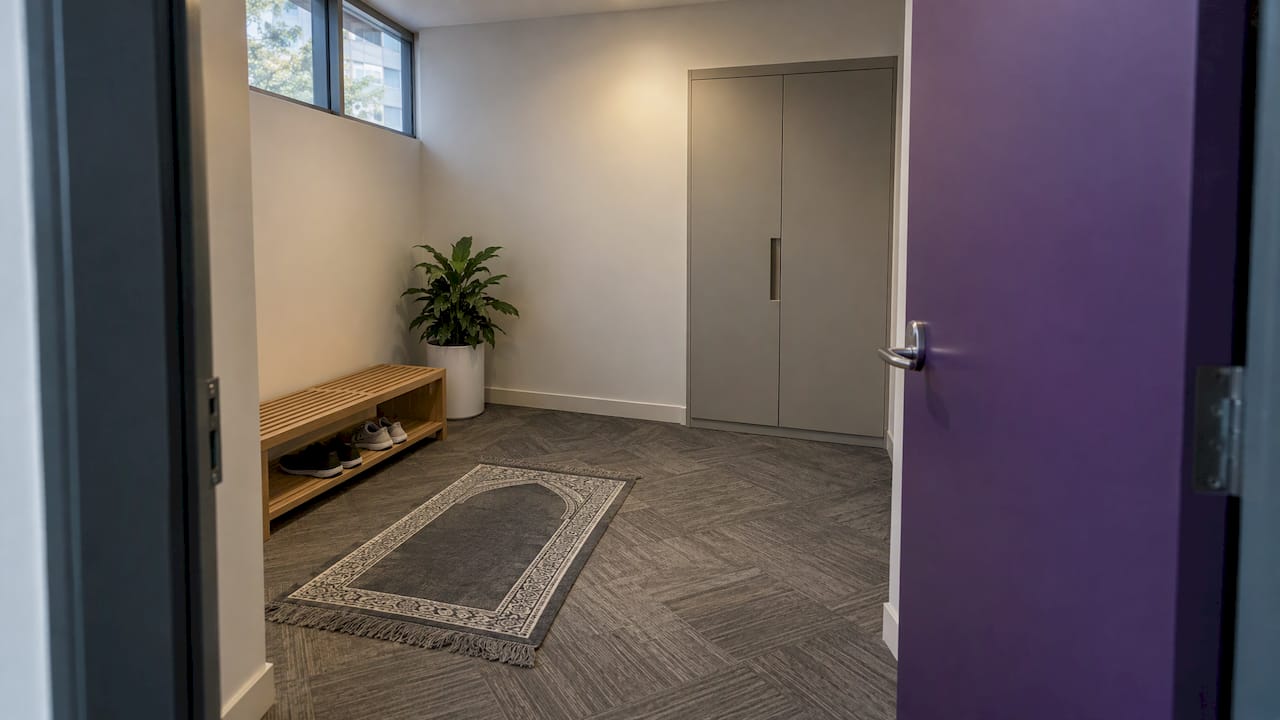
A workable office prayer room is a small, quiet, clean, lockable or screened room, sized for one or two people at a time, with storage for mats, a clear direction marker and a washing facility close by. It is cheapest and most effective when it is planned into the fit-out or refurbishment from the start, not squeezed in later. At Niche Projects we design and build Sydney workplaces, and a prayer room is one of the smaller rooms that most affects whether people feel the office was designed for them.
This guide is for the people who commission and run the space: executives, HR managers, office managers and business owners. It covers what the room is for, what Australian guidance says about it, how to size and build it, and how to find the space when the floorplate is tight.
TL;DR
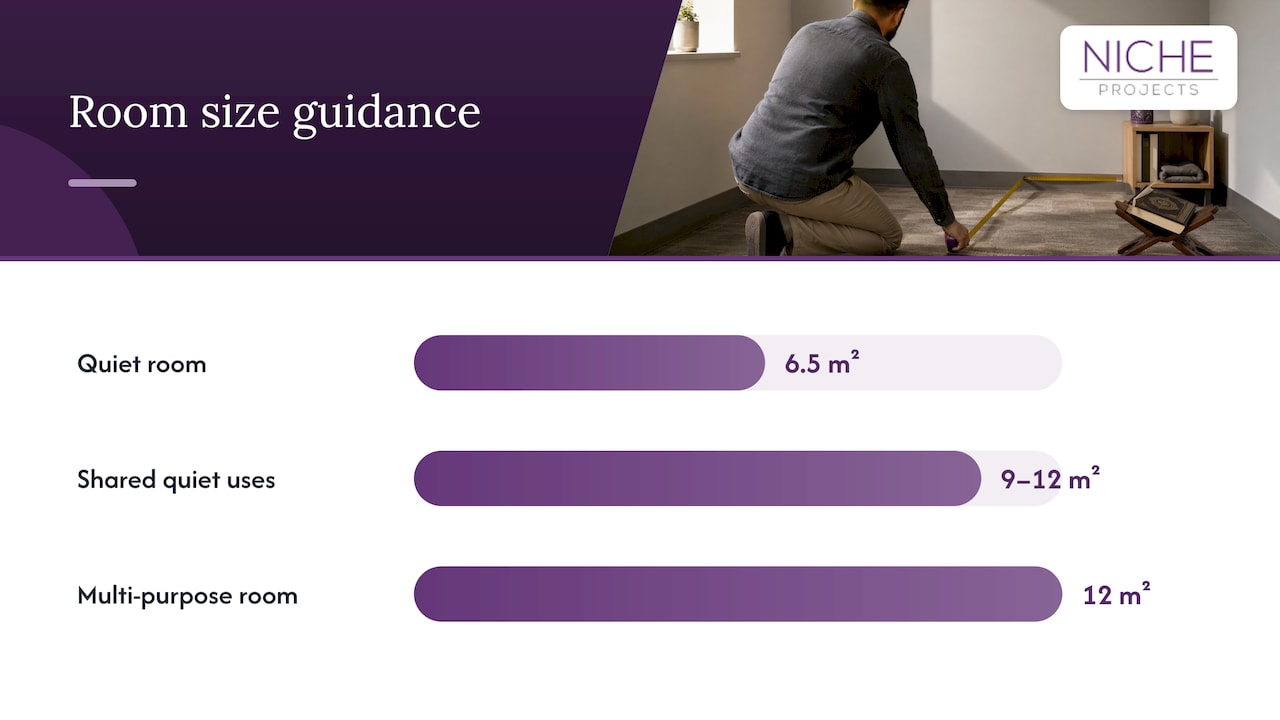
- Plan for one or two people at a time. South Australian government fit-out guidelines use 6.5 m² for a quiet room and 12 m² for a wellness or multi-purpose room.
- Acoustics decide whether the room is usable: aim for a 40 Dw wall rating, and remember that a door can take 5 to 10 points off it.
- Muslim employees typically pray twice in a 9am to 5pm day, about five minutes each, and need a clean, dry, quiet place, mat storage and somewhere to wash beforehand.
- No single national law says “build a prayer room”, but WorkSafe Victoria’s workplace facilities code names prayer or religious rooms as an example of a personal-needs facility, and religion is protected under Australian discrimination law.
- Build it into the next fit-out or refurbishment, and consult your people before the design is fixed.
Table of Contents
- What an office prayer room is for
- Do you have to provide one?
- What people need from the room
- Designing the room: size, privacy, acoustics and access
- Finding the space when the office is small
- A short planning checklist
- Getting it built into your fit-out
- FAQ
- Sources
What an office prayer room is for
A prayer room gives employees a private, quiet place to observe prayer during the working day without having to ask for a meeting room, hide in a stairwell or go without. It also serves people who want a few minutes of stillness for reasons that have nothing to do with religion.
Victoria’s Department of Education guidance on inclusive workplace facilities lists multi-faith rooms among dignified facilities. It also recommends quiet sensory spaces with adjustable lighting, minimal strong smells and low noise in and around the room. That is a useful design brief in one sentence: calm light, neutral smell, low sound.
Diversity Council Australia’s Creating Inclusive Multi-faith Workplaces resource frames inclusion as a higher aspiration than simply meeting legal accommodation requirements. Its idea is that people of diverse backgrounds feel respected, connected, contributing and progressing. A prayer room is one visible, physical signal of that, and DCA’s updated guide builds on it with seven levers for faith inclusion at work, which range from leave policies to inclusive events and responses to discrimination. The room works best as one part of that wider practice, not a substitute for it.
Do you have to provide one?
This is the question most office managers ask first, and the honest answer is that it depends on your state, your workforce and what is reasonably practicable. Here is what the official and professional sources say.
Facilities codes. WorkSafe Victoria’s compliance code on workplace facilities (December 2023) says employers must consult employees when choosing or designing facilities, and should consider additional access or personal needs, including cultural or gender-related needs. It gives prayer or religious rooms as an example and says employees should have suitable privacy and security. The same code ties facilities to the duty to provide adequate welfare facilities “so far as is reasonably practicable”, and notes that being unable to access adequate facilities can be a psychosocial hazard as well as a physical one. It is a Victorian code, so treat it as a strong benchmark if you operate elsewhere, and check the equivalent in your own jurisdiction.
Discrimination law. Australia has no federal Religious Discrimination Act. Religion is protected through the Fair Work Act 2009 general protections and through state and territory anti-discrimination law, so religious harassment and discrimination are unlawful, with complaints going to the Australian Human Rights Commission, state or territory bodies or the Fair Work Commission. A 2025 brochure from the International Commission of Lawyers for Religious Freedom notes that facially neutral requirements can be unlawful indirect discrimination if they unreasonably affect religious observance, and that courts weigh factors such as workforce size.
Newer positive duties. A 2026 Melbourne University Law Review article reports that the ACT’s Discrimination Amendment Act 2023 and a 2022 Northern Territory amendment reframed reasonable adjustments as a positive duty, including for religion, unless it causes unjustifiable hardship. The same article describes the Fair Work Act’s right to request flexible working arrangements, which needs a written request and a written response within 21 days, as a route employees can use for prayer-time adjustments.
The practical reading: a room is not a box you tick once and forget. Employment lawyers point out that liability turns on what an employer did or did not do, such as training, a used complaints process and acted-on reports, so a prayer room policy alone does not discharge obligations. A well-designed room, a clear booking or usage protocol and a consultation record sit together. For a specific situation, such as a request you are unsure how to handle, speak to your employment lawyer or HR adviser.
What people need from the room
Design starts with use. The Victorian Human Rights Commission’s guide for employers working with Muslim employees (May 2022) is clear and practical:
- Muslims generally pray twice in a normal 9am to 5pm day, around 1pm and 4pm, each prayer taking about five minutes.
- Prayer can be performed in any quiet, dry, clean place where a prayer mat can be used.
- Ablution, which means washing the face, hands and feet, is required beforehand.
- Employers are encouraged to provide a clean, quiet room that can operate as a prayer room, allocate storage for prayer mats and let employees know they are happy to discuss needs.
That has two design consequences. First, demand clusters around the same two windows, so a room for one or two people at a time is usually enough in a small or mid-sized office, but you should check your headcount and floors. Second, the room is only half the solution: if the nearest place to wash is a kitchen sink or a shared basin in a busy corridor, many people will not use it.
UK police guidance on prayer provision (College of Policing, 2021) goes further on detail, and is a useful reference for what a thorough room contains. It recommends prayer mats, storage for religious items, a comfortable chair, no images of people or animals, space for prostration, clear Qiblah markings and a seated wudu facility within or near the room. The Qiblah is the direction Muslims face to pray, and a ceiling arrow is described as best practice because it stays correct whatever way furniture moves. The same guidance suggests allowing about 15 minutes per prayer including ablution, which is worth remembering when you estimate how many people can use the room across an hour.
That guidance also observes that faith rooms work best when used for prayer rather than as general wellbeing spaces, because mixed use can create barriers to prayer. It welcomes sharing between faiths. If you plan a combined multi-faith and quiet room, set the ground rules (shoes off, quiet, no phone calls, no meetings) and display them at the door.
Designing the room: size, privacy, acoustics and access
How big should it be?
South Australia’s Department for Infrastructure and Transport fit-out guidelines specify 6.5 m² for a quiet room for one or two people, and 12 m² for a wellness or multi-purpose room for one or two people. They say the multi-function room should support nursing mothers, prayer, retreat and parent and child needs, with flexible privacy, acoustic design and fittings such as a sink, water and storage.
For prostration space, one design guide for multi-faith rooms states that each Muslim needs roughly 1.2 m by 0.6 m of floor for prayer. Two people praying side by side, plus a clear zone for shoes, a mat cabinet and door swing, is why 6.5 m² is a sensible floor and 9 to 12 m² is comfortable if the room is shared with other quiet uses.
The same guide suggests locating the room close to everyday amenities such as toilets, putting a room in each building on a multi-building campus and one per floor in a multi-floor office, and providing separate or lockable washing facilities for men and women. On a single-floor Sydney tenancy, this means asking where the wet area sits before deciding where the room goes.
Privacy and layout
Property NSW’s Fitout Design Principles (July 2017) treat prayer rooms as “sundry rooms” to be provided as multi-use rooms where possible, and describe ad-hoc rooms, including religious rooms, as short-period privacy spaces that are discreetly screened. Discreet screening matters: people should not feel watched as they enter or leave. Place the door off the main circulation path, use frosted film or solid panels at eye height, and add an in-use indicator or a simple lock so no one walks in mid-prayer.
The same principles require workplaces to comply with AS 1428.2 for equality of access for people with disability. Step-free entry, a door wide enough for a wheelchair and seating for those who cannot kneel are part of the brief, not extras. For the wider approach, see our guide to inclusive office design in Australia.
Acoustics
A prayer room that hears the open-plan floor is a room people stop using. The South Australian guidelines set a minimum weighted sound level difference (Dw) of 40 for phone booths, quiet rooms, focus rooms and wellness spaces. They note that a door typically reduces a partition’s performance by 5 to 10 Dw, and that at 40 to 45 Dw normal speech is just audible but not intelligible. RMIT’s 2025 Design Standards state that prayer rooms are available on every campus and need a sensitive and thoughtful design approach. They set a 40 Dw minimum room-to-room for quiet rooms and pods, 30 Dw to the corridor through a partition with glazing or a door, a 30 Rw door rating, and reverberation times of 0.4 to 0.6 seconds.
In plain terms: build the walls to the underside of the slab or a sealed ceiling, specify a solid-core or acoustically rated door with seals, treat the ceiling and one wall with absorption, and keep the room away from kitchens, printers and meeting rooms. We cover the targets in more depth in our pieces on office acoustics standards in Australia and acoustics and office design.
Light, air and finishes
Follow the Victorian guidance on sensory comfort: dimmable or warm lighting, no strong smells from cleaning products or air fresheners, and a calm palette. Use hard-wearing flooring that is easy to keep clean and dry, because the room must stay clean for people who pray on mats. Keep walls free of imagery, as the UK guidance recommends, and let users add their own items to a storage cupboard. A cupboard with shelves for mats, a small bench for shoes and a wall-mounted direction marker cover most needs.
Upkeep is part of design. Wet areas, towels and shared fixtures need a regular schedule, and the same discipline you apply to your pantry applies here: a routine like the one in this guide to office kitchen cleaning is a model for how often shared amenities should be checked.
Finding the space when the office is small
Most Sydney tenancies are not generous, and a dedicated 9 m² room can feel like a luxury. These are the approaches that work in practice.
- Convert an under-used room. A small meeting room, store room or old phone booth is often the quickest route. A room for one or two people is enough, and the sound rating of the existing walls is the first thing to test.
- Combine functions deliberately. A quiet room that serves prayer, rest, a private call and nursing follows the multi-purpose approach in the South Australian and NSW guidance. Schedule peak prayer times (around 1pm and 4pm for many Muslim employees) as priority use, and put a simple booking or sign-in on the door.
- Use a pod or built-in joinery. A compact acoustic pod with a lockable door can stand in for a room where walls cannot move. Our article on why quiet rooms are essential in a Sydney office fit-out and the one on designing for quiet time in bustling offices set out how these rooms earn their floor area.
- Rethink the plan, not just the room. If the new room costs desks, ask whether hybrid attendance already leaves seats empty. A workplace strategy review shows how the space is actually used before you give any of it up.
- Put the wash facility first. If a dedicated washing space is not possible, look for a spot adjacent to an existing accessible bathroom or a clean basin with a bench and a seat nearby.
Privacy and acoustics are the points where small rooms most often fall short, so budget for the wall and door before the furniture.
A short planning checklist
| Question | What to settle |
|---|---|
| Who will use it? | Consult employees, as the WorkSafe Victoria code expects, and record the outcome |
| How many at once? | Plan for one or two people; peak around midday and mid-afternoon |
| Where does it go? | Near amenities, off the main circulation path, away from noisy zones |
| How big is it? | 6.5 m² minimum for a quiet room, 12 m² if multi-purpose |
| How quiet is it? | 40 Dw wall rating, sealed door, absorptive ceiling |
| Is it accessible? | Compliance with AS 1428.2, step-free entry, seating |
| What is inside? | Mat storage, direction marker, no imagery, dimmable light |
| Who looks after it? | Cleaning schedule, usage guidelines at the door |
Getting it built into your fit-out
The cleanest time to add a prayer room is during a fit-out or refurbishment, when walls, doors, ceilings and services are already being specified. Retrofitting acoustics into a finished floor costs more and disrupts the team. We bring workplace strategy, design and construction management together for commercial clients in Sydney, so the room is considered alongside the rest of your plan: how people work, which rooms you need and how they sit together. If you are planning a move or a refresh, our Sydney office design and Sydney office fitout services are the place to start, and our pre-design checklist will help you gather the brief before we talk.
Our in-house trades also cover partitions, doors, ceilings, cladding, soundproofing and floor finishes under our facility maintenance and trades offering, which are the elements that make a small room feel private and quiet.
FAQ
What do Muslims need in a prayer room at work?
A clean, dry, quiet room where a prayer mat can be laid out, storage for mats, a clear indication of the Qiblah direction and a place to wash the face, hands and feet beforehand. Most Muslims pray twice in a 9am to 5pm day, about five minutes each, according to the Victorian Human Rights Commission. Consult your employees about their specific needs.
How big does an office prayer room need to be?
For one or two people at a time, South Australian government guidelines use 6.5 m² for a quiet room and 12 m² for a multi-purpose wellness room. Each person praying needs around 1.2 m by 0.6 m of floor, plus clearance for the door and storage.
Can a prayer room be shared with other faiths or used as a quiet room?
Yes. Sharing between faiths is welcomed in UK police guidance, and government fit-out guidelines in Australia treat prayer as one of several uses of a quiet or wellness room. Set clear usage rules and give prayer priority around midday and mid-afternoon so it remains available when most needed.
Do Australian employers have to provide a prayer room?
There is no single national rule requiring one. However, WorkSafe Victoria’s facilities code names prayer or religious rooms as an example of facilities to consider after consulting employees, and religion is protected under the Fair Work Act and state and territory discrimination law. For a specific request or dispute, seek advice from an employment lawyer or your HR adviser.
Where should the prayer room go in a small office?
Near amenities and away from noisy zones, ideally off the main circulation path. A converted small meeting room or store room, or a lockable acoustic pod, is often the most practical option. A workplace review of how your floor is actually used will show which space can be spared.
Sources
- Inclusive and Equitable Workplaces: Facilities, Victorian Department of Education
- How to use DCA’s updated Creating Inclusive Multifaith Workplaces guide
- Creating inclusive multi-faith workplaces, Diversity Council Australia
- Compliance code: Workplace facilities and the working environment, WorkSafe Victoria
- Discriminatory Harassment at Work in Australia, Sentrient
- Religious Freedom brochure, Australia (2025)
- Extending Reasonable Adjustments, Melbourne University Law Review
- Cultural diversity: a guide for employers working with Muslim employees, Victorian Human Rights Commission
- Prayer provision: Workplace adjustments for Muslims, College of Policing
- Tips for Designing a Multi-Faith Room
- Part 3: Workplace Design, SA Department for Infrastructure and Transport
- Fitout Design Principles (Office Workplace Accommodation), Property NSW
- RMIT 2025 Design Standards