
On an Australian office fit-out, the superintendent is the person the building contract names to administer it for the principal (the business paying for the works). They issue directions, assess payment and variation claims, and certify completion. They are not the site foreman. If you are commissioning a fit-out, the most useful thing to settle early is who holds this role, what the contract lets them decide, and how they work with the people actually building your office. Getting that right is what keeps programme, cost and quality from drifting.
This guide is for business owners, executives, office managers and HR leads who are about to sign a fit-out contract and want to understand the role without a law degree.
TL;DR
- The superintendent administers the construction contract. Under traditional Australian contracts such as AS 4000 they act both as the principal’s agent and as an impartial certifier.
- Administering the contract and supervising the works are different jobs. A superintendent usually visits site at meetings, while a site supervisor or foreman runs the daily work.
- Their decisions (progress payments, variations, extensions of time, practical completion) are where fit-out budgets and programmes are won or lost.
- Appoint someone with technical knowledge of fit-outs and real contract management skill, and have the contract spell out which functions are certifying.
- One team handling design and construction management means fewer handovers between the people who decide and the people who build.
Table of Contents
- What a superintendent actually is
- Two hats: agent and certifier
- Superintendent versus site supervisor
- What the superintendent does through a fit-out
- Safety and the superintendent
- How the superintendent works with the project manager, builder and trades
- What makes a good superintendent
- Setting up the role on your fit-out
- Why one team across design and construction helps
- FAQ
- Sources
What a superintendent actually is
The superintendent is a contract role, not a job title you will find on every site. The Australian Government Solicitor’s legal briefing on Commonwealth construction and fit-out projects explains that the contract often prescribes the superintendent’s framework, and that unless the superintendent is an employee of the principal, a separate consultancy contract sets out their accountabilities.
That is why two superintendents on two fit-outs can have quite different powers. The role is whatever the contract says it is, within the limits of the law.
In practice the superintendent is often an external project manager, architect, quantity surveyor or specialist consultant appointed by the principal. In a smaller fit-out the role may be filled by the principal’s project manager, and some contracts name a person rather than a firm.
Two hats: agent and certifier
The same briefing describes the superintendent as traditionally performing two functions. The first is acting as the principal’s agent or representative to administer or manage the contract. The second is acting as the assessor or certifier under the contract’s rules, which means acting fairly and impartially when making those calls. The briefing adds that the consultancy contract should clearly say which functions are certifying ones.
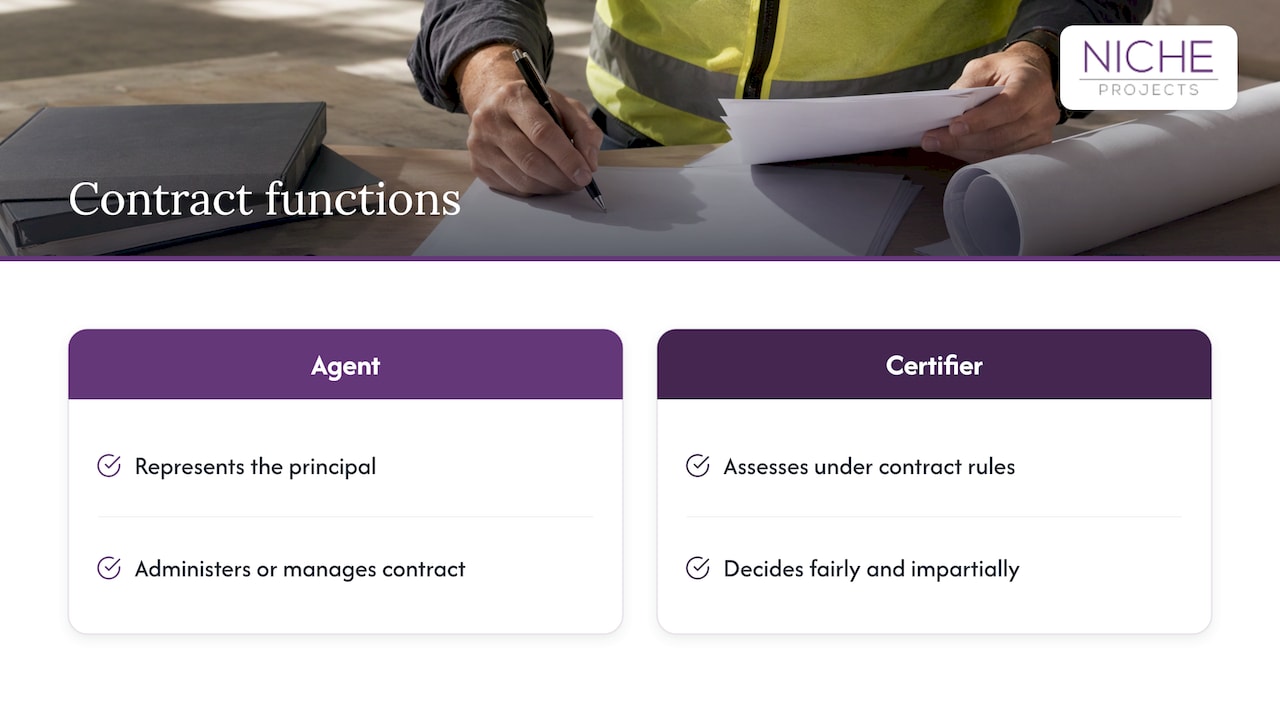
For a business owner this is the part that surprises people. The superintendent is paid by you, yet in the certifying hat they cannot simply side with you. If the builder has genuinely earned an extension of time, a fair superintendent has to say so.
As agent for the principal
A legal commentary on the role lists what the agent hat typically covers: issuing directions to the contractor, approving programs and subcontractors, resolving ambiguities in the contract documents, examining materials, suspending work and ordering variations.
In plain terms, when the builder asks “which of these two conflicting drawings do you want?” or you decide to move a meeting room wall after work has started, the superintendent is who gives the formal answer.
As independent certifier
Holding Redlich explains that in the certifier capacity the superintendent assesses payment claims, variation claims and extension-of-time claims, certifies liquidated damages or delay costs, and issues practical or final completion certificates. Liquidated damages are the pre-agreed daily amount a builder pays if it finishes late.
A 2025 paper by construction lawyer John McMullan adds that assessing a progress claim means judging the degree of completeness and the quality of materials and workmanship, which takes both technical and legal judgement. The same paper names three considerations that run through the role: a duty to act fairly and impartially, independence, and the fact that the role varies with the contract terms.
Superintendent versus site supervisor
This is the confusion behind most searches on the topic. Holding Redlich stresses that administering the contract and supervising the works are separate functions, and only the first belongs to the superintendent.
A Legal 500 article by Laurie James makes the practical consequence clear: the role does not require continuous site attendance, only occasional visits, usually at site meetings. The same article notes that a superintendent is not automatically to blame for poor workmanship, because the contractor remains responsible for repairing defective work.
So who is on site every day? On a tenancy fit-out in a managed building, the building owner’s requirements can be specific. The JLL fit-out guide for 333 Collins Street in Melbourne says the project manager must appoint a competent full-time foreman or supervisor on site for the duration of the works, with authority over quality, performance and daily organisation, and contactable around the clock. That is the person running the floor. The superintendent is the person administering the paperwork and decisions that bind the contract.
The table shows how the roles divide on a typical fit-out.
| Question | Superintendent | Site supervisor or foreman |
|---|---|---|
| Main job | Administers the contract | Runs daily work on site |
| On site | Occasional visits, site meetings | Every day |
| Decides | Variations, extensions of time, payment amounts, completion | Sequencing, trade coordination, daily safety |
| Acts for | The principal, and impartially when certifying | The builder |
What the superintendent does through a fit-out
The sequence below follows the life of a typical office fit-out. The exact duties depend on your contract.
- Before site possession. Confirm the builder has the insurances the contract requires and review the program the builder proposes. What goes wrong: a program that looks fine on paper but ignores building access hours, lift bookings or after-hours work rules.
- During construction. Hold site meetings, review progress against program and keep contract records. What goes wrong: directions given verbally and never confirmed. Under AS 4000, directions may be oral but must be confirmed in writing as soon as practicable, and a contractor who asks for written confirmation need not comply until it arrives.
- Assessing claims. Each month the superintendent assesses the builder’s progress claim and works out what is due. What goes wrong: claims paid on percentage-complete guesses rather than inspected work.
- Handling change. Every moved wall, extra data point or changed finish becomes a variation to be assessed and priced before the work proceeds, not after. This is where most budget blowouts start.
- Delays. The superintendent decides whether a delay entitles the builder to more time, and whether liquidated damages apply.
- Completion. Judging whether the works have reached practical completion, then managing the defects liability period (the agreed window after handover in which the builder must fix defects) through to the final certificate.
Our construction closeout checklist for Australian fit-outs covers the last stage in more detail, including what you should have in hand before accepting handover.
Safety and the superintendent
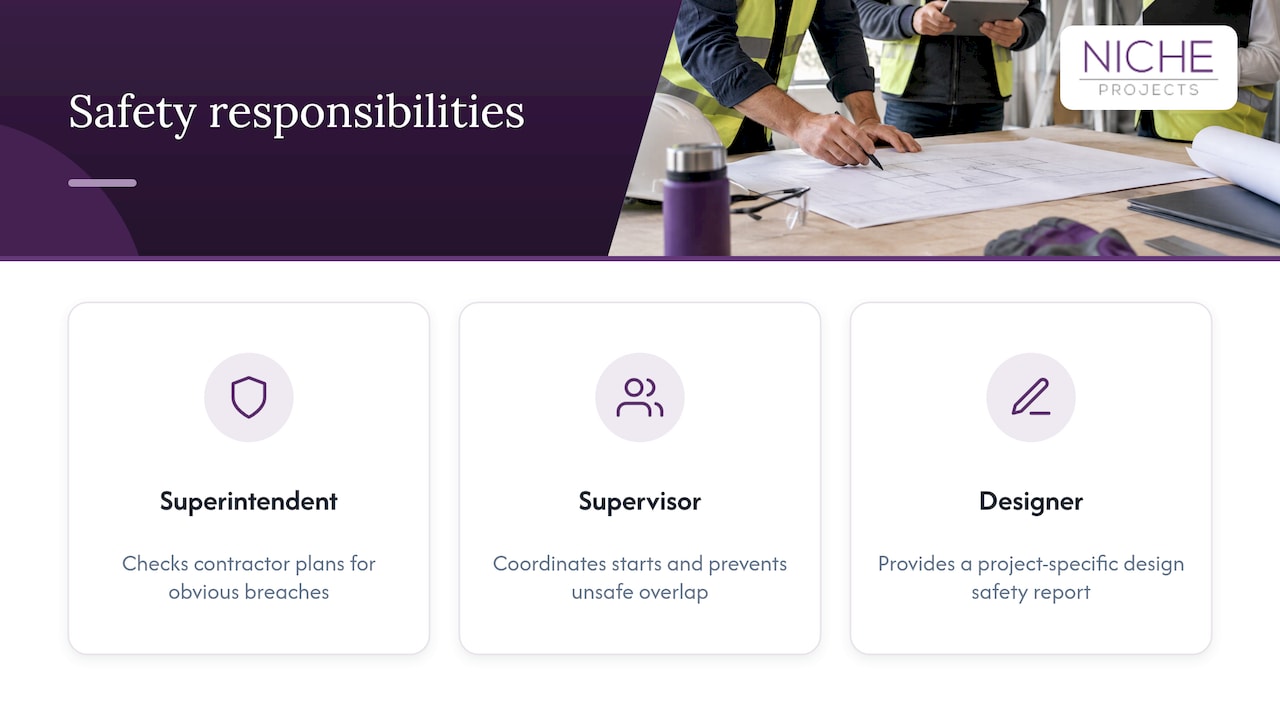
The superintendent’s safety role is narrower than many people assume. Legal 500 says where the work needs a job safety analysis or risk management plan, the superintendent should first make sure the contractor has such documentation, then occasionally check it has not been obviously breached. The article also advises superintendents against “method specification” instructions that take over responsibility for how the work is done.
Day-to-day safety sits with whoever supervises the work. WorkSafe ACT’s construction guidance says effective supervision must be clearly delegated, competent and timely, and covers deciding when contractors or phases can start and coordinating one process so it does not endanger another. This guidance is from the ACT regulator, so check the WHS regulator for your own state when drafting contract terms. In New South Wales that is SafeWork NSW.
Design carries safety duties too. A Western Australian Government brief for interior fitout and workplace design services notes that designers must, so far as reasonably practicable, design structures without risk to those who build, fit out or maintain them, and provide a written project-specific design safety report. Again, this is the WA statement of a duty that has equivalents under the WHS laws in other states.
How the superintendent works with the project manager, builder and trades
A fit-out has several decision-makers: you, the designer, the project or construction manager, the builder and the trades. The superintendent sits in the middle of the contractual chain.
Two rules keep it clean:
- Directions go to the contractor. Legal 500 notes AS 4000 directions should be issued to the contractor, not subcontractors or workers, to preserve the chain of contractual authority. If your office manager tells the plasterer to change something, the contract’s paper trail is already broken.
- Coordination meetings carry weight. The JLL guide says most tenant dissatisfaction with building services traces back to modifications made during the fit-out, which proper planning, design, execution and commissioning can avoid, coordinated through regular meetings with building management and specialist service contractors.
On Sydney sites that coordination spans many trades, from joinery and ceilings to the structural and concrete work that comes first in a building-shell tenancy. Even a local concreting family business such as this Sydney concreting contractor is a reminder of how many separate parties a single project can pull together under one contract, and why a clear line of instruction matters.
What makes a good superintendent
The AGS briefing says care is needed to ensure the appointee has technical expertise in the subject matter of the contract and good contract management skills. For an office fit-out, that translates to someone who can:
- read drawings and spot when a detail does not work with the ceiling services above it;
- understand trade sequencing, so they know when a delay claim is genuine;
- write clear directions, confirm them in writing and keep records;
- stay impartial under pressure from both sides when certifying;
- assess a claim without defaulting to the builder’s number or your wish for a lower one.
Be wary of one trap. A person with strong building knowledge but little contract experience may issue directions that accidentally vary the contract or breach the impartiality duty. The reverse is also a problem: a contracts specialist who cannot judge workmanship will certify blind.
Setting up the role on your fit-out
Before you sign, work through these decisions.
- Decide who the superintendent is. Name a person or firm in the contract. Do not leave it as “the principal’s representative” without clarifying powers.
- Define the certifying functions. Following the AGS advice, make sure the appointment contract says which functions require impartiality.
- Set your delegation limits. Decide the dollar amount of variations the superintendent can approve alone, and what must come back to you.
- Fix the reporting rhythm. A monthly report covering program, cost, quality and safety, plus a regular site meeting, keeps you informed without needing to be on site.
- Confirm the site supervision arrangement. The builder should have a named full-time supervisor. Do not assume the superintendent covers it.
- Plan for handover. Agree how practical completion will be judged and who holds the defects list.
If you are earlier in the process, how to begin a commercial fit-out in Sydney covers the decisions that come before the contract, and our guide to a successful commercial fit-out shows how the stages connect.
Why one team across design and construction helps
Most disputes about variations and delays begin at a handover: the designer’s intent meets the builder’s reality. The fewer handovers between those who design the space, those who plan the workplace and those who manage construction, the fewer gaps a claim can fall into.
Niche Projects offers workplace strategy, office design, space planning, fit-out, refurbishment and construction management for commercial clients in Sydney. Our approach combines creative design with construction expertise, backed by consistent communication and a set delivery methodology. For a business owner, that means one team that understands why a layout was chosen and what it takes to build it.
If you are planning a project, see our Sydney office fitout and Sydney office design services, or start from workplace strategy if you are still working out what the space needs to do.
FAQ
What does a superintendent do in construction?
Under a traditional Australian contract, the superintendent administers the contract for the principal and acts as an impartial certifier. That means issuing directions, assessing payment, variation and time claims, and certifying practical completion. They are not normally the person supervising trades day to day.
Is the superintendent the same as the project manager?
Not necessarily. A project manager plans and coordinates the project for the client, while the superintendent is a named role in the construction contract with defined powers. On smaller fit-outs one person may hold both, so check the contract to see who is named.
Is a superintendent on site every day?
Usually not. The role does not require continuous attendance, and visits commonly happen around site meetings. The daily work is run by the builder’s supervisor or foreman.
Is the superintendent responsible if the work is defective?
Generally the contractor remains responsible for repairing defective work, even where a defect was visible at inspection. The exception is where the superintendent expressly approved a change in the standard. Your contract wording governs, so take legal advice on specific terms before you sign.
What makes a good superintendent for an office fit-out?
Look for technical knowledge of fit-outs and genuine contract management skills, plus the discipline to give written directions and assess claims fairly. Both skills are needed together.
Sources
- Legal briefing: Planning for Commonwealth construction and fit-out projects, Australian Government Solicitor
- Role of a superintendent, Construction Law Made Easy
- What is the role of the superintendent? Holding Redlich
- Role of the Superintendent 2025, McMullan Construction Law
- Role of the superintendent in construction projects, Legal 500
- Tenancy fit out guide, 333 Collins Street
- Construction site management, WorkSafe ACT
- Interior Fitout and Workplace Design services brief, Government of Western Australia