
Before you can renovate a strata office, you need to know three things: which of your works touch common property, which approval tier they fall into, and who maintains the result afterwards. Get these right before design is finalised and the project runs to plan. Get them wrong and you can be made to put the office back as it was, at your cost. The detail below is anchored in New South Wales, where most of our Sydney clients operate, with a state-by-state view further down. A fit-out that is designed and built by one team, like the office fit-out and refurbishment work we do in Sydney, is easiest to align with an approval scope when the drawings and the build come from the same hands.
TL;DR
- In NSW, work is sorted into cosmetic (no approval), minor (approval needed) and major (special resolution needed). Ceilings, waterproofing and structural changes are major.
- Strata offices and shops carry extra risk: even small fixings into the structure can need written consent from the owners corporation, on top of the landlord’s consent.
- Structural changes need 14 days’ written notice to the owners corporation. Unapproved work can mean paying to reinstate.
- Work that changes common property usually needs a by-law, and nothing starts until it is registered.
- Other states use different thresholds. Check the rules of your own state or territory before you commit to a programme.
Table of Contents
- Why strata changes how you plan an office renovation
- The three NSW approval tiers
- Notice, timing and the three-month rule
- When your office works need a by-law
- The documents an application usually needs
- Engineering, services and compliance
- How the rules differ outside NSW
- A worked example: a Sydney office refresh
- Planning an approvable fit-out with Niche Projects
- Questions readers ask
- Sources
Why strata changes how you plan an office renovation
In a strata building you own or lease a lot, and the walls, slabs, risers, façade and services that serve the whole building are common property, controlled by the owners corporation (called the body corporate in Queensland and the strata company in Western Australia). An office fit-out often reaches into exactly those elements: new cabling through a riser, a reconfigured partition, a new ceiling grid, an extra kitchenette with plumbing.
For offices, there is often a second layer. If you are a tenant, the lease gives your landlord a say, and the owners corporation has its own by-laws. A property law firm that advises on strata shops and offices notes that the owners corporation must consent in writing to a fit-out that affects the structure, and that even minor works such as replacing ceilings, tiling or painting can need consent because they involve drilling into or fixing to the structure. The same source explains that in the model commercial by-laws the landlord applies for consent, and applications for structural alteration need an engineer’s report.
The practical consequence is sequencing. Approvals come from committee decisions and general meetings, not from a single signature, so they set your start date. Ask what your building’s by-laws require while you are still choosing a layout, not when the builder is booked.
The three NSW approval tiers
The NSW Government’s strata renovation rules (updated 22 June 2026) sort work into three categories. They are written with residential owners in mind, but the same Strata Schemes Management Act 2015 governs lots in commercial strata schemes, so the logic carries over to offices.
| Tier | Typical office examples | Approval needed |
|---|---|---|
| Cosmetic | Painting, hooks, handrails, blinds, carpet | None |
| Minor | Hard flooring, wiring, cabling, power points, reconfiguring walls, recessed light fittings, kitchen work | More than 50% of votes cast in favour at a meeting, or committee approval if delegated by by-law |
| Major | Structural changes, waterproofing, ceiling changes, anything needing council approval, changes to the outside of the building | Special resolution: no more than 25% of the value of votes cast against |
Two points catch office projects out.
Ceilings. In most offices the ceiling is the first thing a refurbishment changes: new grid, new lighting, new air-conditioning outlets. Ceiling changes sit in the major tier, so a lighting-and-ceiling refresh is not a minor job in strata terms.
Wet areas. Any new or relocated bathroom, kitchenette or break-out area that needs waterproofing is also major.
The owners corporation’s own by-laws can add detail, and your scheme may have delegated minor approvals to the strata committee, which usually speeds things up.
Notice, timing and the three-month rule
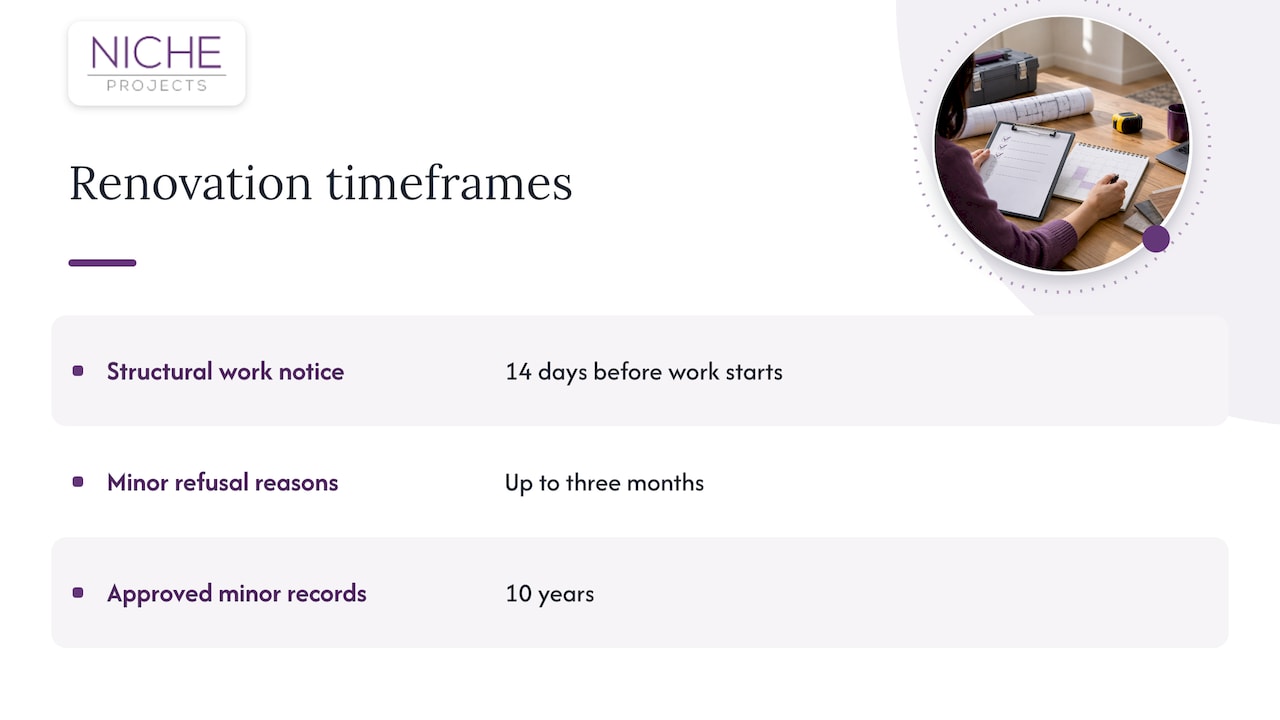
If the work will change the structure, for example by removing a wall, NSW Fair Trading’s guidance says you must give the owners corporation 14 days’ written notice describing how the structure will change before work starts. Unapproved minor or major work can require the owner to pay to restore the property to its previous condition.
The rules also moved recently. Under the NSW strata law reforms rolled out in stages from 1 July 2025, where a strata committee has been delegated to decide minor renovations, a request is automatically approved if the committee gives no written reasons for refusal within three months. Owners corporations must also keep records of approved minor renovations for 10 years. From 27 October 2025, NSW Fair Trading gained enforcement powers over the common property repair and maintenance duty.
Three months is a long time on a fit-out programme. Submit the application early, and do not treat silence as approval unless the by-law delegation and the timing clearly give you that result.
When your office works need a by-law
Major work that changes or occupies common property generally needs a common property rights by-law (the older name was an exclusive use by-law). Marrickville Legal Centre’s strata renovations fact sheet explains that this needs a special resolution, a by-law drafted for the proposed works, and the prior written consent of each owner on whom the by-law confers rights or special privileges. The by-law also sets out who maintains and repairs the affected common property.
That maintenance question is now written into the process. The NSW Government says the special resolution must state whether the owners corporation or the lot owner is responsible for ongoing maintenance of the common property affected. A new ceiling void penetration, a relocated riser connection or a new external sign are all things you may end up maintaining for the life of the by-law.
Two practical details from the by-law process:
- Registration. A by-law has no legal effect until it is registered with NSW Land Registry Services, and one that is not lodged within six months lapses, according to a published guide to exclusive use by-laws. Do not start the affected work until it is registered.
- What the by-law covers. The same guide says a well-drafted by-law specifies the area, the benefited lots, conditions of use such as hours, fit-out requirements, signage and safety, and maintenance and insurance obligations. It cannot authorise anything that breaches planning, building or fire safety laws.
If you lease rather than own, the landlord is generally the party that must give written consent as the benefited lot owner, so bring them into the process at the start.
The documents an application usually needs
Strata managers publish their own application forms, and they show what committees expect to see. One NSW application to carry out alterations asks for:
- a summary of the works and a diagram showing their location
- manufacturer or supplier specifications
- acoustic underlay details where flooring changes
- plumbing, electrical, architectural or structural drawings as relevant
- structural or waterproofing certificates where relevant
- written consent to by-law drafting and registration costs, and, for common property changes, consent to the by-law and to responsibility for maintenance, repair and replacement
The form adds that the owners corporation may consider the application at a general meeting, and that if a by-law is needed you must wait until it is registered before starting. Another NSW strata manager’s renovation guide and form treats waterproofing, structural changes, load-bearing wall reconfiguration, a change to a lot’s external appearance and permanent use of common property airspace as special-resolution work.
The quality of the pack decides how fast it moves. Committees approve what they can understand: clear drawings, a defined scope and named maintenance responsibilities. This is where a design-led approach pays off, because the drawings you submit are the same ones the build will follow.
Engineering, services and compliance
Approval from the owners corporation is not the only gate. Structural alterations to load-bearing walls or floor slabs typically need engineering certification, and changes to electrical, plumbing, air-conditioning or fire protection systems usually involve common property, with owners corporations often requiring licensed contractors and final compliance certification. Separately, work that needs council approval, or that is carried out under the complying development pathway, must satisfy the planning and building rules; the NSW Planning Portal explains that complying development can be determined by a council or registered certifier, and includes provisions for commercial work and fire safety systems.
For an office, build these checks into the programme:
- Fire services. Sprinkler, detection and exit changes touch building-wide systems.
- Mechanical services. New zoning or ductwork often ties into shared plant.
- Noise. New hard flooring over another tenancy usually triggers acoustic underlay requirements, as the application form above shows.
- Access and hours. Loading dock bookings, lift protection and permitted working hours are typically set by the building’s rules.
- Accessibility. NSW legislation passed in 2025 defines accessibility infrastructure as common property changes that give a person with a disability access to the common property or their lot, and lists what an owners corporation must consider when approving it. It is worth raising early if inclusive access is part of your brief.
How the rules differ outside NSW
Every state and territory has its own strata or body corporate law, so do not carry NSW thresholds across a border.
- Victoria. A published guide to resolution types says a special resolution requires 75% of the total votes of all lots, and that significant changes to the use or appearance of common property, and leasing or licensing common property, require one.
- Queensland. The QBCC advises renovators to check by-laws and whether written body corporate approval is needed. Its apartment renovation checklist calls for a contractor licence that can be verified on the QBCC Licensee Register, a waterproofing certificate and independent sign-offs at milestone stages.
- Western Australia. Landgate’s strata fact sheet says owners typically cannot renovate without first seeking permission from, or informing, the strata company, on top of any planning and building approvals. Default by-laws require 14 days’ written notice for structural alteration, and structural work needs prior approval.
- South Australia and the ACT. The same resolution guide notes that South Australia requires a special resolution with 14 days’ notice for alterations to common property, and that the ACT requires a special resolution plus the grantee’s written consent for special privileges.
We operate across Greater Sydney, so the NSW framework is the one we work to. If your office is elsewhere, confirm the rules with your strata manager and the state’s fair trading or titles body.
A worked example: a Sydney office refresh
Take a business leasing a 300 square metre suite in a strata-titled building in North Sydney. It wants new meeting rooms, a relaxed breakout kitchen, new carpet and a new ceiling and lighting layout.
- Painting and carpet are cosmetic: no approval under the NSW tiers, though the lease and building rules may still ask for notice.
- New power and data cabling and reconfigured partitions are minor: approval from the committee or a general meeting.
- The ceiling change and the kitchen with new wet area move the job into major: a special resolution, a by-law covering maintenance, and registration before the affected work starts.
- If a partition wall is structural, 14 days’ written notice and an engineer’s report come on top.
Planned as one package without checking these tiers, the whole project waits for the slowest approval. Planned in stages, the cosmetic and minor work can be programmed around the major approval, or the layout can be adjusted so fewer elements touch common property. That decision belongs at the design stage, which is why strategy and design should come before a builder is asked for a price.
Planning an approvable fit-out with Niche Projects
We combine workplace strategy, office design and construction under one team, so the layout you commit to is designed with how it will be built. For Sydney offices, our office fit-out and refurbishment service covers design through to construction management, and we also work in North Sydney, the CBD, Surry Hills, Homebush, Ultimo and other business districts; see for example our North Sydney commercial fit-out page. Our in-house trades cover partitions, ceilings, painting, labour and demolition, which keeps the scope in your submission aligned with the work on site.
If you are still deciding whether to renovate in place or move, our guide to refurbishing versus relocating sets out the questions to ask. Once you have a shortlist of changes, talk to us about your office design and fit-out so the scope is clear before the strata application is lodged.
Questions readers ask
Can I renovate my strata office in NSW without approval?
Only cosmetic work, such as painting, hooks, blinds and carpet, needs no approval under the NSW rules. Minor and major work needs approval first, and unapproved work can require you to pay to restore the property. Your lease and by-laws may add conditions, so check them before you start.
Who approves a strata office fit-out if I am a tenant?
In most cases both your landlord under the lease and the owners corporation under the by-laws. Dual approval takes longer than a landlord’s consent alone, so build the timing into your lease negotiation and project programme.
How long does strata approval take?
It depends on the tier and the meeting schedule. Minor requests delegated to a NSW strata committee are automatically approved if no written refusal reasons are given within three months. Major work needs a general meeting and, where a by-law is required, registration before work starts, so allow for a longer lead time.
What is a common property by-law and do I need one?
It is a by-law that gives a lot owner rights over, or responsibility for, part of the common property. You generally need one when major work changes or uses common property, and it sets out who maintains it. It must be registered with NSW Land Registry Services within six months or it lapses.
Do the rules differ in other states?
Yes. Victoria, Queensland, Western Australia, South Australia and the ACT each set their own resolution thresholds, notice periods and approval bodies. Confirm the rules for your state before you plan the programme.
Sources
- Strata renovation rules | NSW Government
- Guide to strata law changes for strata committees and owners | NSW Government
- Why landlords and tenants face special risks when leasing strata shops, offices and industrial premises
- Strata Renovations | Marrickville Legal Centre
- Exclusive Use By-Laws in NSW: Guide
- Application to carry out alterations to your lot
- Renovation guide and application form
- Leasing Strata Commercial Space NSW: What Business Owners Need to Know
- Guide to Complying Development | NSW Planning Portal
- Strata Schemes Legislation Amendment Bill 2025
- Ordinary vs Special vs Unanimous Resolutions in Strata
- QBCC’s guide to apartment renovations
- Getting things done | Landgate