
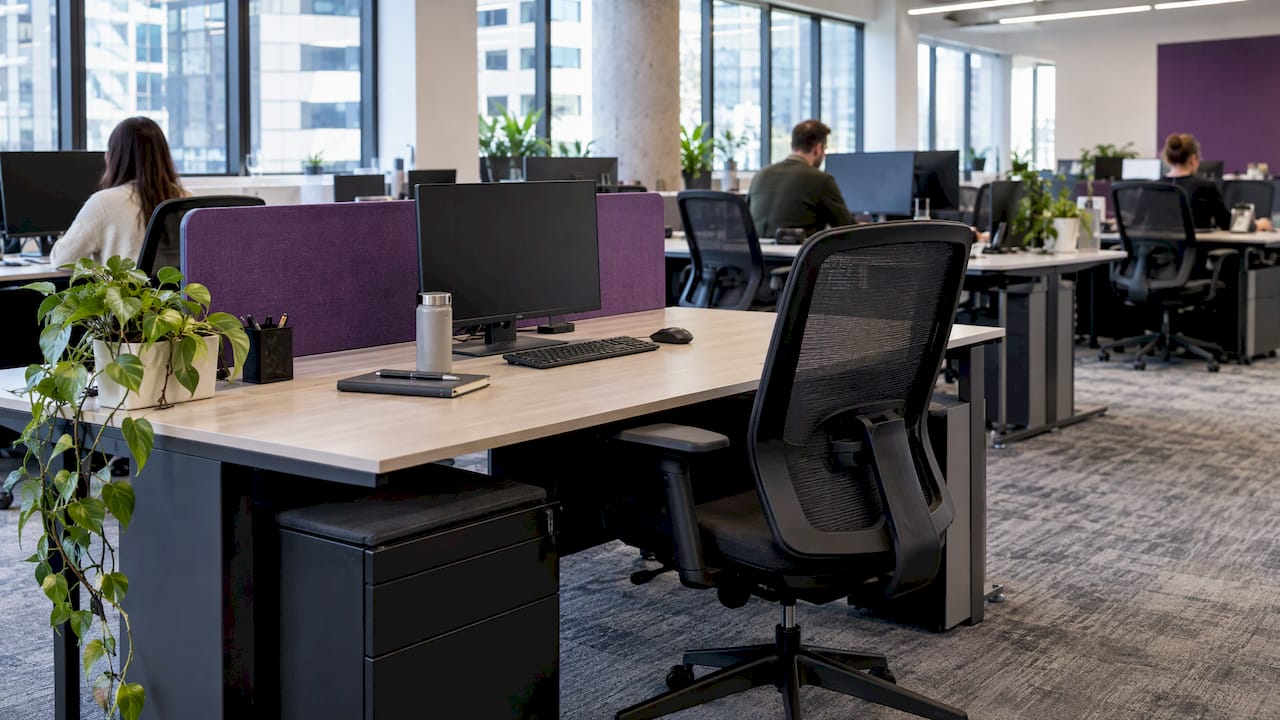
An unassigned seating policy, also called a desk sharing or hot-desking policy, sets out who may sit where when nobody owns a desk. A good one is short, but it rests on decisions about desk numbers, health and safety consultation, adjustments for people who need a fixed or adapted workspace, and a floor plan that makes sharing easy. The policy only works when the office is designed to match it, which is why the wording and the fit-out need to be planned together. Our workplace strategy and office design work starts from that point.
TL;DR
- Decide the desk-to-people ratio from real attendance data before you write a single rule. Insufficient desks on busy days was the most common complaint in an Australian study of flexi-desking.
- Consult employees and health and safety representatives before you introduce the change. WorkSafe Victoria states this is required, so far as is reasonably practicable.
- Build in assigned or adapted desks for people who need them, and make every shared desk adjustable.
- Cover booking, clean-desk rules, storage, cleaning, zones for teams and quiet work, and how disputes get resolved.
- Pair the policy with a layout that adds collaboration and quiet space, not just fewer desks.
Table of Contents
- What an unassigned seating policy is
- Start with the ratio, not the rules
- Consult before you announce
- What the policy should cover
- Make it inclusive from day one
- Roll it out in stages
- Design the floor to match the policy
- Where Niche Projects fits
- FAQ
- Sources
What an unassigned seating policy is
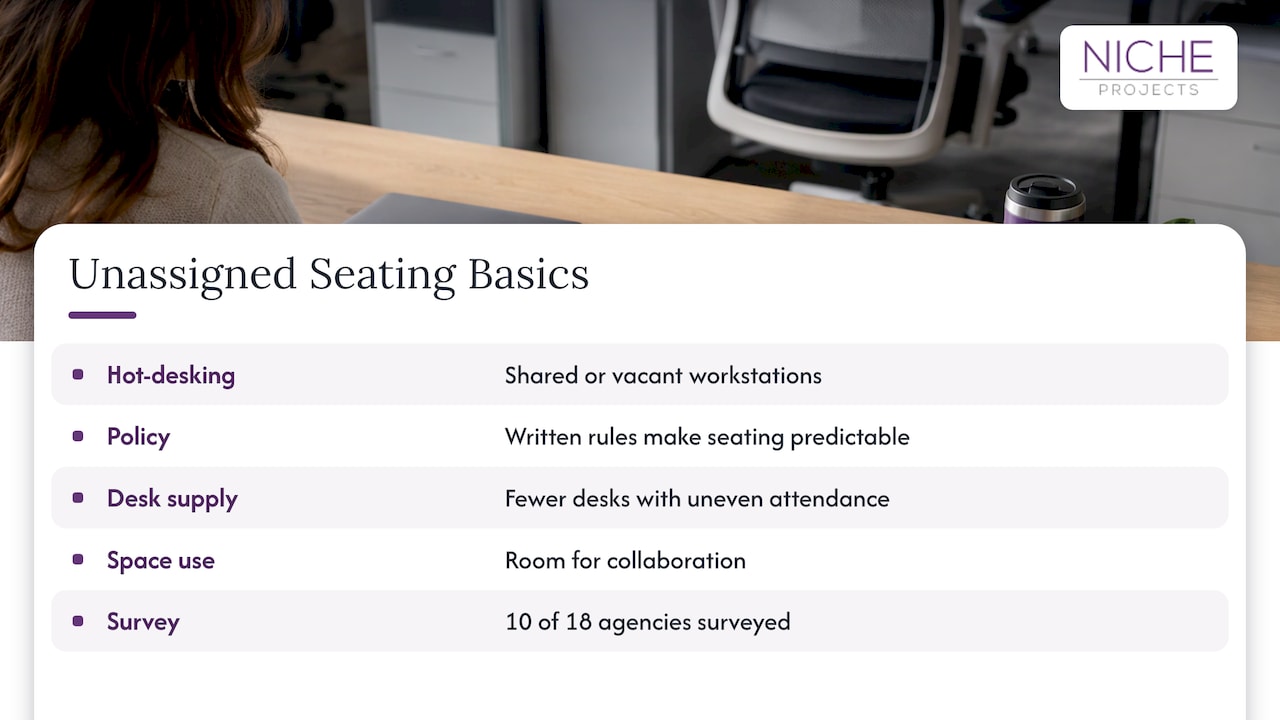
WorkSafe Victoria describes hot-desking as an office system where different users share a workstation or work at a vacant workstation. The policy is the written set of rules that makes this predictable for staff: how a desk is chosen, how long it can be held, what gets left behind at the end of the day and who looks after the equipment.
Organisations adopt it because attendance is uneven. The Queensland Government’s workplace design guidance says that if people do not need an allocated desk for the full spread of office hours, the number of desks can be reduced and the space used for other functions such as collaboration. A Canberra Times survey in March 2023 found that 10 of 18 federal agencies surveyed had already introduced some form of flexible seating in their Canberra offices. Private employers face the same pattern: hybrid attendance leaves rows of empty desks on some days and standing room only on others.
A policy that only says “sit anywhere” does not solve this. It moves the problem from the lease to the staff. The rest of this article sets out what to decide first and what to write down.
Start with the ratio, not the rules
The number of desks per person decides whether staff accept the policy. In a 2016 study of about 1,000 Australian employees (Kim, Candido, Thomas and de Dear), the most-cited problems with flexi-desking were:
- Not enough desks on busy days: 26.8% of negative comments, at a ratio of 1.3 employees per desk.
- Difficulty finding and sitting near colleagues: 21.6%.
- Time wasted finding, setting up and packing up a workstation: 12.4%.
- Limited ability to adjust or personalise a workstation for ergonomic needs: 11.3%.
The same study concluded that having no pre-allocated desk does not on its own make people rate their workspace worse. Perceived productivity and health suffered when satisfaction with layout, colleague interaction, furniture comfort, adjustability and storage dropped. In other words, the policy is not the risk. A poor setup is.
For a benchmark, the NSW Department of Communities and Justice (DCJ) Workplace Design Guide (May 2025) sets a sharing ratio of 70% or less positions to staff, written as 1:1.43, for back-office staff, with a target density of 10 to 12 sqm per workpoint or less. That is a government agency’s standard, not a rule for private employers, but it shows the scale of ratio a large public employer plans around.
To set your own ratio:
- Collect badge, Wi-Fi or booking data for at least a few typical weeks, not a single quarter-end.
- Find the busiest day, then the number of people on a typical busy day, not the absolute peak.
- Add a buffer for team events and growth.
- Check the result against your roles. Teams that must sit together every day, or roles that handle sensitive information, may need a lower sharing ratio or an assigned neighbourhood.
Our guide to peak occupancy and office space standards walks through how roles and peak attendance translate into square metres, and our note on Australian workstation sizes covers the footprint each desk needs.
Consult before you announce
This step is the one most often skipped. WorkSafe Victoria’s December 2024 guide for employers says the OHS Act requires employers to consult employees, so far as is reasonably practicable, on matters that directly affect their health and safety, including planning changes to the workplace, and that health and safety representatives must be part of that process. That is Victorian law, and other states and territories have their own work health and safety legislation with similar consultation duties, so check the rules where your office sits.
The Australian Bureau of Statistics took this approach when it trialled unallocated desks in Adelaide. The Australian Public Service Commission’s case study, Workspaces Fit for the Future, describes a six-month trial from 2015, staff working groups, a partnership across Property, IT and HR, and a package deal in which staff gave up allocated desks in return for more flexibility. The ABS reported 91% staff satisfaction with non-monetary conditions. One of its people put the risk plainly: rolling it out without consulting staff would have put people offside.
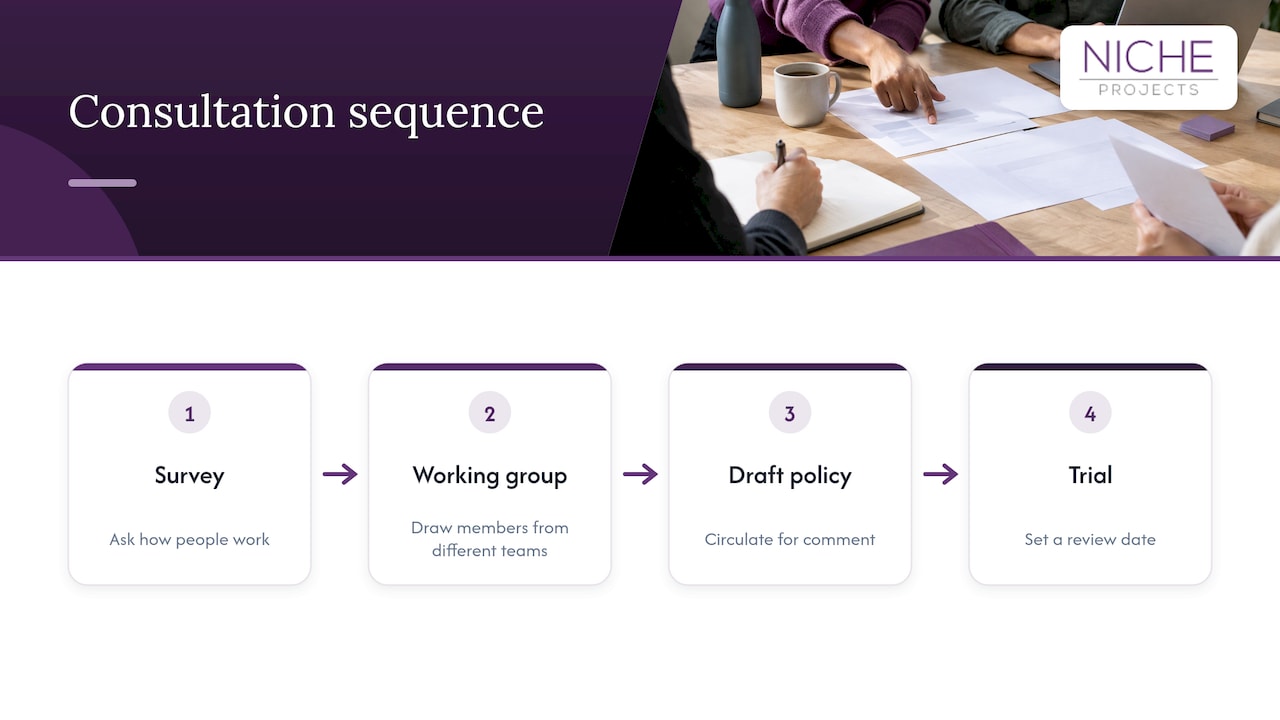
Practical consultation looks like this: a short survey on how people work, a working group drawn from different teams, a draft policy circulated for comment, and a trial period with a defined review date.
What the policy should cover
WorkSafe Victoria lists five hazards to manage with hot-desking: infection and hygiene, stress from not having a set workstation, suitability for all users, productivity effects on team-based work, and discrimination. A policy that answers each is a safer and more usable one.
| Policy section | What to write | Why it matters |
|---|---|---|
| Scope | Who is covered, which floors and zones, and which roles keep assigned desks | Avoids arguments about fairness |
| Booking and release | How to reserve, how long a desk can be held, when an unused booking is released | Stops desks being held all day |
| Clean-desk rule | Nothing left overnight; personal items go in lockers | Keeps desks available and clean |
| Storage | Lockers or secure storage for each regular attendee | WorkSafe Victoria lists secure storage as a control |
| Setup and ergonomics | How to adjust chair, desk and screens, and who to ask for help | Limited adjustability was a top complaint in the 2016 study |
| Hygiene | Cleaning supplies at each desk, personal headsets | Both are controls WorkSafe Victoria recommends |
| Team zones | Designated areas where teams can sit together | Protects team-based work |
| Adjustments | How to request an assigned or adapted desk | Keeps the policy inclusive |
| Review | Date and method for reviewing, including tracking employee sentiment | Catches problems early |
WorkSafe Victoria’s office layout guidance recommends these controls where hot-desking cannot be avoided: personal headsets, cleaning supplies, adjustable furniture, secure storage, team-designated areas and tracking employee sentiment. Write each into the policy as a standing arrangement rather than a hope.
Ergonomics at a shared desk
A desk used by many people has to fit many bodies. WorkSafe Victoria notes that multi-user workstations must be adjustable, with electric adjustment the most appropriate. The University of Melbourne’s flexible office guidance (version 2.0, November 2024) prefers an electric sit/stand desk with a 620 to 1250 mm height range, a choice of task chair sizes, monitor arms that adjust with a finger touch, and antimicrobial wipes. It also advises against sitting or standing for more than 30 minutes without a break.
The policy should include a one-page setup guide at each desk, covering chair, desk, monitor, keyboard and mouse. Our article on ergonomic office design covers the detail, and the flexible furniture piece shows what suits shared floors.
Make it inclusive from day one
Sharing desks is not neutral for every employee. Someone with low vision, a mobility need or sensory sensitivity may need the same desk, near the same facilities, every time. A policy that has no path for this exposes the employer to discrimination complaints and to a poor employee experience.
Public sector policies show the pattern. The NSW DCJ Workplace Adjustment Policy lists setting aside desks in an otherwise agile environment as a physical workplace adjustment. NSW Health’s Policy Directive PD2025_041 (November 2025) says employers must make reasonable workplace adjustments unless this would cause unjustifiable hardship or the employee still cannot perform the inherent requirements of the role. Its examples include desks with wheelchair space and proximity to essential facilities, quiet areas for sensory sensitivities, and workstation assessments by occupational therapists or ergonomists. The ABS trial likewise allocated fixed desks to staff with special requirements, such as low vision needing special technology, and made every desk sit-stand and electrically adjustable.
In your policy:
- Name the adjustment route and who decides, in plain words.
- Keep requests confidential, and do not require staff to explain a condition to colleagues.
- Reserve a number of assigned or near-fixed desks that sit outside the booking pool.
- Design the floor to accessibility standards. The DCJ guide aligns fitouts with Australian Standards AS1428.1 and AS1428.2, including 1500 x 1500 mm turning circles and 1500 mm wide corridors where possible.
Our inclusive office design guide covers how to build this into the floor plan rather than adding it afterwards.
Roll it out in stages
The ABS case gives a workable sequence, and the Canberra Times survey shows large employers following something similar, with the ATO and the Department of Employment and Workplace Relations planning moves off allocated seating in 2025 and 2026 after staff consultation.
- Gather data and set the ratio. Use attendance, not assumptions.
- Form a working group. Include HR, facilities, IT and staff from the teams most affected.
- Consult, including health and safety representatives. Share the draft and record what changed because of feedback.
- Fix the physical setup first. Lockers, adjustable desks, screens and cleaning supplies should be in place before the first person is asked to give up a desk.
- Trial for a fixed period. The ABS ran six months.
- Review with data and sentiment. Check desk utilisation, complaints, and whether teams can still sit together.
- Adjust, then lock in. Update the policy and publish the revision date.
The benefits and risks for staff are broader than the desk itself. Working patterns, booking tools and team coordination all shape how the change feels, and our hybrid workforce solutions reference is useful for thinking through the systems side of hybrid working.
One caution from the industry is worth building into your business case. The ACT Property Council’s Ross Grove said in 2023 that not every cost reduction is a productivity gain, warning against shifting the burden of accommodation onto staff homes. ISPT’s Zoe Ferrari said successful flexible environments add collaboration and quiet zones rather than only taking space away. That points to the real task: the policy releases floor area, and the fit-out decides what that area is used for.
Design the floor to match the policy
A rule cannot make a poor layout work. Three design points carry most of the weight:
- Variety of settings. Desks, quiet rooms, meeting spaces and team zones let people choose the right place for the task. Our article on designing a hot-desking office sets this out.
- Clear movement space. The ACT’s Work Environment and Facilities Code of Practice, which commenced on 5 November 2025, requires layouts that give clear space between furniture so workers can move freely and evacuate quickly. It applies in the ACT, but it reflects the same principle as Safe Work Australia’s model code, which many jurisdictions adopt.
- Space per person. WorkSafe Victoria’s office layout guidance suggests a minimum of 6 m² per person for workstation space, plus secondary and primary space around it. Queensland Health’s fitout standards recommend desks 1500 to 1800 mm long for most office activities, screens no higher than 1,200 mm, and 10 per cent sit-to-stand workstations unless a medical assessment calls for more. The DCJ guide goes further for shared offices, requiring 70% of workstations to be sit-to-stand.
Noise is the other complaint that hot-desking amplifies, since people move around and take calls everywhere. Our piece on acoustics and office design covers the options.
Where Niche Projects fits
A desk sharing policy sits between strategy and construction, and that is where we work. Niche Projects provides workplace strategy consulting, Sydney office design, and office fit-out and refurbishment with construction management for commercial clients. Having strategy, design and delivery under one roof means the ratio you set, the zones you describe in the policy and the furniture that gets built come from the same plan. If you are weighing a move to unassigned seating, our approach to workplace strategy is the place to begin.
FAQ
What is the difference between a hot-desking policy and an unassigned seating policy?
In practice they describe the same arrangement: staff do not own a desk and use whichever is free. Some organisations use “hot-desking” for booking-based systems and “unassigned seating” for first-come, first-served, but the policy content is much the same.
Do we have to consult staff before introducing desk sharing?
WorkSafe Victoria states that employers must consult employees, and health and safety representatives, so far as is reasonably practicable before introducing hot-desking. Other jurisdictions have comparable consultation duties under their work health and safety laws, so confirm the requirements for your state or territory.
How many desks do we need for a hybrid team?
Start from measured peak attendance rather than headcount. The 2016 Australian study found desk shortages on busy days were the leading complaint at 1.3 employees per desk, and the NSW DCJ guide uses 70% or less positions to staff for back-office roles. Your own data should set the figure, with a buffer for busy days.
Can some employees keep an assigned desk?
Yes, and the policy should say how. Public sector policies in NSW list setting aside desks in an agile environment as a workplace adjustment, and the ABS trial gave fixed desks to staff with special requirements. Write a clear, confidential request route into your policy.
Sources
- WorkSafe Victoria: Office layout and design
- WorkSafe Victoria: Office health and safety, a guide for employers (December 2024)
- Queensland Government: Workplace design guideline
- Queensland Health: Office accommodation fitout standards
- University of Melbourne: Ergonomics in flexible office workspaces
- Kim, Candido, Thomas and de Dear (2016): Desk ownership in the workplace
- Australian Public Service Commission: Workspaces Fit for the Future
- Canberra Times: Hot-desking in Canberra public service offices
- NSW DCJ: Workplace Adjustment Policy
- NSW Health: Reasonable Workplace Adjustments, PD2025_041
- NSW DCJ Workplace Design Guide, version 1.90
- ACT Work Environment and Facilities Code of Practice 2025
- Safe Work Australia: Managing the work environment and facilities