
A construction closeout checklist is the list of tasks that turns a finished building site into a handed-over, legally usable, fully paid and documented asset. For an Australian office fit-out, it covers five things: finishing defects, passing inspections and gathering approvals, delivering the handover documents, settling money and securities, and formally closing the contract. This guide gives you the checklist in the order the work usually happens, who owns each item, and where projects most often slip.
TL;DR
- Closeout starts well before the last tradesperson leaves. Book inspections, commissioning and training while the site is still active.
- The core items are the defects (punch) list, approvals and certificates, as-built drawings, O&M manuals, warranties, testing and commissioning reports, and the final account.
- Requirements vary by state, building type and scope. Confirm with your certifier and your contract what applies to your site.
- Missing paperwork is a leading cause of handover delay and dispute, so track every item with an owner and a due date.
- Practical Completion is not the end. The defects liability period, retention and final certificate still follow.
Table of Contents
- What closeout actually means on an office project
- The stages of closeout, in order
- The construction closeout checklist
- Practical Completion is not the finish line
- Who owns each task
- How to keep closeout on track
- Where Niche Projects fits
- FAQ
- Sources
What closeout actually means on an office project
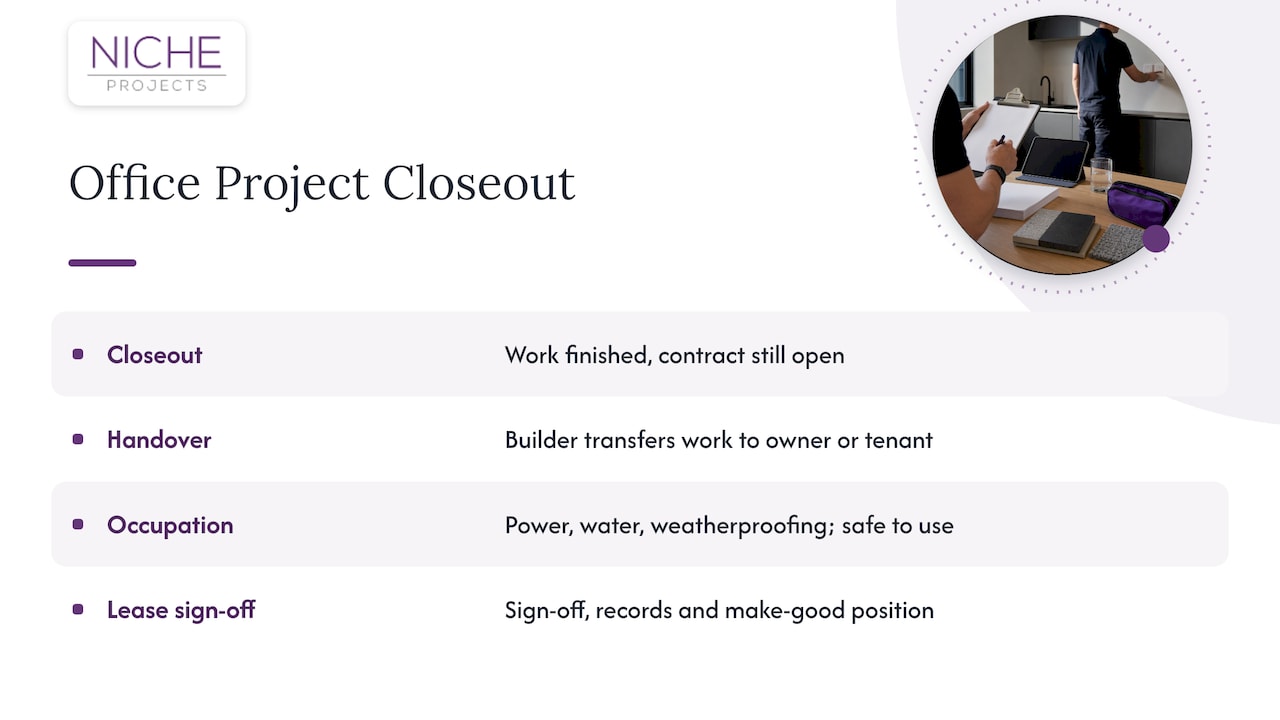
Closeout is the stretch between “the work looks finished” and “the contract is finished”. Autodesk describes it as a complex process that includes checking specifications and closeout documents, clearing the site and completing contracts. Handover is one part of it: the point where the builder gives the completed work to the owner or tenant.
In Queensland, for example, the regulator says handover is when the builder officially hands over completed work, and that the work must be suitable for occupation, with power, water and weatherproofing. That wording is aimed at homes, but the principle carries to commercial space: you should not accept a floor you cannot safely use.
For a tenant fitting out leased space, closeout has a second audience. Your landlord or building manager will often want its own sign-off, records and make-good position. Ask for those requirements early, ideally at lease and design stage.
The stages of closeout, in order
Think of closeout as five stages. Each has a gate you pass before moving to the next.
| Stage | What happens | Gate |
|---|---|---|
| 1. Pre-completion | Defects walk-through, testing, commissioning, training booked | Defects list agreed |
| 2. Approvals | Final inspections, certificates, authority sign-offs | Approvals in hand |
| 3. Practical Completion and handover | Keys, documents, training, as-builts | Signed handover |
| 4. Defects liability period | Rectification of defects that appear after occupation | Joint inspection |
| 5. Financial and contract close | Final account, retention release, final certificate | Contract closed |
One useful way to see it: closeout is a chain of dependencies. One US-based standard puts it as occupancy enabling inspection, inspection setting a date, and that date starting the clocks for resolution and payment. Australian contracts are worded differently, but the logic holds. A late certificate delays Practical Completion, which delays everything that hangs off it.
The construction closeout checklist
Use the lists below as a starting template. Adjust each to your contract, your certifier’s advice and your building’s requirements.
1. Defects and completion of works
- Walk the site with the builder and your design lead, room by room, and record every defect with a photo and a location.
- Agree a written defects list (often called a punch list) with a completion date for each item.
- Separate items that block occupation (safety, fire, services, access) from cosmetic ones. Blockers must be fixed before handover; minor items can sometimes be agreed for completion shortly after.
- Re-inspect each fixed item and sign it off, rather than relying on a verbal “done”.
- Confirm temporary works, protection and builder’s materials are removed and the site is cleaned.
Procore’s guidance on handover recommends defect lists, completion timeframes and sign-off procedures to verify that corrections are actually made. That is the habit to build: every defect has an owner, a date and a closing signature.
2. Inspections, testing and commissioning
- Complete testing and commissioning of building services you have altered: air-conditioning, electrical, lighting controls, data and communications, and security.
- Collect testing and commissioning reports that confirm systems are functioning properly.
- Complete fire protection checks, including sprinklers, detection, emergency lighting and exit signage, and file the certification. Our own guide to fire safety checks before handover walks through the items worth confirming on an office floor.
- Check any acoustic, waterproofing or specialist-trade certificates. In Queensland, for instance, Form 43 or Form 12 is required when waterproofing work exceeds $3,300, a reminder that state rules set the paperwork.
The same Queensland page notes that if you have not received all certification documents, the building certifier needs to provide the inspection documentation within five business days. Those timings are Queensland-specific. For a Sydney project, ask your certifier which NSW documents and timeframes apply to your scope.
3. Approvals and certificates
- Confirm which final approval your project needs (for example an occupation certificate or equivalent for your scope of work) with your certifier before you set a move-in date.
- Get written confirmation of any conditions of consent that must be satisfied before occupation.
- Collect compliance and safety certificates from the trades involved.
- Check landlord or building-manager requirements, such as fire engineer sign-off or building-management inspections.
Requirements vary by building type, location and scope of work. A small refurbishment inside an existing fitted floor may need little more than trade certificates; a full fit-out with new services, partitions and fire changes will need much more. Do not assume a previous project’s paperwork list applies.
4. Handover documents (the close-out book)
A close-out book, sometimes called a handover pack or O&M manual set, is an organised collection of project information for the owner. Procore lists the usual contents: as-built drawings, O&M manuals, warranties and guarantees, compliance and safety certificates, testing and commissioning reports, and asset and equipment registers.
A practical contents list for an office fit-out:
- As-built drawings, including services, partition layouts and ceiling plans
- Operation and maintenance manuals for all installed equipment
- Product and workmanship warranties, with start dates and contacts
- Compliance and safety certificates, including fire and electrical
- Testing and commissioning reports
- Asset and equipment register, with serial numbers and service intervals
- Finishes schedule: paint codes, flooring and joinery suppliers, so repairs match
- Key, access card and security schedule
- Contact list for the builder, consultants and key subcontractors
The stakes are real. Procore notes that missing or incomplete documentation is among the most common causes of handover delays and disputes. Ask for a draft of the pack a few weeks before Practical Completion, not on the day.
Some owners need the pack to stay alive after handover. One Australian water utility’s standard says O&M manuals should be updated after the defects and warranty period to reflect changes made to assets. The same idea applies to an office: if a unit is replaced under warranty, update the register.
5. Training and operational readiness
- Schedule training for whoever will run the space: office or facilities managers, reception, and IT.
- Cover building controls, meeting-room AV, access systems, after-hours air-conditioning and emergency procedures.
- Procore notes that owners are responsible for assigning operational staff to receive training and take over ongoing maintenance responsibilities, so name those people before handover.
- Load assets into your maintenance system so servicing starts on schedule. If your team will manage assets through software, computer-aided facilities management training helps staff turn an asset register into a working maintenance program.
One Australian owner’s standard sets the bar clearly: completion occurs only when all deficiencies are resolved, all information is provided and necessary training has been undertaken. That is a utility’s rule, not a universal one, but it is a sound test to write into your own handover criteria.
6. Insurance and risk transfer
- Confirm the builder’s insurances were in place through the works and what continues after handover.
- Arrange your own contents and tenant’s cover from the date you take possession.
- Confirm responsibility for site security and utilities on the handover date.
We cover this in more detail in seven insurance checks before handover.
7. Financial and contract close
- Reconcile the final account: contract sum, approved variations, provisional sums and any credits.
- Confirm which variations are agreed in writing and which are still disputed.
- Check how Practical Completion links to contract terms. Hutchies notes that it ties to liquidated damages, final payment and the release of retention securities.
- Obtain supplier and subcontractor payment confirmations required by your contract, so no one can claim against you after completion.
- Keep security or retention until the contract allows release.
- Issue the final certificate or equivalent close-out notice, and file the contract record.
A project that finishes on site but stays open on paper ties up retention and management time. Settle the final account while the team and the facts are still fresh.
Practical Completion is not the finish line
Most commercial contracts include a defects liability period after Practical Completion. During it, the builder must return to fix defects that appear in use. We explain how it works, and how it protects retention and your rights, in our guide to Australia’s defects liability period.
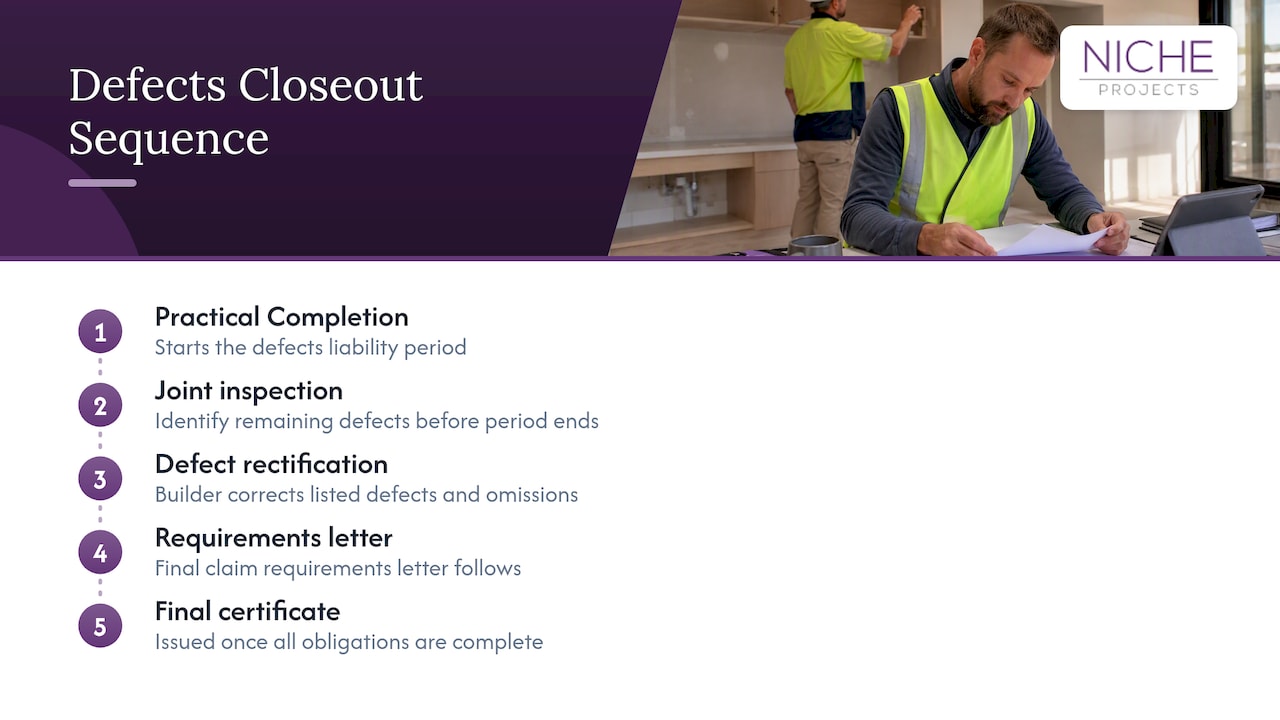
Public-sector processes show the typical sequence. Under a Transport for NSW Works Authorisation Deed, the defect liability period commences on the date of Practical Completion and the developer must correct the listed defects and omissions. Before the period ends, a joint inspection identifies what still needs rectification. A final claim requirements letter follows, and a final certificate is issued once all obligations are complete, including return of remaining security where appropriate. Your private contract will differ, but the shape is common: occupy, inspect jointly, rectify, then release.
Timeliness matters. BC Housing, a Canadian body, warns that deficiencies may be overlooked, or owners may lose the chance to claim correction under warranty if not raised before the warranty period ends. The lesson travels: diarise your defects liability end date and run your own inspection a few weeks before it.
Who owns each task
Closeout fails when everyone assumes someone else has it. Assign each line of the checklist before the site winds down.
| Task | Usually led by | Your role as owner |
|---|---|---|
| Defects list and rectification | Builder or project manager | Inspect and sign off each item |
| Testing and commissioning | Builder with trade contractors | Receive and file reports |
| Approvals and certificates | Certifier with builder | Confirm before setting move-in date |
| Close-out book | Builder, with design team input | Review draft, check against contents list |
| Staff training | Builder and trades | Nominate attendees |
| Final account | Builder and contract administrator | Check against variations register |
| Defects liability tracking | Owner | Diarise dates, inspect before expiry |
The Snowy Hydro operations readiness document shows the same idea on a very large scale: at closure, contractors produce a closeout report, and the owner’s team ensures documentation, contracts, residual materials and equipment, environmental works and financial matters are closed out. Your project is smaller, but the split is the same: the contractor delivers, the owner verifies and closes.
How to keep closeout on track
- Start the checklist at design stage. Put the handover pack contents, training and approvals into the contract scope and program.
- Hold a closeout meeting about four to six weeks before Practical Completion to review open items, certificates and the pack draft.
- Use one register. A shared spreadsheet or project tool with an owner, due date and status for each item beats scattered emails.
- Sequence inspections realistically. Allow time between a defect being fixed and the inspection that verifies it.
- Do not hand over keys against a vague promise. If major items are open, agree in writing what is outstanding, by when, and what happens if it is missed.
- Run a short lessons-learned review once the dust settles, covering what slowed approvals, what the design team missed and what you would change in the next brief.
Where Niche Projects fits
We handle design, fit-out, refurbishment and construction management, so the people who plan your closeout are the people building the space. That keeps the handover pack, defects process and sign-offs in one conversation. If you are planning an office fitout in Sydney or a refurbishment and want closeout requirements written in from day one, talk to our team. After handover, our facility maintenance service can look after the repairs and upkeep that follow.
FAQ
What is a close-out book?
It is the organised collection of project information handed to the owner at completion. It typically holds as-built drawings, O&M manuals, warranties, compliance and safety certificates, testing and commissioning reports, and an asset register. Treat it as the building’s user manual and records.
What documents should be included in a construction handover?
At minimum: as-built drawings, O&M manuals, product and workmanship warranties, compliance and safety certificates, asset and equipment registers, and testing and commissioning reports. Your certifier and contract may add more, depending on your state and scope.
When does closeout start?
It starts during construction, not after it. Approvals, commissioning and training all have lead times, so book them early and begin drafting the handover pack well before Practical Completion.
Is the project finished at Practical Completion?
No. Practical Completion usually starts the defects liability period and affects final payment and retention release. The contract is only closed once defects are rectified and the final certificate or equivalent is issued.
Do closeout requirements differ between states?
Yes. Requirements vary by building type, location and scope of work, and the forms, certifiers and timeframes differ between states and territories. Confirm the current requirements with your certifier and the relevant state regulator.
Sources
- Handover and final documentation, Queensland Building and Construction Commission
- Construction Project Closeout Checklist and Guide, Autodesk
- Closeout Procedures, SYNC construction standard
- Construction Handover, Procore Australia
- AM2755 Testing, Commissioning, Completion and Handover Standard, Southeast Water
- Project Completion and Handover, Hutchies
- Works Authorisation Deed process manual for developers, Transport for NSW
- Guide to Building Handover, BC Housing
- Operations Readiness, Snowy Hydro