

The best workplace survey questions are the ones tied to a decision you are about to make. If you are asking how people feel about their job, use satisfaction and engagement questions. If you are planning a refurbishment or a new layout, ask about the physical environment and how people use the space. This guide gives you question banks for both, then shows how to design the survey, protect anonymity and turn the answers into action.
We work with Sydney businesses on workplace strategy, office design and fit-outs, so the examples lean towards the office. Most of the questions work for any Australian workplace.
TL;DR
- Start with what you need to decide, then write a small set of targeted questions. Long, unfocused surveys produce weak data.
- Group questions into four blocks: job and satisfaction, physical environment, how people use the office, and inclusion and culture. Add two or three open-ended questions.
- Keep one topic per question, use neutral wording and pilot the survey before it goes out.
- Tell staff upfront who sees the data and how it will be used, then report back on what you heard and what you will do.
- For office changes, repeat the environment questions three to six months after the move.
Table of Contents
- Start with the decision, not the questions
- How to design the survey so the answers are usable
- Job and satisfaction questions
- Questions about the physical environment
- Questions about how people use the office
- Inclusion, safety and culture questions
- Open-ended questions that add the “why”
- Response formats and collecting the answers
- Anonymity, privacy and trust
- Turning survey results into changes
- Where we can help
- FAQ
- Sources
Start with the decision, not the questions
Before you draft a single question, write down what you want to learn and what you will do with the answer. The Workplace Gender Equality Agency (WGEA) advises that a survey should begin with clear questions about what the organisation wants to learn, and recommends a small number of targeted questions rather than a long list.
A useful test: for every question, name the action that a high or low score would trigger. If you cannot, cut the question.
Typical purposes, and the question blocks that serve them:
| Decision you face | Question blocks to use |
|---|---|
| Is the team engaged and satisfied? | Job satisfaction, manager support, communication |
| Should we refurbish, reconfigure or relocate? | Physical environment, space use, attendance |
| What hybrid pattern suits us? | Attendance, purpose of office days, amenities |
| Is the workplace inclusive? | Inclusion, psychological safety, accessibility |
If the survey is feeding a design brief, our pre-design checklist for offices shows what else to gather alongside it, and the key questions to ask when designing and building a commercial workplace covers the questions you should be asking your design team.
How to design the survey so the answers are usable
Good questions can still produce bad data when the survey around them is poorly built. Two Australian sources agree on the main rules.
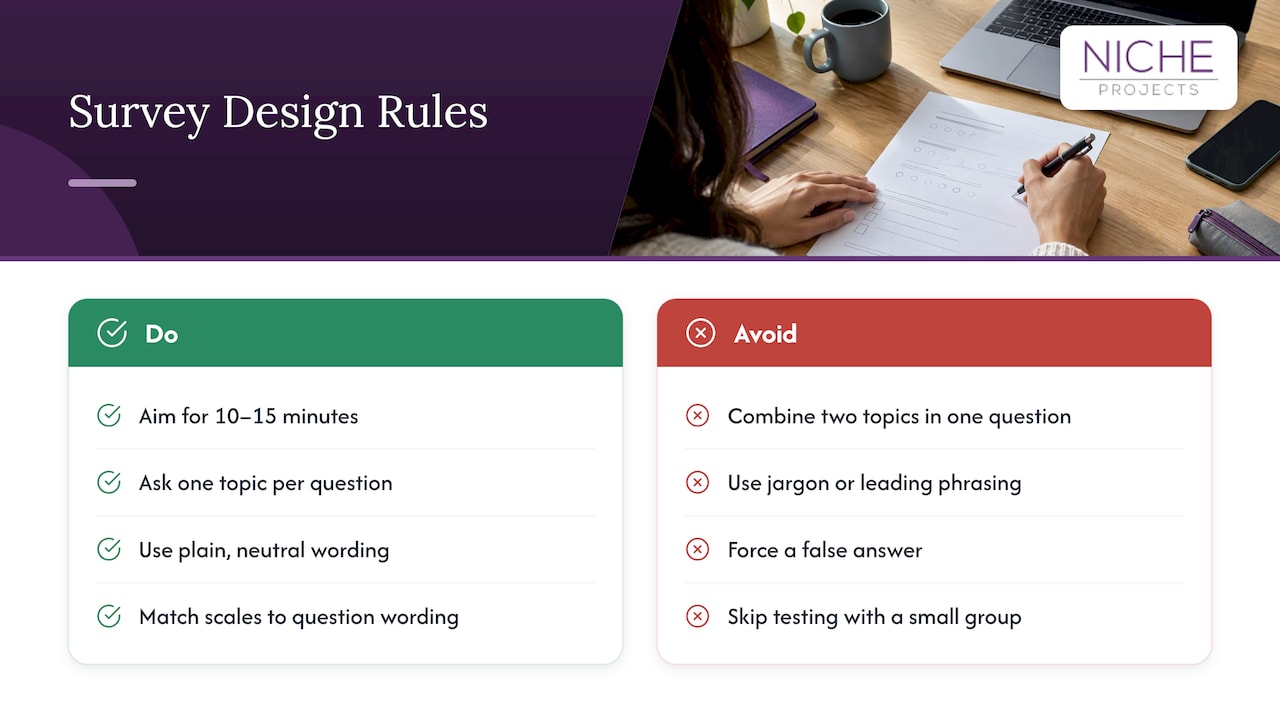
Keep it short. My Business Australia suggests limiting completion to about 15 to 20 minutes and roughly 50 to 60 questions, allowing staff to complete it during normal work time. For a single-purpose office survey, you will need far fewer. Aim for 10 to 15 minutes.
One topic per question. “How satisfied are you with the lighting and temperature?” is double-barrelled: someone happy with one and unhappy with the other cannot answer. WGEA specifically advises checking for double-barrelled and double-negative questions.
Use plain, neutral wording. Avoid unexplained acronyms and jargon. Write “How easy is it to find a quiet space when you need to concentrate?” rather than “Does the activity-based working zone meet your focus requirements?” Leading phrasing such as “How much do you enjoy our new open-plan layout?” assumes the answer.
Match the scale to the question. If the question asks “how often”, the options must be frequencies. If it asks “how satisfied”, use a satisfaction scale. WGEA notes that response options should match question wording, and that a “don’t know / not applicable” option is worth considering so people are not forced into a false answer.
Combine broad and specific questions. My Business recommends pairing a broad question, such as overall job satisfaction, with specific questions about the issues that drive it. Ask about important themes more than once, from different angles, and add open-ended questions to learn why people hold a view.
Provide context and pilot. Tell people why you are asking, then test the survey on a small group from different teams. Piloting catches confusing wording and reveals how long it really takes.
If you are also changing how teams work, our guide to piloting workplace culture design and meeting WHS duties explains why testing before committing matters.
Job and satisfaction questions
These are the questions behind most searches for workplace satisfaction surveys. They measure how people feel about the work itself, and they give context for any design findings.
Qualtrics’ employee experience guide suggests measuring engagement through pride and advocacy, intention to stay, and discretionary effort, then asking about drivers such as growth, collaboration, communication, leadership and inclusion. Australian provider elcom publishes sample satisfaction questions covering role, manager support, information access, tools, work-life balance and comfort raising concerns.
A practical set, rated on a five-point agreement or satisfaction scale:
- Overall, how satisfied are you with working here?
- How satisfied are you with your role and daily responsibilities?
- How supported do you feel by your manager?
- How easy is it to get the information you need to do your job?
- How well do your tools and systems support your work?
- How satisfied are you with your work-life balance?
- How comfortable do you feel giving feedback or raising concerns?
- How likely are you to recommend this organisation as a place to work?
- Do you see yourself working here in two years?
- How clear are you about what is expected of you?
Questions 1 and 8 are the broad ones. Questions 2 to 7 and 10 are the specific drivers. Read them together: a low overall score with a high manager score points somewhere other than leadership.
Questions about the physical environment
This is where an office design survey earns its keep. You are looking for the specific friction that stops people working well.
A 2019 Australian study of 8,827 post-occupancy surveys across 61 offices identified features linked to perceived productivity, health and comfort in the work area. They included spatial comfort, indoor air quality, building image and maintenance, noise distraction and privacy, visual comfort, personal control and connection to the outdoors. The Australian BOSSA post-occupancy questionnaire, introduced by AIRAH, covers layout, furnishings, thermal comfort, air quality, lighting, acoustics, cleanliness and maintenance, as well as activity-based fit-outs, views and control over the immediate environment.
Turn those themes into questions:
Layout and furniture
- How satisfied are you with the layout of your work area?
- How comfortable is your chair and desk setup for a full day’s work?
- Does the office have the right mix of spaces for the work you do?
Comfort and air
- How satisfied are you with the temperature in your work area?
- How satisfied are you with the air quality (freshness, stuffiness, odours)?
- How much control do you have over heating, cooling or ventilation near your desk?
Light and views
- How satisfied are you with the lighting where you work?
- Is glare from windows or screens a problem?
- How satisfied are you with your view and access to natural light?
Noise and privacy
- How often are you distracted by noise when you need to concentrate?
- How easy is it to have a private conversation when you need one?
- Where do you go when you need quiet, and how easy is it to find a space?
Upkeep
- How satisfied are you with the cleanliness of the office?
- When something breaks, how quickly is it fixed?
Noise and privacy are worth extra attention. Our piece on designing offices for privacy and confidential work explains what to do once the survey shows a problem. For temperature complaints, see office design and air-conditioning, and for desk comfort complaints, ergonomic office design.
Questions about how people use the office
The space may be fine and still be the wrong size, in the wrong shape, or empty on the wrong days. Attendance and utilisation questions tell you which. The workplace survey checklist from Smartway2 suggests covering attendance frequency and days, ideal weekly attendance, use of desks, hot desks, meeting rooms and break rooms, amenities, and what would make people more likely to come in.
Adapted for an Australian office:
- On average, how many days a week do you work from the office?
- Which days do you usually come in?
- How many days a week would you ideally come in?
- What is the main reason you come to the office? (Focused work, meetings with my team, meeting clients, social connection, access to equipment, other)
- How often do you use a) your assigned desk, b) shared desks, c) meeting rooms, d) break or kitchen areas?
- Which facilities do you use regularly? (Tick all that apply)
- How often can you not find a meeting room when you need one?
- What would make you more likely to come in?
- Are there areas of the office that are distracting or disruptive? Where, and why?
- How satisfied are you with the overall layout and design of the office?
Self-reported answers are only half the picture. Compare them with badge, booking or sensor data if you have it, because people tend to remember their busiest days. Together, the two show whether you need more collaboration space, fewer desks or better quiet zones. Our hybrid workplace strategy playbook shows how leaders use those patterns, and the best office designs to bring back employees shows what tends to change attendance.
Inclusion, safety and culture questions
Inclusion questions belong in a design survey because the environment shapes who can do their best work. Accessibility, sensory comfort, prayer or quiet rooms, parenting needs and flexible arrangements all show up here.
The NSW Public Service Commission’s People Matter survey groups questions into purpose and direction, work environment, enabling practices and leadership, a useful model for structuring your own. WGEA’s reporting topics include flexible work, carers, sexual harassment, discrimination and family and domestic violence, which gives you an idea of the issues Australian employers are expected to consider.
Sample questions:
- I feel I belong in this workplace. (Agree/disagree)
- People from all backgrounds are treated fairly here.
- The office meets my accessibility or physical needs. (Yes / Mostly / No / Not applicable)
- I can adjust my working hours or location when I need to.
- I feel safe raising a concern, even if it is critical.
- Are there spaces in the office you avoid? If so, why?
Handle the sensitive ones carefully. Ask only for what you can act on, and keep wording respectful. If your survey touches mental health and workload, our article on office design and mental health is a helpful companion.
Open-ended questions that add the “why”
Scores tell you where the problem sits. Comments tell you what it is. Keep these to two or three, and place them after the related rating questions:
- What one change to the office would most improve your working day?
- What works well in the office that we should keep?
- Describe the last time the workspace got in your way.
- Is there anything else you would like us to know?
Code the comments into themes (noise, meeting rooms, temperature, storage) and count them. A theme mentioned by a quarter of respondents deserves more weight than an eloquent single complaint.
Response formats and collecting the answers
Most questions suit a five-point scale, because it is quick and easy to compare over time. Use multiple choice for reasons and facilities, ranking for priorities (“rank these five improvements”), and free text sparingly. Label every point of the scale, not only the ends.
For quick pulse checks, such as choosing between two breakout-area concepts or voting on a name for a new meeting room, online polling and voting tools can gather responses with live results. Keep full surveys for the structured questions above, since they need consistent scales and a clear privacy approach.
Anonymity, privacy and trust
People answer honestly only if they believe it is safe. WGEA notes that anonymity can support honest views, but respondents may still have confidentiality concerns, and that organisations should say which staff can access the data. Its consultation guidance also asks whether participants feel safe giving critical feedback and whether safeguards such as anonymising information are needed.
Practical steps:
- Collect only the demographics you need. Asking for team, level, age band and location together can identify someone in a small team. Set a minimum group size for reporting, for example no results shown for fewer than five responses.
- Say who sees the raw data. If a third party administers the survey, say so.
- Explain how results will be used, and do not use them for anything else.
- Do not promise anonymity you cannot deliver. If responses are linked to logins, say “confidential”, not “anonymous”.
The Privacy Act 1988 and the Australian Privacy Principles govern how personal information is handled. The OAIC’s guidance on surveys is written for Australian Government agencies, and it says they must comply with the Act and the Principles, including on secondary use and disclosure. If you are a private business, check your own obligations with your privacy adviser or legal counsel before collecting identifiable data.
Turning survey results into changes
A survey with no visible outcome teaches staff not to bother next time. WGEA recommends documenting feedback and decisions, and telling employees what was heard and what action will follow. It also says better practice is to use more than one consultation method, such as surveys plus focus groups or interviews, and to consult early in planning and change processes.
A workable sequence:
- Share the headline results within a few weeks. Include the good news, not only the problems.
- Pick the top three issues, based on how many people raised them and how fixable they are.
- Separate quick fixes from capital projects. Lighting, furniture adjustments and booking rules are quick. Acoustic treatment, new meeting rooms and layout changes need design and construction.
- Test with the people affected through a focus group or a trial zone before committing.
- Report back again when the action is done.
If your results point to a bigger change, workplace change management and how to plan your perfect workspace set out the next steps. Five office design studies gives you the research context to weigh the findings against.
Repeat after a move
If you have refurbished or relocated, survey again. The Queensland Government’s guideline recommends a post-occupancy review typically three to six months after project completion, allowing occupants to adjust to new surroundings and ways of working. It adds that reviews can use meetings, interviews, discussion groups or structured survey forms, with results recorded, analysed and shared with occupants, executives and project consultants.
Keep the environment questions the same as your baseline survey. WGEA recommends repeating surveys at regular intervals with stable questions so you can track trends. Changing the wording each year makes comparisons meaningless.
Where we can help
A survey tells you what is wrong. Turning it into a workspace that works is the harder part. At Nicheprojects we combine workplace strategy with design and construction, so the findings from your survey carry through into the brief, the layout and the build. If the results point to a new layout, our Sydney office design team can translate them into a concept, and our Sydney office fitout and refurbishment service can deliver it. Get in touch if you would like help scoping the survey or acting on what it finds.
FAQ
How many questions should a workplace survey have?
As few as it takes to answer your decision. WGEA recommends a small number of targeted questions. As an outer limit, My Business Australia suggests around 50 to 60 questions and 15 to 20 minutes. For an office design survey, 15 to 25 well-chosen questions is usually enough.
Are workplace surveys really anonymous?
Only if the survey is built that way. WGEA notes that respondents may have confidentiality concerns, so tell staff who can access the data and avoid collecting demographic details that could identify people in small teams. If responses are linked to individuals, call the survey confidential rather than anonymous.
What is the difference between a satisfaction survey and an office design survey?
A satisfaction survey measures how people feel about their job, manager and organisation. An office design survey focuses on the physical environment: layout, comfort, light, noise, privacy and how people use the space. Running both, or combining them in separate blocks, shows whether a morale problem has a physical cause.
How often should we run a workplace survey?
Regularly, with stable questions so you can track trends, as WGEA recommends. Many organisations run a full survey once a year and short pulse checks between. After a refurbishment or move, survey again three to six months later.
What should we do with negative feedback?
Share it, group it into themes and respond to the top issues. Document the feedback and decisions, and tell employees what you heard and what will change. Silence after critical feedback is what stops people from answering honestly next time.
Sources
- How to effectively survey your staff, WGEA
- Policy and strategy guidance: employee consultation, WGEA
- Employer Questionnaire, WGEA
- PMES 2021 methodology guide, NSW Public Service Commission
- Climate Surveys, My Business
- The essential guide to employee experience surveys, Qualtrics
- Employee Satisfaction Survey: 18 Essential Questions, elcom
- Post-occupancy survey study of Australian offices, Griffith University (2019)
- Introducing BOSSA, AIRAH (2013)
- 23 Questions to Ask in Your Next Employee Workplace Survey, Smartway2
- Conducting surveys, OAIC
- Post-occupancy review, Queensland Government